
Kairos Pharma: Oncology Pipeline Progress, Capital Constraints, and the Value of Clinical Differentiation
Kairos Pharma advances a diversified cancer drug pipeline with recent Phase 2 efficacy signals and NIH support for its lead asset, ENV 105. Yet, clinical-stage risks, cash limitations, and market volatility frame both the company's promise and its near-term hurdles.
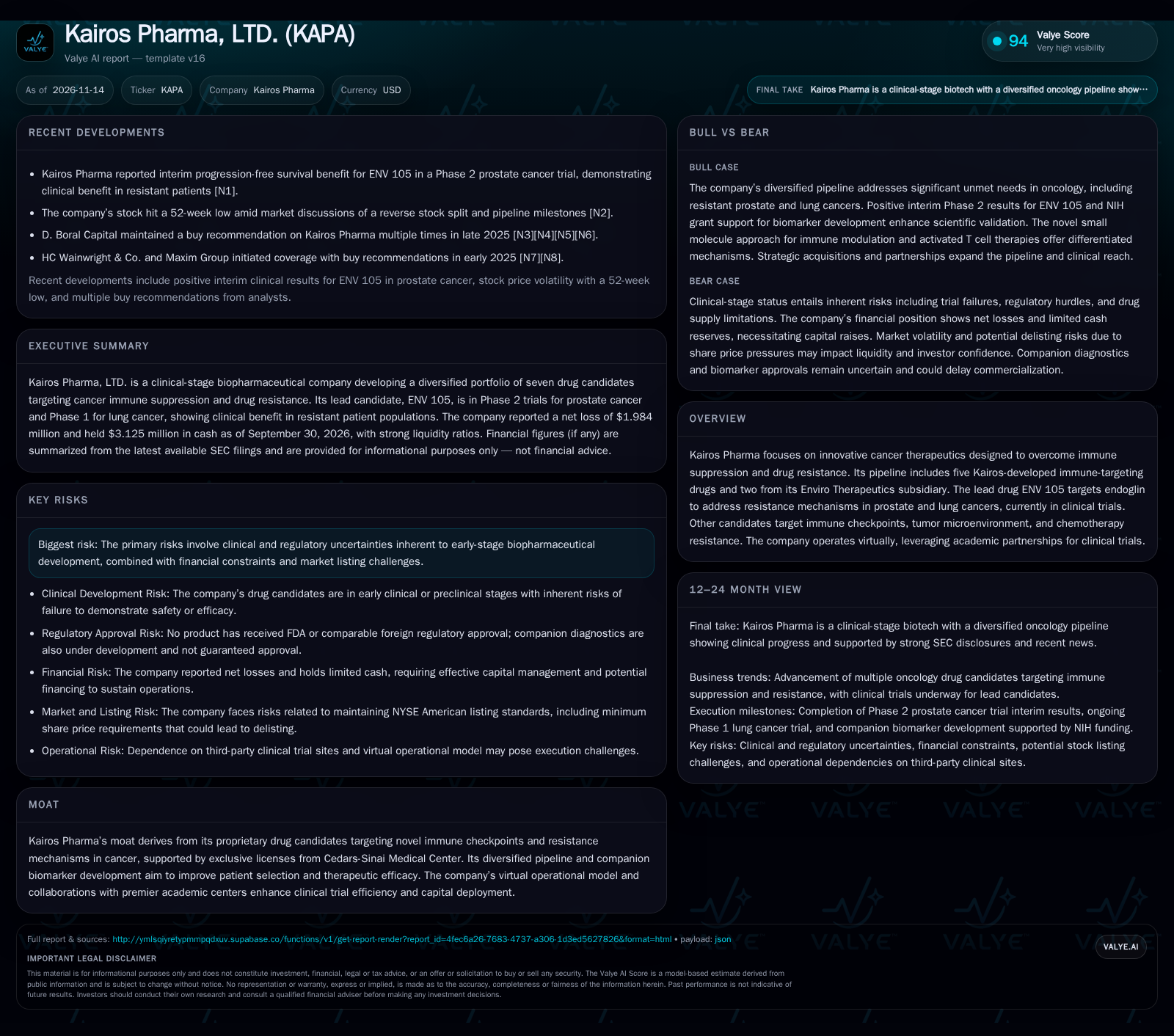
Kairos Pharma is a clinical-stage biotech with seven anti-cancer drug candidates, including ENV 105, which has shown interim Phase 2 benefit in resistant prostate cancer. While NIH backing for biomarker development and strong clinical partnerships bolster its scientific case, the company faces typical early-stage risks: ongoing losses, limited cash, and potential stock listing challenges. The next milestones hinge on clinical progress, especially for ENV 105 and companion diagnostics, and the company's ability to secure further funding as trials advance. [S1] [S2] [N1] [N2]
Kairos Pharma represents the archetype of a clinical-stage oncology innovator: a focused portfolio targeting drug-resistant cancers, early signs of efficacy in a high-need patient segment, and external validation through NIH support. Its lead asset, ENV 105, has produced interim clinical benefit in prostate cancer patients who have exhausted standard options—a group with few alternatives. The interplay between clinical milestones, scientific validation, and capital access will shape the company's near-term trajectory. [S1] [S2] [N1] [N2]
Recent Clinical Progress and Funding Milestones Define the Moment
The most material current developments for Kairos Pharma are centered on ENV 105, its lead drug candidate. Interim results from a Phase 2 trial in prostate cancer showed a clinical benefit rate of 62% in a patient group characterized by resistance to androgen-targeted therapies, suggesting potential differentiation in a setting with limited alternatives. [S1] [N1] The NIH’s $3.2 million grant to support further mechanism and biomarker work around ENV 105 strengthens the external scientific validation and could facilitate regulatory and commercial progress if the biomarker panel proves predictive. [S1] On the financial front, the company reported $3.125 million in cash and equivalents as of September 30, 2026, with a net loss of $1.984 million for the period, and a current ratio of 6.77. [S2] Stock price volatility, including a recent 52-week low and reverse split discussions, underscores the market’s sensitivity to both clinical and financial milestones. [N2]
How Kairos Could Capture Value: Pipeline Leverage and the Challenge of Capital Intensity
Kairos Pharma’s business model is typical for early-stage biotechs: value is created through the successful development of novel therapeutics and ultimately monetized via partnerships, licensing, or—if successful—commercialization. With no products approved or revenue streams disclosed, the company is pre-commercial and depends on external funding, grants, and potentially milestone payments from partnerships (if any are secured in the future). Operating virtually and leveraging academic medical centers for trials helps contain fixed costs, but the core economic engine remains capital-intensive: clinical trials, especially in oncology, require significant funding and carry high fixed costs per program.
Pricing and revenue potential, if any product reaches market, would depend on the therapeutic benefit demonstrated, the size of the treatable patient population, payer adoption, and competition from both standard-of-care and other emerging therapies. Oncology drugs addressing resistant disease can command premium pricing, but payer scrutiny and companion diagnostic requirements may affect adoption speed and reimbursement. The development of a biomarker panel as a companion diagnostic for ENV 105 could enable more precise patient targeting, potentially improving clinical and commercial outcomes, but also introduces regulatory and market-access complexities.
Operating leverage—when it emerges—would likely be realized only if one or more candidates progress to late-stage development or approval, as the company’s current model keeps variable costs tied closely to trial activity. Until then, capital needs are recurring, and dilution or partnership economics are likely to shape shareholder value.
Differentiation Hinges on Novel Mechanisms and Biomarker Strategy
Kairos Pharma’s competitive position is built around its differentiated approach to overcoming immune suppression and drug resistance in cancer—an area where many large and small biotechs are actively competing. ENV 105’s mechanism, targeting endoglin to address resistance to androgen-targeted and EGFR-inhibitor therapies, is distinctive and, if validated, could provide an entry point into patient segments underserved by existing options. The company’s pipeline diversification, spanning small molecules, biologics, and cell therapies, offers multiple shots on goal.
However, competition is intense: established oncology players and other clinical-stage biotechs are also pursuing drug resistance and immune modulation, often with deeper resources and broader clinical programs. The development of a three-gene biomarker panel as a companion diagnostic for ENV 105 could create a competitive moat by enabling better patient selection and potentially higher response rates, but success depends on robust clinical validation and regulatory acceptance. The company’s virtual model and academic partnerships may foster efficiency and access to leading investigators, but also mean dependence on third-party execution and potentially less control over trial timelines.
The question is whether Kairos can translate its mechanistic differentiation into clinically meaningful and commercially viable products before competitors with similar targets or platforms reach the market.
If Clinical Validation and Biomarker Integration Deliver, Value Could Accrue Rapidly
A favorable scenario for Kairos Pharma would see ENV 105’s Phase 2 and subsequent trials confirm robust clinical benefit in resistant prostate and lung cancers, with the companion biomarker panel reliably identifying responders. This would position the company to pursue expedited regulatory pathways, attract licensing or partnership interest from larger oncology players, and potentially command premium pricing in targeted populations. The NIH grant and academic collaborations could further accelerate mechanistic insights and trial enrollment.
Additional upside could come from advancing other pipeline candidates—such as KROS 201 for glioblastoma—into the clinic, increasing the company’s optionality and partnership appeal. External validation, either through peer-reviewed publications, conference presentations, or industry deals, would further de-risk the story.
Evidence that would confirm this scenario includes positive final Phase 2 and Phase 1/2 data, successful validation of the biomarker panel, initiation of pivotal trials, or announcements of major partnerships or licensing deals. Accelerated regulatory feedback or breakthrough designations would also be strong confirmations.
Most Likely Trajectory: Incremental Progress, Ongoing Funding Needs, and Market Volatility
The most plausible near-term path for Kairos Pharma is a measured advance of ENV 105 and the broader pipeline through ongoing Phase 2 and early Phase 1 trials, with periodic data updates and gradual biomarker development. The company is likely to continue operating at a net loss, requiring recurring capital raises or non-dilutive funding to sustain operations. Market sentiment will remain tightly coupled to clinical milestones and the company’s ability to avoid major delays or setbacks.
The base case assumes that ENV 105 continues to show some clinical benefit in resistant populations, supporting further development but not yet sufficient for regulatory submission. The companion diagnostic may show promise but require additional validation. Other pipeline candidates may progress, but not at a pace that fundamentally alters the company’s risk/reward profile in the short term.
Evidence against this scenario would be either a major clinical setback or, conversely, a breakthrough event that rapidly accelerates the company’s trajectory.
Clinical or Funding Setbacks Could Force Restructuring or Asset Sales
The adverse scenario for Kairos Pharma centers on one or more clinical failures—such as ENV 105 failing to demonstrate efficacy in final Phase 2 or subsequent studies, or the biomarker panel not validating as a reliable companion diagnostic. In this outcome, the company could struggle to attract further investment, face a rapidly shrinking cash runway, and be forced into cost-cutting, asset sales, or strategic alternatives such as licensing out programs at distressed terms.
Market volatility, including the risk of delisting if share price remains under pressure, could further constrain options and damage investor confidence.
Evidence confirming this downside would include the announcement of negative or inconclusive clinical results, failed biomarker validation, difficulty enrolling trials, unsuccessful or highly dilutive financings, or formal warnings regarding listing status.
What Will Shape Kairos Pharma’s Next Phase of Value Creation
Progression-free survival and overall response rates in ongoing and future Phase 2 and Phase 1 trials for ENV 105—especially in resistant cancer populations.
Validation, regulatory progress, and clinical utility of the three-gene biomarker panel as a companion diagnostic for ENV 105 (if disclosed).
Updates on IND filings, trial initiations, and advancement of other pipeline candidates such as KROS 201 and ENV 205.
Announcements of licensing, strategic partnerships, or collaborations with larger biopharma companies.
Formal communications regarding NYSE American listing status, potential reverse splits, or other actions to address market capitalization and share price thresholds.
Peer-reviewed publications or major conference presentations that provide external scientific validation for the company’s programs.
Operational execution and timelines for clinical trial enrollment and data readouts—delays or accelerations would be material.
Disclaimer: This is research-only, informational analysis and not investment advice. It may include AI-generated interpretation and general industry context. Always verify important details using primary sources.

Comments