
Processa Pharmaceuticals: Pipeline Expansion, Clinical Execution, and the Long Road to Commercialization
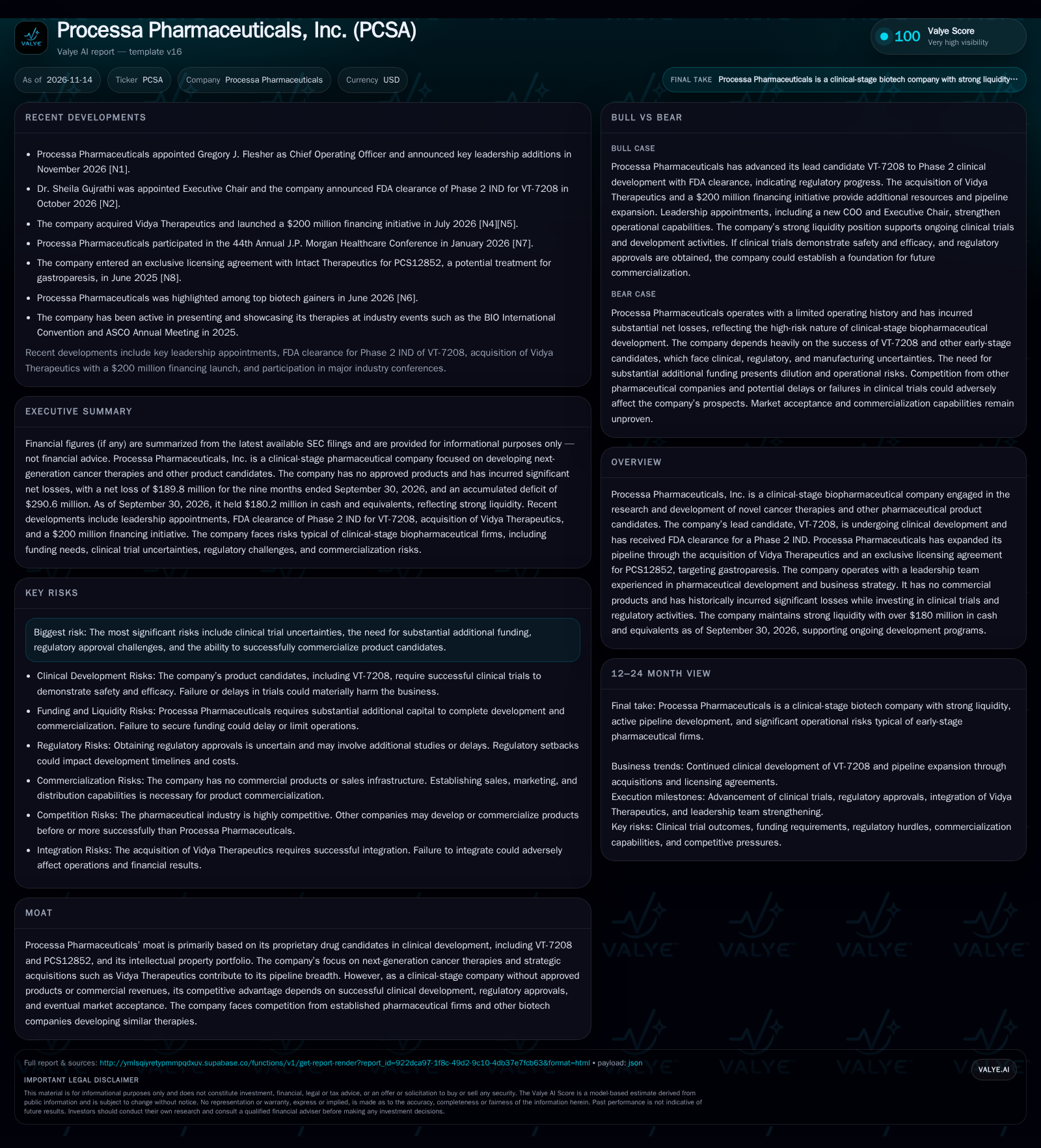
Processa Pharmaceuticals has advanced its lead candidate VT-7208 into Phase 2 with FDA clearance, acquired Vidya Therapeutics to broaden its pipeline, and secured significant cash resources.
Processa Pharmaceuticals has advanced its lead candidate VT-7208 into Phase 2 with FDA clearance, acquired Vidya Therapeutics to broaden its pipeline, and secured significant cash resources. However, its prospects hinge almost entirely on successful clinical outcomes, regulatory milestones, and the eventual ability to transition from R&D to commercial operations. The company’s operational runway is strong, but the path to revenue and sustainable value creation remains unproven and fraught with typical biotech risks.
Processa Pharmaceuticals, a clinical-stage biotech focused on next-generation cancer and immunological therapies, has made notable strategic moves in 2026: advancing its lead candidate VT-7208 into Phase 2 trials, acquiring Vidya Therapeutics to diversify its pipeline, and raising significant capital to sustain R&D. These developments provide the company with a deeper bench and extended operational runway. Yet, as with most early-stage biotechs, the core challenge remains: translating scientific promise and regulatory milestones into long-term commercial success amid intense competition, clinical risk, and the need for continued funding. The next 12–24 months will be critical in testing the company’s ability to deliver clinical proof and set the stage for future commercialization.
Recent Pipeline Advances and Financial Position Set the Stage—But Proof Remains Ahead
The most material recent developments for Processa Pharmaceuticals are the FDA clearance of a Phase 2 IND for its lead asset VT-7208, the acquisition of Vidya Therapeutics, and the launch of a $200 million financing initiative in July 2026. The company reported cash and liquidity metrics for the period; these figures do not by themselves establish operating runway, investment capacity, financial flexibility, or financing capacity. These moves reflect both regulatory and strategic progress, giving Processa a broader pipeline and the resources to pursue multi-year development programs. However, the company remains pre-revenue and recorded a net loss of $189.8 million for the first nine months of 2026, underlining its dependence on successful clinical outcomes and future capital raises for sustainability. [S2] [N2] [N4] [N5]
Clinical-Stage Economics: High Burn, Deferred Value, and the Financing Imperative
Processa’s current economics are typical of a clinical-stage biotech: no commercial revenue, ongoing high R&D expenditures, and reliance on external capital. Cost structure is dominated by variable R&D and milestone-driven expenses, with fixed overheads likely to increase following the Vidya integration and expanded leadership team. Until regulatory approval and commercialization, value is deferred and based on pipeline progress, data readouts, and the ability to attract further investment or partnership interest. If VT-7208 or other assets generate positive clinical data and advance toward approval, Processa could see stepwise increases in valuation or partnership opportunities, but any failure or delay could force cost cuts, asset sales, or dilutive financings.
The financing imperative for Processa also underscores the delicate balance between dilution and value creation inherent in clinical-stage biotechs. Each capital raise potentially dilutes existing shareholders but is necessary to sustain costly R&D activities and maintain competitive positioning. The timing, size, and terms of future financings will critically influence investor sentiment and the company’s strategic flexibility. Moreover, the ability to secure non-dilutive funding sources such as partnerships, grants, or milestone payments could mitigate dilution risks and extend the operational runway. This dynamic creates a continuous pressure to demonstrate meaningful clinical progress to justify capital influx and preserve valuation momentum.
Differentiation Hinge on Pipeline, IP, and Execution in a Crowded Field
Processa’s competitive posture is defined by its proprietary candidates—particularly VT-7208, a Bruton’s tyrosine kinase inhibitor—and its ability to advance novel therapies for cancer and immunological diseases. The exclusive licensing of PCS12852 (for gastroparesis) and the Vidya acquisition expand the addressable market and pipeline depth. However, the company faces competition from established pharmaceutical and biotechnology firms with greater resources, more advanced programs, and existing commercial infrastructure. Intellectual property around its lead assets and the ability to generate differentiated clinical data will be critical for fending off competition from both branded and generic challengers. Further, the company’s reliance on third-party manufacturers and CROs introduces execution risks that could undermine its competitive advantage if not managed carefully. In the absence of approved products, Processa’s position remains speculative and contingent on successful clinical and regulatory execution.
Clinical Success and Pipeline Synergy Could Unlock Transformational Value
A favorable scenario for Processa would see VT-7208 deliver robust safety and efficacy data in Phase 2, leading to further regulatory advancement and potential Breakthrough or Fast Track designation. Successful integration of Vidya Therapeutics could accelerate pipeline progression, leveraging operational synergies and scientific expertise. If PCS12852 also progresses in clinical development, the company could position itself as a multi-asset, late-stage biotech with optionality for partnerships or out-licensing deals. Evidence confirming this scenario would include positive interim or topline clinical data, regulatory milestone achievements (e.g., successful end-of-Phase 2 meetings with the FDA), and non-dilutive partnership announcements. A sustained ability to attract top-tier leadership and scientific talent would further support the case for transformational value creation.
Most Likely Path: Incremental Progress, Costly Development, and Event-Driven Volatility
The most plausible outcome is continued advancement of VT-7208 through Phase 2 trials, with other pipeline assets progressing at a typical clinical-stage cadence. Cash burn remains high, and the company is likely to require additional capital before any product reaches the market. Clinical and regulatory updates will drive stock volatility, with data readouts, FDA feedback, and partnership discussions serving as key catalysts. Evidence confirming this path would include ongoing trial enrollment, milestone payments (if applicable), and further fundraising efforts. Delays or setbacks in clinical development—common in this sector—would temper enthusiasm but may not derail the overall strategy unless accompanied by negative data or a tightening funding environment.
Adverse Outcomes: Clinical Setbacks, Capital Pressures, and Strategic Retrenchment
In a negative scenario, VT-7208 or other lead assets could deliver disappointing efficacy or safety results, resulting in program discontinuation or costly delays. The cash balance, while substantial, could be rapidly depleted if multiple assets encounter setbacks or if integration costs from the Vidya acquisition escalate. Failure to secure additional funding on favorable terms could force Processa to cut programs, reduce headcount, or pursue asset sales under pressure. Evidence confirming this outcome would be clinical hold letters, negative trial data, restructuring announcements, or highly dilutive emergency financings. Increased competitive pressure from faster-moving rivals or regulatory surprises could further exacerbate downside risks.
Milestones and Metrics That Will Test Processa’s Pipeline-Driven Thesis
Progress and data readouts from Phase 2 trials of VT-7208, including safety, efficacy, and regulatory feedback.
Updates on the integration of Vidya Therapeutics, including cost synergies, pipeline harmonization, and retention of key scientific personnel.
Clinical advancement and partnership activity related to PCS12852 and other non-core pipeline assets.
Disclosure of cash burn trajectory and projected runway, especially in relation to clinical trial timelines and expansion.
Announcements of non-dilutive funding, strategic partnerships, or licensing deals that could supplement or replace equity financing.
FDA communications, including protocol amendments, special designations (e.g., Fast Track), or unexpected regulatory hurdles.
Leadership stability and ability to attract or retain talent with deep clinical development experience.
If disclosed, actual enrollment rates, patient retention, and trial site activation for ongoing studies—key indicators of operational execution.
Disclaimer: This is research-only, informational analysis and not investment advice. It may include AI-generated interpretation and general industry context. Always verify important details using primary sources.

Comments