
Haymaker Acquisition Corp. 4: SPAC Lifecycle, Suncrete Deal Mechanics, and the Countdown to 2026
Haymaker Acquisition Corp. 4 has entered the critical phase of its SPAC lifecycle, with a pending multi-step business combination with Suncrete and a hard July 2026 deadline. The outcome now hinges on regulatory approvals, deal execution, and shareholder redemption dynamics, as operating cash remains minimal and no revenues will materialize until after a successful merger.
Haymaker Acquisition Corp. 4 is a SPAC nearing its mandatory 2026 deadline, now focused on closing a complex merger with Suncrete. Its $232 million trust remains its central asset, but with no operating revenue and minimal cash on hand, the path forward depends entirely on deal execution, regulatory clearance, and the behavior of shareholders at closing. If the deal fails, liquidation and return of funds is the default.
Haymaker Acquisition Corp. 4 is approaching the defining moment of its SPAC lifecycle: the execution of its initial business combination, this time with the private company Suncrete. With $232 million in trust, minimal operating liquidity, and a looming July 2026 deadline, the SPAC's future now rests on a series of regulatory, shareholder, and executional hurdles. The outcome is binary—either Haymaker successfully closes the Suncrete transaction, converting into a new operating public company, or it dissolves and returns funds to shareholders. The next several quarters are critical for deal closure, redemption dynamics, and the shape of the resulting entity.
Deal Status, Trust Assets, and the 2026 Deadline Define the Present Moment
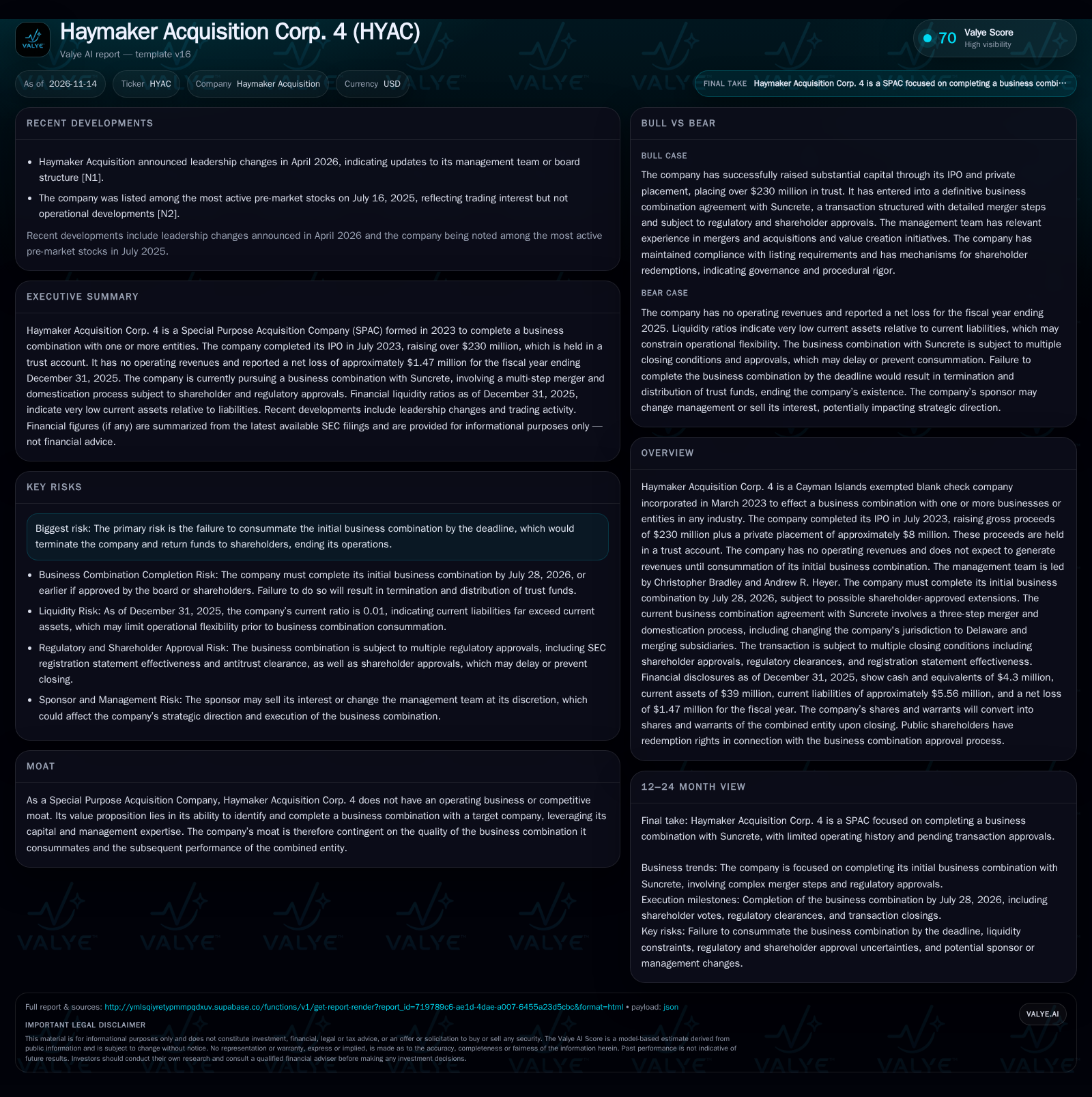
Haymaker Acquisition Corp. 4’s most material current facts are: (1) it has entered a definitive business combination agreement with Suncrete, structured as a three-step merger and domestication from the Cayman Islands to Delaware; (2) the transaction is subject to several closing conditions, including shareholder and regulatory approvals, with a hard deadline of July 28, 2026; (3) as of December 31, 2025, Haymaker’s cash and equivalents outside the trust account were just $4.3 million, with a current ratio of 0.01 and a reported net loss of $1.47 million for the year; and (4) the $232.3 million trust account established from the IPO and private placement remains the company’s sole substantive asset [S1]. These facts matter because they place Haymaker firmly in the pre-merger holding pattern typical of SPACs: all value is contingent on executing the Suncrete deal before the liquidation deadline, with no ongoing business or revenue generation until that point.
SPAC Economics: Trust Capital, Redemption Exposure, and the Post-Merger Revenue Question
Haymaker’s pre-combination economics are straightforward: its only asset of consequence is the $232.3 million in trust, which cannot be accessed for general operations and is reserved for use in the business combination or, if the deal fails, for liquidation and return to shareholders [S1]. Operating expenses (legal, advisory, administrative) are funded from minimal cash outside the trust, explaining the low current and cash ratios. The company’s net losses reflect typical SPAC costs, not ongoing business activity.
The pivotal economic mechanism is the business combination itself. If the Suncrete merger closes, Haymaker’s trust is used to capitalize the new public entity, likely after deducting redemptions and transaction costs. The actual cash delivered to Suncrete (and thus the public company’s starting balance sheet) will depend on the rate at which public shareholders elect to redeem their shares at closing—a dynamic that can dramatically shrink available capital and shift deal terms.
Post-merger, Haymaker’s economics will be entirely those of Suncrete; until then, there is no revenue, margin, or operating leverage to analyze. The SPAC structure provides flexibility in deal terms (including potential PIPE financings, earn-outs, or sponsor concessions) but exposes the transaction to execution and capital-raising risks, especially if redemptions are high.
SPACs in a Crowded Field: Execution Risk, Target Quality, and Redemption Dynamics
Haymaker’s competitive position is shaped by the broader SPAC market, where numerous blank-check companies are chasing a shrinking pool of attractive targets and investor appetite for de-SPAC transactions has become more selective. The main differentiators are the quality and readiness of the chosen target (Suncrete), the experience and credibility of the sponsor/management team, and the ability to structure a deal that survives high redemption rates.
Unlike operating companies, Haymaker’s pre-merger 'moat' is limited to its capital pool, public listing, and the perceived value it can add through the business combination. The risk of high redemptions—where public shareholders opt for cash rather than rolling into the new entity—can erode the trust capital and jeopardize deal economics. Competing SPACs, PIPE investors, and direct listings are all alternative routes for private companies like Suncrete, meaning Haymaker must offer a compelling value proposition to both its own shareholders and its target.
If Suncrete is seen as a high-quality, scalable business with public-market appeal, Haymaker could stand out in the crowded SPAC landscape. Otherwise, it risks falling into the common trap of post-announcement deal renegotiation, capital shortfalls, or outright liquidation.
Successful Suncrete Merger Unlocks Trust Value and Public Market Access
In the favorable scenario, Haymaker secures all necessary approvals and closes the Suncrete transaction before the July 2026 deadline, with a manageable level of redemptions. The trust proceeds, minus redemptions and costs, are deployed to fund Suncrete’s growth as a new public company. If Suncrete’s fundamentals are strong—demonstrating revenue growth, profitability, or a compelling story—public market investors may reward the combined entity with a premium valuation, facilitating further capital raises via follow-on offerings or secondary financings.
Evidence that would confirm this upside includes: (1) SEC effectiveness of the registration statement and regulatory clearances; (2) positive shareholder vote with a redemption rate low enough to preserve meaningful cash for Suncrete; (3) Suncrete disclosing attractive financials, growth plans, or customer traction; and (4) post-closing trading that supports the public valuation and liquidity of the combined company.
Redemptions Reshape the Deal, but a Transaction Still Closes
The most plausible outcome—given current SPAC market dynamics—is that Haymaker and Suncrete succeed in closing the merger, but only after negotiating deal amendments to address a high rate of public shareholder redemptions. In this scenario, the actual cash delivered to Suncrete is significantly less than the headline trust amount, but the deal nevertheless proceeds, possibly with the help of PIPE investors or sponsor concessions.
This path is confirmed if: (1) the company amends deal terms (valuation, earn-out, minimum cash condition) in response to redemption levels; (2) supplemental PIPE capital is raised to backstop the trust; and (3) the transaction closes with Suncrete gaining a public listing, albeit with less cash than initially anticipated. Falsification would occur if redemptions or regulatory hurdles are so high that the deal cannot be restructured and is terminated.
Deal Failure Triggers Liquidation and SPAC Dissolution
The adverse scenario is that the Suncrete business combination fails to close—due to regulatory obstacles, inability to secure shareholder approval, or insurmountable redemptions—before the July 28, 2026, deadline. In this event, Haymaker is forced to liquidate, distributing the trust assets back to public shareholders and ceasing operations as required by its charter [S1]. The sponsor loses its at-risk capital, and public investors receive their pro rata share of the trust, but no business combination is completed.
This scenario would be confirmed by: (1) public announcements of deal termination or failure to secure key approvals; (2) lack of a viable alternative transaction; and (3) initiation of the trust liquidation and dissolution process. The main falsification would be a successful renegotiation or extension that preserves a path to combination before the deadline.
Milestones That Will Define Haymaker’s Outcome and Suncrete’s Public Debut
Shareholder redemption rate at the business combination vote—if disclosed, a high redemption rate would signal capital flight and could force deal restructuring.
Effectiveness of the SEC registration statement and receipt of all required regulatory clearances, as these are mandatory for closing the transaction.
Shareholder approval of the Suncrete merger, as failure here would directly trigger liquidation.
Amendments to deal terms (including valuation, minimum cash conditions, or additional PIPE financings) in response to market or redemption pressures.
Sponsor or management team changes, as these could affect deal execution, credibility, and investor confidence.
Any Suncrete financial disclosures or projections, which would clarify the quality and scalability of the target business.
Public trading volume and price behavior of HYAC shares and warrants leading up to the vote, which may indicate market expectations for deal closure and post-merger value.
Announcements regarding extensions or alternative deals if the Suncrete transaction stalls, as these would affect the probability of timely combination and avoid liquidation.
Disclaimer: This is research-only, informational analysis and not investment advice. It may include AI-generated interpretation and general industry context. Always verify important details using primary sources.

Comments