
Wellgistics Health: Profitability Amid Acute Liquidity Constraints and the Search for Sustainable Execution
Wellgistics Health, Inc. has delivered a profitable quarter backed by executive expertise in pharmacy and digital health, but a severe liquidity shortfall and limited disclosure on business operations raise questions about the durability of its current trajectory and ability to invest for growth.
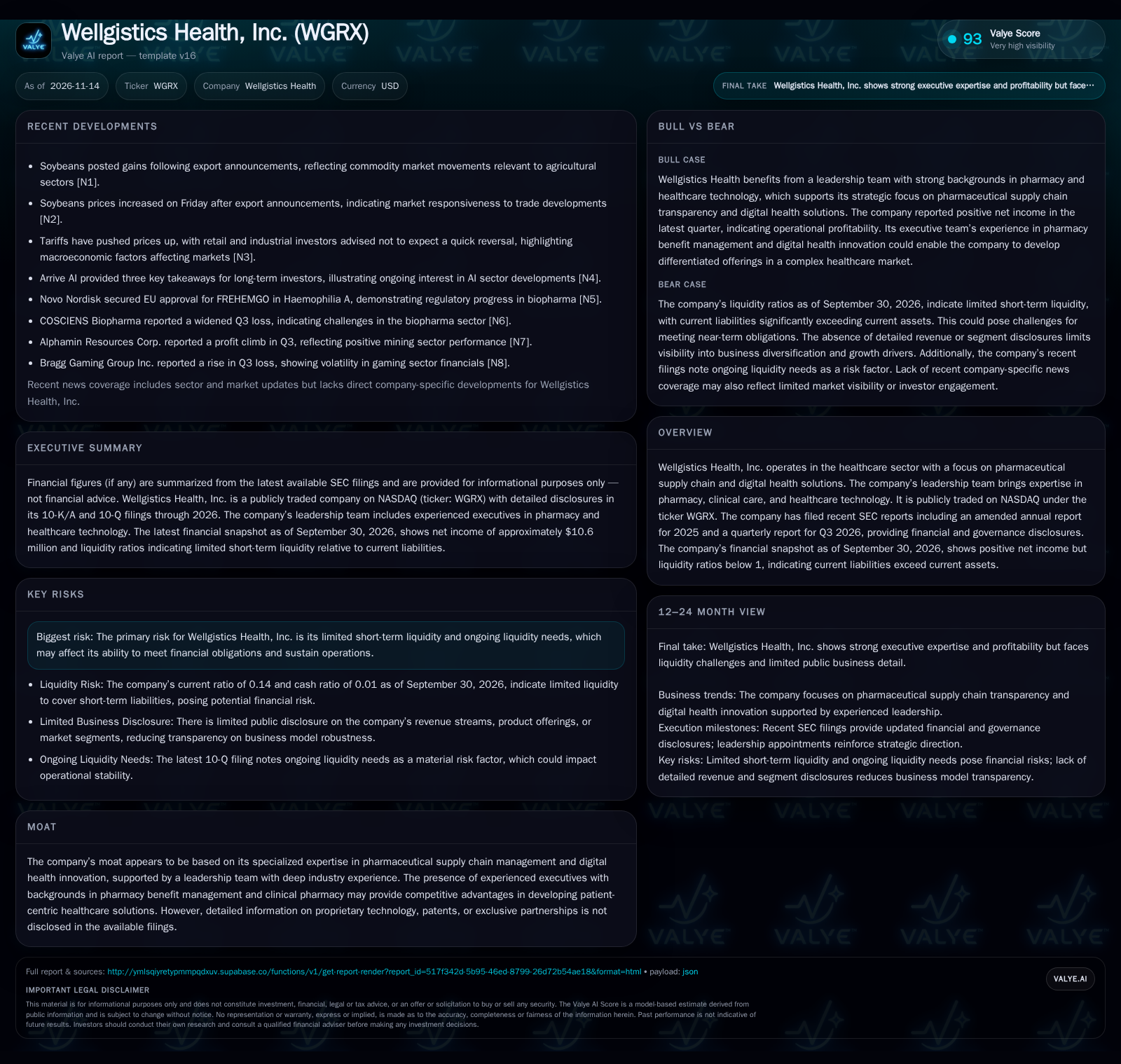
Wellgistics Health posted positive net income in Q3 2026 but faces a critical short-term liquidity gap and ongoing financing needs. Leadership’s deep sector experience could support differentiated solutions in pharmaceutical supply chain and digital health, but with current liabilities far outstripping assets and minimal public detail on revenue streams or contracts, the company’s ability to sustain operations and fund innovation remains uncertain. Scenario outcomes hinge on whether Wellgistics can secure additional liquidity and translate executive vision into recurring, defensible business lines. [S2]
The company’s leadership brings deep healthcare and technology experience, which could enable differentiated solutions in the pharmacy supply chain and digital health arenas. However, the absence of detailed disclosures on revenue streams, customer composition, or contract mechanics clouds visibility into the sources and sustainability of profitability. The central question for investors is whether Wellgistics can bridge its liquidity gap, sustain operational momentum, and convert executive vision into recurring, defensible business lines.
Profitability Contrasts with Severe Liquidity Shortfall
As of September 30, 2026, Wellgistics Health, Inc. reported net income of $10,589,764 for the quarter, with basic earnings per share of $3.29 and diluted EPS of $2.72. At the same time, the company’s cash and equivalents stood at $476,598, and total current assets were $5.22 million, dwarfed by current liabilities of $36.55 million. The company reported cash and liquidity metrics for the period; these figures do not by themselves establish operating runway, investment capacity, financial flexibility, or financing capacity. The company’s latest 10-Q filing explicitly highlights ongoing liquidity needs as a material risk factor, and there are no recent company-specific news items indicating new financing or strategic partnerships. [S2]
Understanding Wellgistics’ Potential Economic Engines
Wellgistics Health’s stated focus on pharmaceutical supply chain and digital health suggests it could generate revenue through distribution services, technology-enabled logistics, and potentially value-added digital health platforms. In mature healthcare distribution, margins tend to be thin, with scale and operational efficiency as key profit drivers. Digital health solutions can offer higher gross margins if delivered via SaaS or platform models, but these typically require significant up-front investment in technology, integration, and regulatory compliance.
Given the lack of detailed segment or revenue disclosures, it is unclear whether Wellgistics’ recent profitability stems from high-margin digital offerings, traditional distribution, or nonrecurring sources. If the company is primarily a supply chain intermediary, working capital intensity and low pricing power could constrain cash generation and amplify liquidity stress. Conversely, if digital health or pharmacy benefit management services are gaining traction, higher recurring revenue and operating leverage may be achievable—but only if the company can invest in customer acquisition and technology upgrades. The reported liquidity shortfall likely limits Wellgistics’ ability to scale technology or fund working capital for growth. Absent additional financing, the company may face trade-offs between servicing existing obligations and pursuing long-term strategic initiatives. [S2]
Can Executive Experience Offset Market and Capital Constraints?
Wellgistics’ leadership team brings direct experience in pharmacy, clinical care, and healthcare technology—positions that could enable the company to identify gaps in supply chain transparency, medication tracking, or digital patient engagement. In theory, this expertise may allow for the design of differentiated solutions in an industry dominated by large-scale distributors, pharmacy benefit managers, and emerging digital health platforms.
However, the company faces formidable counterforces: entrenched incumbents with extensive logistics networks, technology platforms with deep integration and switching costs, and a regulatory environment that demands both compliance and capital. Without evidence of proprietary technology, exclusive partnerships, or unique data assets, it is uncertain whether Wellgistics can defend a durable moat or avoid commoditization pressures. Liquidity constraints may also limit its ability to invest in customer relationships, technology, or compliance—areas where competitors can outspend or outlast new entrants. Unless Wellgistics can leverage its leadership’s network to secure strategic partnerships or accelerate innovation, it risks being outcompeted by both legacy players and well-funded digital disruptors.
Unlocking Value Through Financing and Strategic Execution
With enhanced potential financial flexibility, the company could accelerate the development of digital health offerings or expand its supply chain capabilities, leveraging its leadership’s sector expertise to differentiate in a crowded market.
If Wellgistics is able to demonstrate recurring revenue streams, improve working capital management, and disclose segment-level performance, investor confidence could improve. Evidence of new product launches, regulatory milestones, or exclusive partnerships would further support the case for sustainable growth. In this scenario, Wellgistics could transition from a position of financial vulnerability to one where it can pursue long-term strategic initiatives and potentially capture a defensible niche in healthcare logistics or digital health.
Sustained Profitability Constrained by Structural Liquidity Deficit
The most plausible near-term outcome is that Wellgistics continues to operate profitably on an accounting basis but remains hampered by its acute liquidity shortfall. The company may be forced to prioritize immediate obligations, limiting its ability to invest in technology or customer acquisition, and potentially missing out on longer-term opportunities in digital health or advanced supply chain management.
This scenario would be confirmed by continued positive net income but persistent low cash and current ratios, lack of new financing disclosures, and minimal news on product launches or customer wins. Any improvement in liquidity metrics, or evidence of cost discipline and working capital optimization, would suggest the company is managing its constraints. However, if obligations outpace operating cash flow, pressure could mount for asset sales, restructuring, or dilutive capital raises.
Liquidity Crisis Forces Retrenchment or Restructuring
In the adverse scenario, Wellgistics’ inability to address its liquidity gap leads to missed payments, supplier or customer attrition, or regulatory intervention. The company could be forced into emergency financings on punitive terms, asset divestitures, or even bankruptcy protection if it cannot renegotiate obligations or secure new funding.
Warning signs would include rapidly deteriorating working capital, negative operating cash flow, loss of key personnel, or abrupt changes in auditor or governance structure. If these emerge in SEC filings or news coverage, the risk of operational disruption or going concern qualification would increase, undermining any remaining shareholder value and halting strategic initiatives.
Benchmarking the Path to Sustainable Growth and Liquidity
Evidence of new debt or equity financing, or announced strategic partnerships that materially improve liquidity.
Quarterly disclosure of operating cash flow and working capital trends—if disclosed—as a test of whether net income is translating into cash.
Any segment or revenue breakdowns that clarify the mix between distribution, digital health, and pharmacy benefit management.
Updates on customer concentration, contract structure (recurring vs. transactional), and retention rates—if disclosed—to gauge revenue durability.
Announcements of technology launches, regulatory certifications, or exclusive partnerships as evidence of competitive differentiation.
Changes in board or executive composition, especially departures, which could signal stress or a shift in strategic direction.
Filing of going concern warnings, covenant breaches, or auditor notes in SEC filings.
Material changes in risk disclosures or contingent liabilities that might affect operational stability.
Disclaimer: This is research-only, informational analysis and not investment advice. It may include AI-generated interpretation and general industry context. Always verify important details using primary sources.

Comments