
Senmiao Technology: Retrenchment in Auto Services and the High-Stakes Pivot Toward AI Infrastructure
Senmiao Technology’s exit from key business lines and its tentative moves into AI infrastructure signal a company in transition, grappling with persistent losses and searching for a new growth narrative. The viability of its pivot—and its ability to overcome entrenched industry risks—will depend on execution, capital discipline, and the reality behind early-stage strategic partnerships.
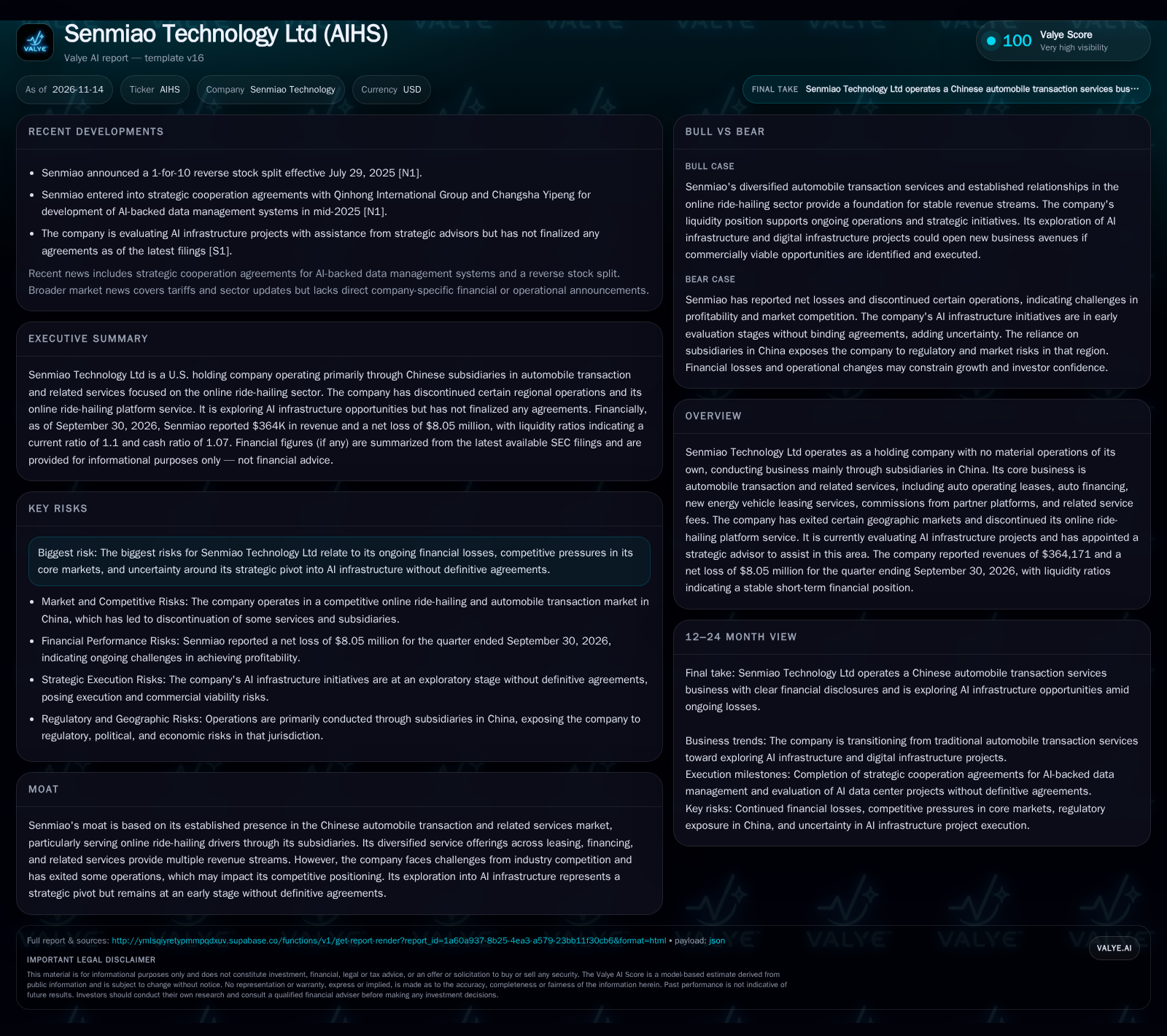
Senmiao Technology has discontinued major segments of its legacy auto services business and is now evaluating AI infrastructure opportunities, but faces persistent losses and has yet to secure meaningful AI-related contracts. The company’s reported liquidity position for now, but future profitability and strategic execution remain highly uncertain. The next year will test whether Senmiao can translate its exploratory moves into a viable new business model or whether competitive and financial pressures will dominate.
Senmiao Technology Ltd stands at a strategic crossroads after exiting core segments of its automobile transaction and ride-hailing services business in China. The company’s focus has shifted toward AI infrastructure and digital initiatives, but without definitive commercial agreements, this pivot remains speculative. With persistent net losses and a shrinking operational footprint, Senmiao’s future hinges on its ability to either restore profitability in its legacy business or successfully establish a new growth engine in the competitive AI infrastructure sector.
Recent Exits, Persistent Losses, and an Uncertain Pivot Shape the Present
Senmiao Technology has made decisive moves to exit major parts of its legacy business: it sold its Sichuan automobile transaction and related service subsidiaries for nil consideration in December 2025, and discontinued its online ride-hailing platform in August 2024 [S1]. These exits have left the company with a reduced operational base, as evidenced by leasing just 340 automobiles at an average monthly rental income of $381 each as of March 31, 2026 [S1]. Financially, the company reported $364,171 in revenue and a net loss of $8.05 million for the quarter ended September 30, 2026 [S2]. While liquidity ratios remain above 1 (current ratio 1.1, cash ratio 1.07), the company’s ongoing losses highlight the urgency of finding a sustainable business model [S2]. Senmiao’s recent efforts include evaluating AI infrastructure opportunities and entering into strategic cooperation agreements on AI-backed data management, but as of the latest filings, there are no definitive agreements or revenue streams from these initiatives [S1].
Legacy Leasing and Financing: Low Margins, High Overhead, and the Search for Scale
Senmiao’s traditional business model in automobile transactions and related services combines auto leases, financing facilitation, and service fees. The economics of this segment typically depend on high fixed costs (vehicle acquisition and depreciation, employee overhead) and low-to-moderate variable margins, with profitability hinging on fleet utilization and minimizing defaults. With only 340 cars leased at $381/month, total annualized rental revenue now runs below $1.6 million—a scale that is unlikely to cover the company’s operating and public-company costs, as reflected in recent net losses [S1] [S2].
The company’s reported revenue sources also include service fees from new energy vehicle leasing, commissions from partner platforms, default fees, and auto purchase service fees, but the discontinuation of platform operations and the sale of regional subsidiaries have likely diminished these ancillary streams [S1]. Absent significant volume growth or a shift to higher-margin services, the legacy business appears structurally challenged to generate positive cash flow.
On the AI infrastructure front, no commercial mechanics have been established. If Senmiao were to secure contracts for AI data center build-outs or digital infrastructure services, the economics would likely involve high upfront capital investment, long payback periods, and dependence on client stickiness or recurring service fees. Until concrete agreements are reached, these remain theoretical.
Competitive Realities: Fragmented Auto Services, Platform Giants, and a Crowded AI Frontier
Senmiao’s legacy competitive position relied on serving online ride-hailing drivers with flexible leasing and financing solutions—an area characterized by thin margins, high competition, and exposure to regulatory shifts. The exit from key provinces and platform operations suggests that scale and differentiation were difficult to sustain against larger, better-capitalized auto leasing firms and digital ride-hailing platforms.
In the AI infrastructure arena, Senmiao faces a fundamentally different set of competitors and challenges. The Chinese AI and data center market is dominated by large technology conglomerates, specialized cloud service providers, and state-backed infrastructure companies. Barriers to entry are high: capital requirements, technical expertise, and regulatory relationships are all critical. Without clear proprietary technology, established customer relationships, or a proven track record in this field, Senmiao’s ability to carve out a sustainable competitive niche remains questionable. The strategic cooperation agreements may offer entry points, but their commercial and operational impact is unproven.
How a Strategic Pivot to AI Infrastructure Could Unlock Value—If Execution Follows
A favorable scenario for Senmiao would see its strategic exploration in AI infrastructure translate into definitive project wins, leveraging the expertise of its new advisor and strategic partners to secure contracts for AI data management systems, digital infrastructure, or specialized leasing of new energy vehicles for AI/data center logistics. In this pathway, Senmiao could reposition itself as a niche provider of infrastructure solutions for emerging digital economies in China.
Confirmation of this scenario would require the announcement of binding agreements for AI data center build-outs, recurring service contracts, or high-margin digital infrastructure projects. Additional evidence could include new revenue streams in quarterly filings, improved gross margins, and a reversal of sequential net losses. Falsification would be the continued absence of contract wins or meaningful revenue from AI initiatives over the next several quarters.
Incremental Progress, Persistent Losses: The Most Likely Trajectory for Now
Given the absence of definitive AI infrastructure agreements and the shrinking scale of the core auto services business, the most plausible scenario is one of continued modest operations, slow progress on strategic initiatives, and ongoing net losses. Senmiao may maintain its current liquidity for several quarters but will face mounting pressure to either secure new business or further cut costs.
Evidence supporting this scenario would be a lack of material change in revenue mix, continued reliance on legacy auto leasing income, and sustained negative operating cash flow. Quarterly reports showing stable but low revenues and persistent losses—without breakthrough announcements in AI or digital infrastructure—would confirm this middle path. A pivot toward profitability would require either dramatic cost reductions or new revenue engines, neither of which is currently evident.
Failure to Pivot: Erosion of Liquidity and Strategic Options
The major risk is that Senmiao’s legacy business continues to contract while its AI infrastructure ambitions fail to materialize commercially. In this scenario, fixed costs and public company overhead consume available liquidity, and the absence of new revenue sources accelerates the erosion of potential financial flexibility.
Downside confirmation would come from sequential declines in cash and current assets, worsening net losses, and potential regulatory or compliance issues related to its Chinese subsidiaries. A lack of progress updates on AI partnerships, or the unwinding of existing cooperation agreements, would further signal execution risk. If the company is unable to raise capital or monetize new initiatives, options could narrow to further asset sales, business wind-down, or recapitalization under distressed terms.
Milestones That Will Determine Whether Senmiao’s Transformation Is Real or Illusory
Execution of binding contracts or revenue-generating agreements in AI infrastructure or digital infrastructure—if disclosed—would be a critical sign of business model viability.
Quarterly revenue growth outside of legacy automobile leasing, especially attributable to new verticals or digital infrastructure, would help test the thesis.
Gross margin improvements or a narrowing of net losses, indicating successful cost control or higher-margin business mix, are essential to monitor.
Updates on the status, scope, and commercial terms of the strategic cooperation agreements with Qinhong International Group and Changsha Yipeng would clarify the real commercial impact.
Disclosure of capital expenditure plans or financing arrangements related to AI/data center projects would indicate commitment and execution risk.
Retention or growth of the automobile leasing fleet, if maintained, could signal stabilization in the legacy business.
Changes in regulatory or market conditions in China that could affect either the auto services or AI infrastructure opportunities must be tracked.
Disclaimer: This is research-only, informational analysis and not investment advice. It may include AI-generated interpretation and general industry context. Always verify important details using primary sources.

Comments