
GRI Bio’s Clinical Progress in IPF: Can Immune Modulation Redefine the Fibrosis Treatment Landscape?
With positive Phase 2a safety and biomarker data for its lead oral iNKT inhibitor in idiopathic pulmonary fibrosis, GRI Bio is at a critical inflection point. The company’s reported liquidity position, expanding IP portfolio, and differentiated pipeline offer strategic options—but the leap from biomarker promise to clinical and commercial impact will require robust late-stage outcomes and sustained capital access.
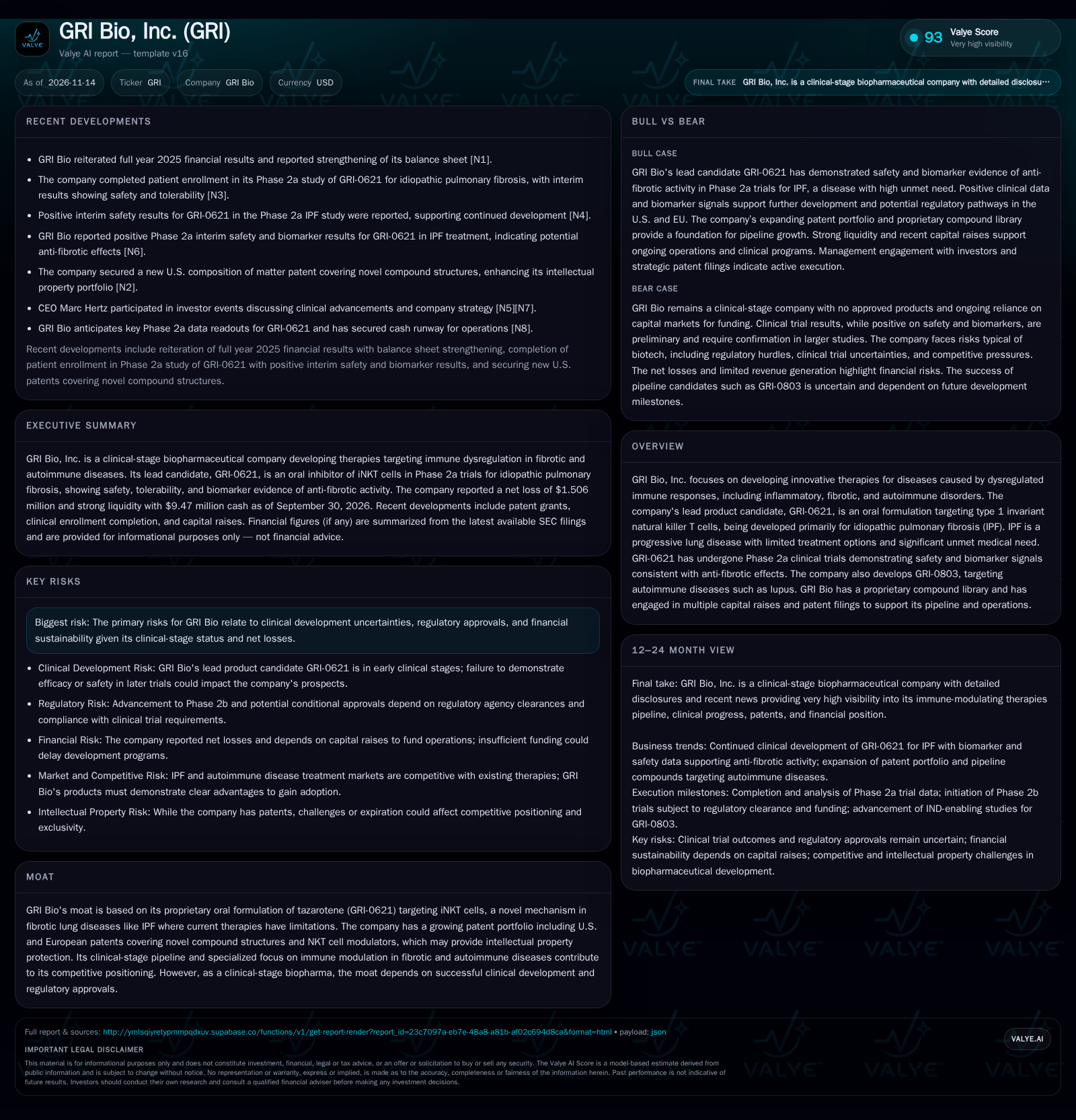
GRI Bio is advancing GRI-0621, an oral iNKT inhibitor, in Phase 2a trials for idiopathic pulmonary fibrosis, showing safety and anti-fibrotic biomarker trends. The next clinical milestones and regulatory clarity will be pivotal for value creation and risk management. [S1] [S2] [N2] [N6]
GRI Bio, Inc. stands at a decisive juncture as it advances its lead oral iNKT cell inhibitor, GRI-0621, for idiopathic pulmonary fibrosis (IPF)—a condition with limited therapies and high mortality. Recent Phase 2a data show safety and biomarker signals of anti-fibrotic activity, positioning the asset as a potential new entrant in a space dominated by incremental improvements. With a reported cash position and an expanding intellectual property portfolio, GRI Bio has the resources to drive near-term development. However, as a pre-commercial biotech, its path to value hinges on confirming clinical efficacy, navigating regulatory hurdles, and securing ongoing capital to bridge the gap to potential approval.
Phase 2a Results and Financial Strength Define GRI Bio’s 2026 Position
GRI Bio’s most material recent development is the completion and reporting of its Phase 2a clinical trial for GRI-0621 in idiopathic pulmonary fibrosis. The 35-patient, randomized, double-blind study met its primary endpoint of safety and tolerability, with no treatment-related serious adverse events. Notably, biomarker data suggested anti-fibrotic effects, and 39% of patients in the treatment arm saw improvements in lung function (FVC), compared to an 80% FVC decline in placebo subjects. These signals, while preliminary, are critical for informing the design and regulatory dialogue for a Phase 2b study. [S1] [N6]
Financially, GRI Bio reported $9.47 million in cash and cash equivalents as of September 30, 2026, with a current ratio of 10.21 and a net loss of $1.506 million for the quarter. The company reported cash and liquidity metrics for the period; these figures do not by themselves establish operating runway, investment capacity, financial flexibility, or financing capacity. [S2]
Additionally, the company strengthened its IP position with a new U.S. composition of matter patent covering novel structures, supporting both its lead and pipeline programs. [N2]
Pipeline-Driven Value Creation: Funding the Leap from Clinic to Market
GRI Bio’s economics are typical of a clinical-stage biotech: high upfront R&D and clinical trial costs, no product revenue, and a business model that relies on infrequent, milestone-driven value inflections. The company’s lead asset, GRI-0621, targets a high-value indication—IPF—which is characterized by significant unmet need and limited competition from oral, disease-modifying therapies. If ultimately approved, pricing power could be substantial given the life-threatening nature of IPF and the precedent for premium pricing in rare, severe diseases.
Operating leverage is latent: R&D and G&A are largely fixed until late-stage success, at which point commercial infrastructure and COGS become relevant. [S2]
Capital needs are a central issue: GRI Bio has repeatedly accessed the public markets and used warrant structures to fund development. Future economics will depend on its ability to either license assets to larger partners (potentially monetizing clinical progress through upfronts and milestones) or to secure additional equity/debt funding without excessive dilution.
Can GRI Bio’s iNKT Modulation Strategy Carve Out Defensible Space in Fibrosis?
GRI Bio’s competitive positioning is anchored in its novel approach—oral inhibition of type 1 invariant natural killer T (iNKT) cells—to address fibrotic disease. This mechanism is differentiated from current standard-of-care IPF treatments, which include antifibrotic agents like pirfenidone and nintedanib that offer only modest slowing of disease progression and come with significant side effects.
The company’s IP portfolio, recently strengthened by new composition of matter patents, may provide a period of exclusivity if its assets reach approval. However, as a clinical-stage company, GRI Bio faces classic counterforces: larger biopharmas with established commercial footprints, competing pipelines targeting alternative immune and fibrotic pathways, and the ongoing risk of technology substitution if other mechanistic approaches (e.g., anti-TGF-beta, galectin inhibitors) prove superior.
Switching frictions in IPF are moderate; physicians are motivated to adopt new therapies if clinical outcomes improve, but reimbursement, guideline inclusion, and real-world safety/tolerability are gating factors. GRI Bio’s oral administration route could be a commercial advantage if efficacy is proven, as chronic injectable or hospital-administered options can limit uptake.
A Path to Conditional Approval: What Would Transform GRI Bio’s Risk/Reward Profile?
The upside scenario for GRI Bio is driven by successful execution on pivotal clinical milestones for GRI-0621. If the company’s Phase 2b trial, informed by Phase 2a biomarker and FVC trends, demonstrates statistically and clinically meaningful efficacy in IPF—with continued safety and tolerability—regulatory pathways could open for conditional approval in the EU and registrational status in the U.S. [S1]
In this scenario, GRI Bio could attract partnership interest from larger biopharma, unlocking non-dilutive capital and commercial infrastructure. Additional upside could come from out-licensing pipeline assets such as GRI-0803 for autoimmune indications, leveraging its proprietary compound library.
Confirmation would come from: 1) initiation and rapid enrollment of a robustly powered Phase 2b trial; 2) positive top-line efficacy and safety results; 3) formal engagement with the FDA/EMA and clear regulatory guidance supporting accelerated or conditional approval; and 4) partnering or licensing announcements that validate the platform and provide funding for commercialization.
Incremental Progress Amid Ongoing Dilution and Clinical Uncertainty
The most probable near-term outcome is a steady advance through additional clinical development, with GRI Bio completing Phase 2b trial planning and seeking regulatory feedback. [S2]
The base case assumes continued demonstration of safety and biomarker activity, but acknowledges that efficacy signals in a larger, longer study may be less robust than in the smaller Phase 2a. Dilution risk remains as additional equity raises are needed before any revenue realization. The pipeline beyond GRI-0621 (notably GRI-0803 for autoimmune diseases) remains early-stage and unlikely to contribute materially in the next 18-24 months.
This scenario would be confirmed if GRI Bio announces Phase 2b trial initiation, secures additional funding through equity or partnerships, and continues to present supportive, but not yet definitive, clinical data.
Adverse Clinical Outcomes or Funding Gaps Could Derail the Development Trajectory
The primary risk to GRI Bio is the classic binary outcome of clinical-stage biotech: if Phase 2b or subsequent trials fail to demonstrate efficacy, or if unexpected safety signals emerge, the lead asset’s value could be severely impaired. This would leave the company reliant on a less-validated pipeline and likely force retrenchment or strategic alternatives.
A secondary risk is funding: despite current liquidity, GRI Bio remains dependent on timely access to capital markets. Market volatility, sector sentiment, or poor trial data could impede future raises, leading to program delays or pipeline cuts.
This scenario would be confirmed by negative or equivocal trial readouts, regulatory delays, or disclosures of failed financings, as well as a material reduction in operational scope or workforce.
Milestones That Will Shape GRI Bio’s Clinical and Commercial Trajectory
Initiation and enrollment progress of a Phase 2b trial for GRI-0621 in IPF; trial design (sample size, endpoints, duration) would help gauge regulatory and commercial potential.
Updates on regulatory interactions—FDA/EMA feedback on Phase 2a data and Phase 2b trial design, including any signals of support for accelerated or conditional approval.
Top-line efficacy and safety results from the next clinical trial phase, particularly FVC and biomarker outcomes compared to standard of care.
Cash runway disclosures and details of any new capital raises, partnerships, or licensing transactions that impact funding risk and dilution.
Development progress on GRI-0803 and other pipeline assets, including IND/Phase 1 initiation and early safety or biomarker data if disclosed.
Intellectual property developments, such as additional patent issuances or challenges to existing claims.
Management commentary on commercial strategy, including potential partnerships, go-to-market planning, or early payer/reimbursement discussions if disclosed.
Disclaimer: This is research-only, informational analysis and not investment advice. It may include AI-generated interpretation and general industry context. Always verify important details using primary sources.

Comments