
Paloma Acquisition Corp I: Assessing SPAC Mechanics and Paths to Value Creation
With $168.1 million in trust and no operating business, Paloma Acquisition Corp I’s entire value proposition rests on its ability to identify and close a compelling merger within regulatory deadlines—amid a shifting SPAC market landscape and the ever-present risk of mass redemptions.
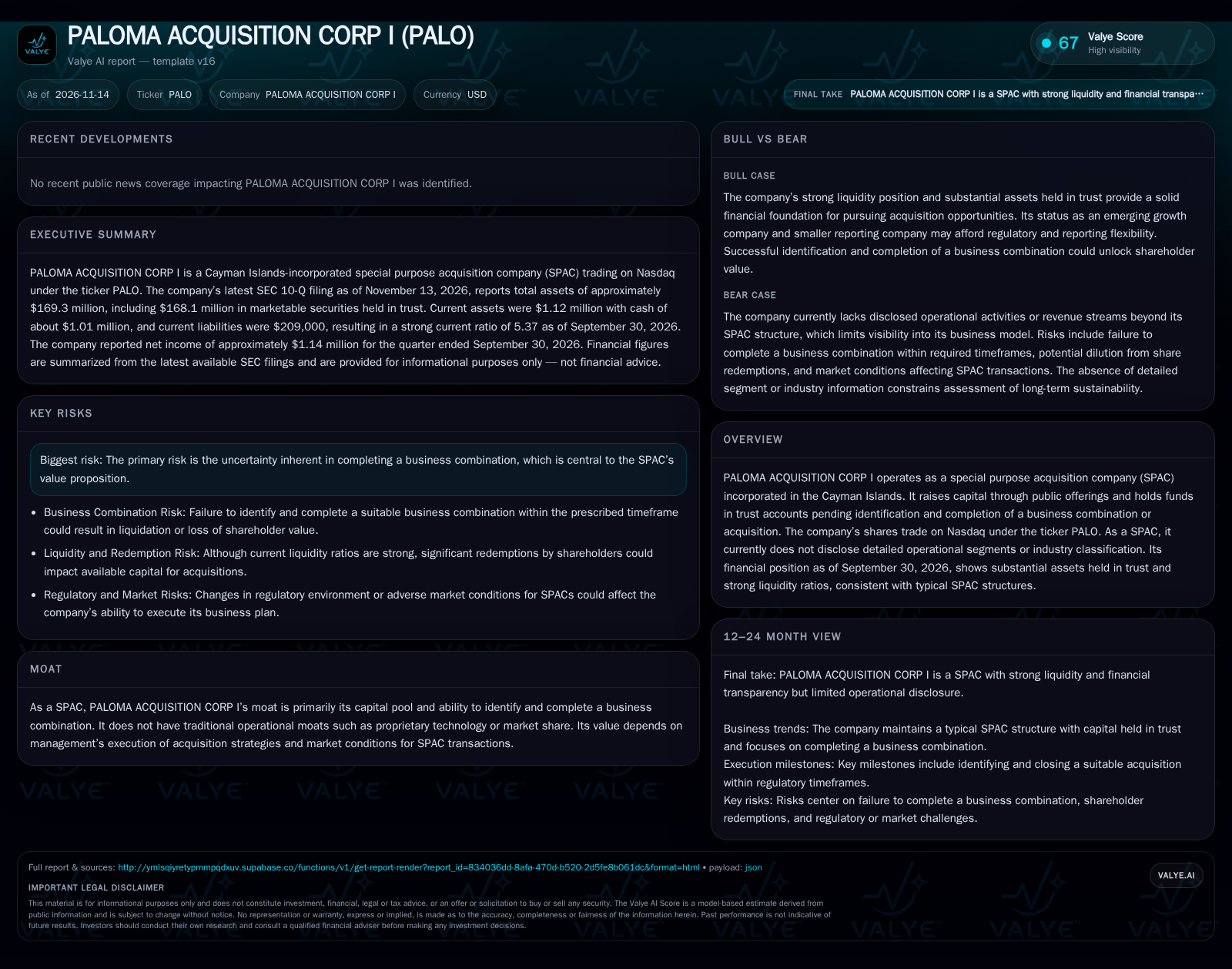
Paloma Acquisition Corp I maintains strong trust assets and liquidity but, as a SPAC, offers no operational business or recurring revenue. Its future hinges entirely on completing an advantageous business combination before its regulatory window closes. Shareholder redemptions, market sentiment, and management’s deal execution will dictate whether value is created or eroded.
PALOMA ACQUISITION CORP I (Nasdaq: PALO) represents the quintessential SPAC blank check company: flush with $168.1 million in trust and nearly all value contingent on a future acquisition, with no operating business or recurring revenue to anchor valuation today. Investors are essentially betting on the management team’s ability to source and consummate a deal under tight regulatory timelines and in a SPAC market facing heightened redemption pressure and regulatory scrutiny. The next year will be decisive for Paloma’s trajectory—either unlocking value through a successful merger or risking capital return and dissolution if no combination is achieved.
Overview: Trust Assets, Share Structure, and Operational Status
As of September 30, 2026, Paloma Acquisition Corp I had $168.1 million in marketable securities held in a trust account, with total assets of $169.3 million and current liabilities of $209,000 [S1]. The company’s Class A shares (16,450,000) are subject to redemption, and 4,112,500 Class B shares are outstanding [S1]. Net income of $1.14 million for the quarter was driven by interest income on trust assets, not business operations [S1]. There is no disclosed operating segment, revenue stream, or industry focus, making Paloma a pure-play on the SPAC process and its ultimate business combination outcome.
Value Implications of the Blank Check Framework
Paloma’s economics are fundamentally binary. Prior to a business combination, the company generates interest income from trust-held marketable securities, offset by administrative and compliance costs—a net positive in the current interest rate environment but not a durable value driver. The true economic engine is the eventual merger: if management identifies and closes a deal with an attractive target, Paloma can convert its trust assets into equity in a new operating business, potentially capturing upside for remaining shareholders.
However, this model is highly sensitive to redemptions. When a deal is announced, shareholders can redeem their shares for a pro rata slice of the trust, which can materially shrink the capital base available for the merger and dilute the post-combination company's financial strength. The fixed costs of running a public company persist, and high redemptions could leave the surviving business undercapitalized or force unfavorable deal renegotiations. SPAC sponsors typically receive founder shares and warrants that dilute public shareholders, further complicating the value equation. If no deal is closed within the regulatory window (often 18-24 months post-IPO), Paloma must liquidate and return trust assets, minus expenses, to shareholders.
A further dimension to consider is the timing of the merger within the SPAC lifecycle. Deals completed earlier in the regulatory window generally benefit from greater investor patience and potentially lower redemption rates, as shareholders may be more optimistic about the target's prospects. Conversely, mergers occurring late in the window often face compressed timelines and heightened redemption risk, as investor confidence wanes and the pressure to consummate a transaction intensifies. This temporal dynamic can influence management's negotiation leverage and the structuring of deal terms, potentially leading to concessions that affect long-term value. Additionally, the interplay between trust asset yields and market interest rates can subtly shift the net economic benefit of holding the SPAC prior to a merger, impacting investor incentives around redemption versus retention.
SPAC Market Competition for Targets and Sponsor Reputation
Paloma operates in a crowded field of SPACs, all seeking attractive merger targets—often in overlapping sectors such as technology, healthcare, or consumer. Its competitive advantage is not structural (no proprietary IP or recurring revenue) but rests on the experience and networks of its sponsor and management team, which are not detailed in the current disclosures. The market for high-quality targets is intensely competitive, and recent years have seen a marked increase in failed or renegotiated SPAC deals, as well as a surge in redemptions that can leave post-merger entities cash-starved.
Other SPACs, private equity, and direct listings all compete for the same pool of targets, and sellers are increasingly sophisticated in extracting favorable terms. Investor skepticism, regulatory headwinds, and the dilution from sponsor shares and warrants further erode the typical SPAC’s ability to offer a compelling value proposition.
Sponsor reputation and track record play a pivotal role in differentiating Paloma in a saturated SPAC market. Experienced sponsors with demonstrated success in closing value-accretive deals may command greater investor trust, reducing redemption likelihood and facilitating access to higher-quality targets. Conversely, sponsors lacking a clear sector focus or proven execution history may struggle to attract compelling opportunities, leading to prolonged search periods or suboptimal deals. The competitive landscape also pressures sponsors to innovate deal structures, such as incorporating earn-outs or performance-based incentives, to align interests and mitigate investor concerns. Furthermore, evolving regulatory scrutiny around SPAC disclosures and governance practices intensifies the need for transparent and credible sponsor conduct to maintain competitive positioning.
Potential Value from a Successful Merger
The best-case scenario for Paloma is the identification and closing of a business combination with a high-quality, fast-growing private company at a reasonable valuation—ideally in a sector with favorable secular tailwinds. If management can structure a deal that minimizes redemptions (for example, by offering PIPE financing, aligning incentives, or targeting a business with strong investor appeal), Paloma could convert its trust assets into a meaningful stake in a new public company with long-term growth prospects.
Evidence confirming this scenario would include a well-received deal announcement, limited redemptions at the merger vote, and robust post-combination trading. Additional PIPE investment or strategic partners participating in the deal would further validate the target’s quality. A falsification of the upside would be a poorly received deal, high redemption rates, or failure to close a transaction within the regulatory window.
Likely Scenario: Search Progress, Timing, and Redemption Impact
The most plausible path for Paloma is an extended search for a viable target, followed by a deal announcement in a competitive market where redemptions remain high. The management team may need to renegotiate terms, seek PIPE financing, or adjust valuation to accommodate a smaller-than-expected capital base after redemptions. If a deal is completed, the resulting company may face the typical challenges of post-SPAC mergers: limited float, dilution, and the need to quickly demonstrate operational performance to retain investor confidence.
Confirmation of this scenario would be a deal announcement followed by moderate to high redemption rates and a post-merger company with a modest initial cash position. Falsifying evidence would include failure to announce a deal or a surprisingly low redemption rate signaling strong investor support.
Risks of Execution Failure on Shareholder Value
If Paloma fails to identify or close a business combination within the required timeframe, or if overwhelming redemptions make a merger unviable, the trust will be liquidated and returned to shareholders (less expenses). In this scenario, public shareholders receive their pro rata trust value, but all optionality for upside is lost, and sponsor capital and effort are effectively written off.
This downside is confirmed by missed regulatory deadlines, liquidation filings, or the inability to secure a target willing to accept the terms dictated by a high-redemption environment. Other signs would include repeated extension votes, negative market sentiment, or sponsor forfeiture of founder shares.
Factors Influencing Paloma’s Future Performance
Announcement of a definitive business combination agreement: The timing, target quality, and sector will be critical for investor reception.
Shareholder redemption rate at the merger vote: High redemptions will shrink the deal’s capital base and may force renegotiation or threaten deal completion.
PIPE (private investment in public equity) commitments, if disclosed: These can supplement trust assets and signal institutional confidence in the target.
Extension votes and amendments to the trust liquidation deadline: Multiple extensions may signal difficulty in sourcing or closing a deal.
Sponsor and management team disclosures: Additional details on their track record, sector focus, or alignment mechanisms would help test the likelihood of a successful combination.
Regulatory or market shifts affecting SPAC dealmaking: Changes in SEC rules, redemption mechanics, or market appetite for de-SPACed companies could alter Paloma’s prospects.
Post-merger trading and operational disclosures (if a deal closes): Early performance of the combined company would provide evidence for or against long-term value creation.
Disclaimer: This is research-only, informational analysis and not investment advice. It may include AI-generated interpretation and general industry context. Always verify important details using primary sources.

Comments