
Cumberland Pharmaceuticals: Specialty Brands, Pipeline Potential, and Post-Exclusivity Market Dynamics
Cumberland combines a portfolio of hospital and specialty-care pharmaceuticals with a late-stage rare-disease pipeline, but faces rising generic pressures and the transition away from non-recurring financial gains. The company’s strategy hinges on extracting durable value from branded products, advancing clinical assets like ifetroban, and executing on international expansion—each with distinct economic and competitive implications.
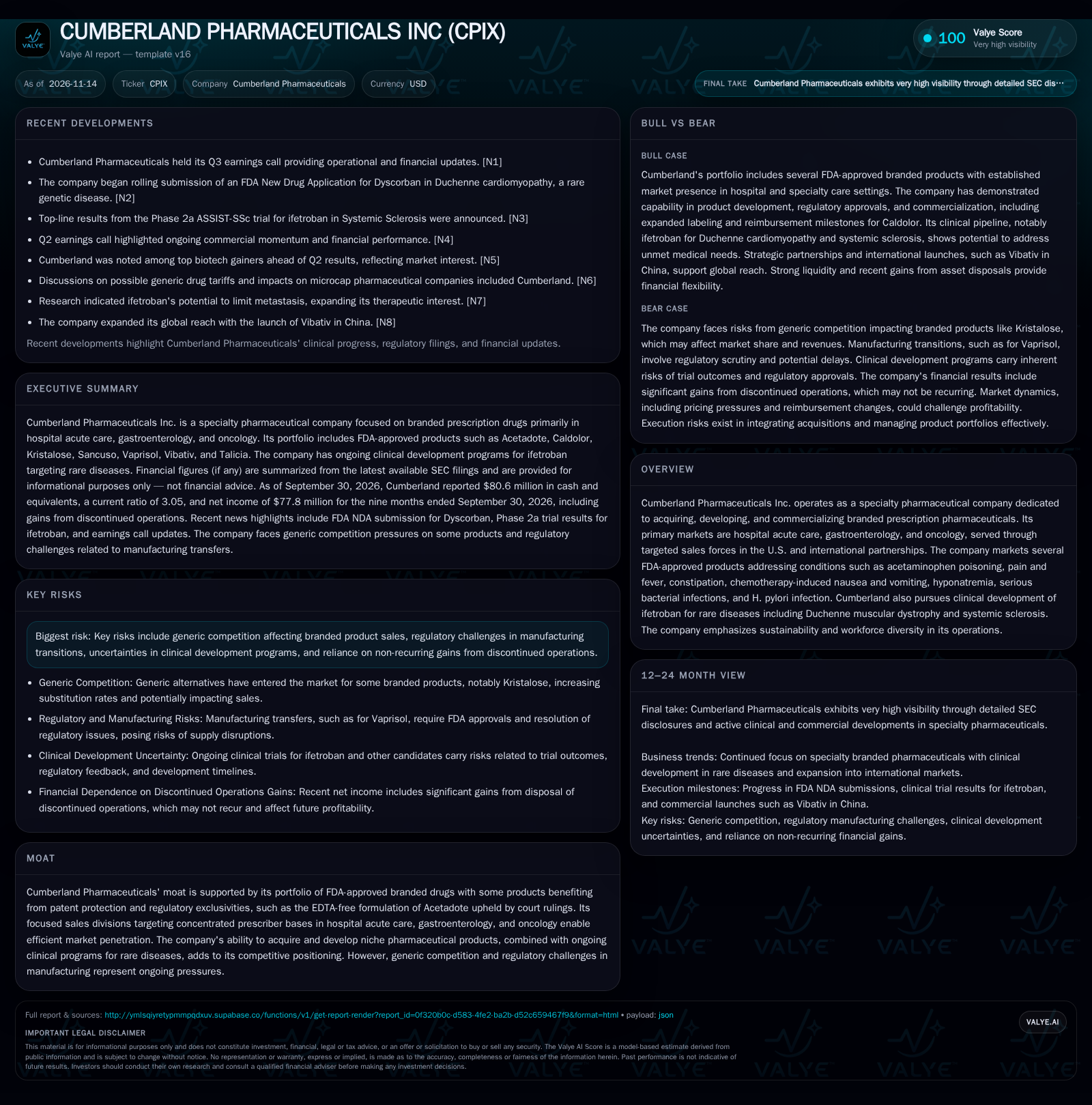
Cumberland Pharmaceuticals is navigating a pivotal phase as it manages a mature branded-drug portfolio facing generic headwinds, pursues late-stage clinical programs in rare diseases, and transitions manufacturing while deploying recent financial gains. The company’s future value will depend on its ability to offset eroding exclusivities, convert pipeline assets into commercial franchises, and sustain profitability absent discontinued operation windfalls. [S1] [S2] [N1] [N2] [N3]
Cumberland Pharmaceuticals sits at a strategic crossroads: its branded hospital and specialty pharmaceuticals generate cash flow but are increasingly exposed to generic competition and expiring exclusivities. The company’s near-term performance has been buoyed by one-off financial events, while its long-term trajectory depends on successfully advancing late-stage pipeline assets—particularly ifetroban for rare and orphan indications—through regulatory and commercial hurdles. Cumberland’s execution in international markets and ability to manage manufacturing risk will be critical to sustaining value as legacy products mature and new competition emerges.
Cumberland’s Current Position: Portfolio, Pipeline, and Financial Highlights
Cumberland’s branded portfolio spans hospital acute care, gastroenterology, and oncology, with FDA-approved products including Acetadote, Caldolor, Kristalose, Sancuso, Vaprisol, Vibativ, and Talicia. Acetadote, once protected by orphan drug exclusivity, now relies on a next-generation EDTA-free formulation with court-upheld patent protection set to expire in August 2025. Kristalose faces growing generic substitution, while Caldolor and Sancuso have achieved expanded labeling and reimbursement milestones. [S1]
The company’s pipeline is anchored by ifetroban, a molecule in late-stage clinical development for rare diseases such as Duchenne muscular dystrophy (DMD) and systemic sclerosis. Cumberland has begun a rolling FDA NDA submission for Dyscorban (ifetroban) in DMD cardiomyopathy, and reported positive Phase 2a data in systemic sclerosis. [N2] [N3]
Financially, Cumberland posted $77.8 million in net income for the nine months ended September 30, 2026, but this includes a significant gain on the disposal of discontinued operations. The company maintains a cash balance of $80.6 million and a current ratio of 3.05. [S2]
Recent corporate developments include the launch of Vibativ in China, furthering the company’s international reach, and ongoing manufacturing transition for Vaprisol, pending FDA approval. [N8] [S1]
Economic Pressures on Branded Drugs: Pricing Trends, Volume Shifts, and Pipeline Contributions
Cumberland’s economics have historically been driven by branded hospital and specialty drugs, where pricing and reimbursement can be favorable but are vulnerable to generic entry upon loss of exclusivity. Products like Acetadote, formerly protected by orphan status and then by a new formulation patent, exemplify the finite nature of these advantages—once exclusivity lapses, pricing power typically erodes rapidly as generic competitors enter, compressing both unit prices and volumes.
The mix of hospital acute care and specialty products creates variable gross margins: acute care drugs often command premium pricing but must be supported by field sales and education, while products like Kristalose, now facing generic substitution, may see both volumes and margins contract as payors and pharmacies favor lower-cost alternatives.
Operating leverage in this model is driven by the ability to scale sales over a largely fixed commercial infrastructure—meaning incremental revenue from new indications or product launches can disproportionately benefit the bottom line. However, the company’s recent net income was materially impacted by non-operating gains, not core product economics. [S2]
The pipeline, especially ifetroban, represents Cumberland’s most viable opportunity to reset its margin and revenue base. If approved for rare-disease indications, ifetroban could command orphan pricing and potentially benefit from market exclusivity, supporting high gross margins and limited initial competition. The degree to which pipeline assets can offset declining legacy revenues will likely determine the company’s long-term economic trajectory.
Competing in a Saturated Market: Cumberland’s Strategic Advantages and Emerging Challenges
Cumberland operates in highly competitive therapeutic areas, with branded drugs facing not only direct generic substitutes but also alternative therapies and evolving clinical guidelines. In hospital acute care, the company’s advantage has historically come from first-mover status (e.g., Caldolor as the first injectable ibuprofen) and focused field sales targeting concentrated prescriber groups. However, these advantages wane as exclusivity expires or as more entrenched generics dilute brand preference.
In gastroenterology, Kristalose’s crystalline formulation once offered differentiation, but generic alternatives—often with similar clinical profiles—have increased substitution rates. Oncology assets like Sancuso benefit from unique delivery mechanisms (transdermal patch), but must contend with both branded and generic antiemetics, meaning sustained share depends on clinical differentiation and formulary access.
International expansion, such as Vibativ’s launch in China, opens new markets but also exposes Cumberland to local competitors, pricing controls, and regulatory complexities. The ability to leverage partnerships and navigate foreign regulatory pathways will be critical to capturing and defending share outside the U.S. [N8]
While the company’s expertise in acquisition, development, and commercialization provides a platform for ongoing portfolio renewal, the core threat remains: as branded drugs mature, the window for supernormal returns narrows, and competitive intensity rises.
Revenue Transformation Through Pipeline Breakthroughs and Global Expansion
The most favorable scenario for Cumberland involves the successful approval and rapid uptake of ifetroban in rare disease indications like Duchenne cardiomyopathy and systemic sclerosis. If ifetroban achieves regulatory approval and demonstrates clinically meaningful benefit, it could secure orphan drug exclusivity and premium pricing, providing several years of protected, high-margin revenue with limited direct competition. [N2] [N3]
Simultaneously, further international expansion—such as continued Vibativ launches in additional territories or new products entering major ex-U.S. markets—could diversify revenue streams and offset U.S. pricing or volume declines. [N8]
Confirmation of this upside would require: clear regulatory approvals for ifetroban; published clinical data demonstrating efficacy and safety; robust initial sales uptake in targeted rare disease populations; successful execution of international launches with meaningful revenue contribution; and evidence that new branded products can replace lost margin from maturing legacy drugs.
Falsification would come from failed or inconclusive late-stage trials, regulatory setbacks, or slower-than-anticipated market adoption of new products, as well as inability to achieve international traction.
Balancing Legacy Brand Declines with Pipeline Development
The most plausible intermediate scenario is that Cumberland continues to experience gradual revenue and margin erosion in its legacy branded portfolio as exclusivities expire and generic competition intensifies—particularly for Kristalose and, post-2025, Acetadote. New generic entrants will likely force price concessions and volume losses, especially in cost-sensitive hospital and specialty settings.
Meanwhile, the clinical pipeline—anchored by ifetroban—progresses but faces the usual delays, regulatory hurdles, and commercialization ramp associated with rare-disease drugs. International expansion, such as the Vibativ launch in China, provides incremental growth but is unlikely to fully offset U.S. legacy declines in the near term. [N8]
This scenario would be confirmed by stable-to-declining core product revenues, rising sales and marketing costs relative to revenue, ongoing R&D spend without near-term product launches, and a gradual shift in revenue mix toward new geographies or indications. Falsification would come from a dramatic acceleration in pipeline approvals or a steep, sudden drop in base product sales beyond normal generic erosion.
Profitability Risks from Rapid Generic Competition and Pipeline Delays
The primary risk is that generic competition erodes branded product revenues faster than expected—either due to earlier-than-anticipated generic launches, aggressive pricing by competitors, or loss of formulary access. If Acetadote’s patent protection lapses in 2025 and generics scale rapidly, the company could see a sharp drop in one of its historically significant revenue streams.
Further, if the clinical pipeline falters—due to negative trial results, regulatory rejections, or slow enrollment in rare disease studies—Cumberland may find itself without a near-term replacement for lost branded revenues. Manufacturing or supply chain disruptions (e.g., delays in FDA approval for Vaprisol’s new facility) could exacerbate margin pressure or create product shortages. [S1]
Downside confirmation would be evident in sharp, year-over-year revenue declines, margin compression, negative operating leverage, or the need to raise capital to fund ongoing R&D and operations. Conversely, early positive signals from the pipeline or stabilization in legacy product volumes would help disconfirm the worst-case trajectory.
Factors Shaping Cumberland’s Upcoming Growth Trajectory
Year-over-year revenue and gross margin trends for key branded products—especially Kristalose, Acetadote, and Caldolor—as a real-time indicator of generic erosion and pricing power. [S1] [S2]
Progress milestones for ifetroban: regulatory submissions, trial readouts (particularly for Duchenne cardiomyopathy and systemic sclerosis), and any orphan designation or priority review acknowledgments. [N2] [N3]
Commercial uptake and market share metrics for newly launched or acquired products—such as Sancuso and international sales of Vibativ—if disclosed.
Updates on manufacturing transitions, particularly FDA approval for the new Vaprisol facility, as a gauge of supply chain and margin risk. [S1]
Shifts in R&D spending relative to revenue, highlighting the balance between pipeline investment and ongoing commercial operations—if disclosed.
Cash flow from operations excluding gains on discontinued operations, to clarify core business profitability trends. [S2]
Any disclosure on product recalls, clinical trial terminations, or regulatory actions that could impact portfolio durability or reputation.
Disclaimer: This is research-only, informational analysis and not investment advice. It may include AI-generated interpretation and general industry context. Always verify important details using primary sources.

Comments