
CaliberCos: Real Estate Platform Ambitions Meet Blockchain Experimentation and Market Headwinds
CaliberCos is pursuing a hybrid strategy at the intersection of traditional real estate asset management and blockchain-enabled financial innovation. Recent tokenized offerings, a growing digital asset treasury, and a major development pipeline highlight the company’s bid for differentiated growth, but persistent net losses, Nasdaq compliance issues, and execution risks underscore the challenges of scaling an emerging platform in volatile markets.
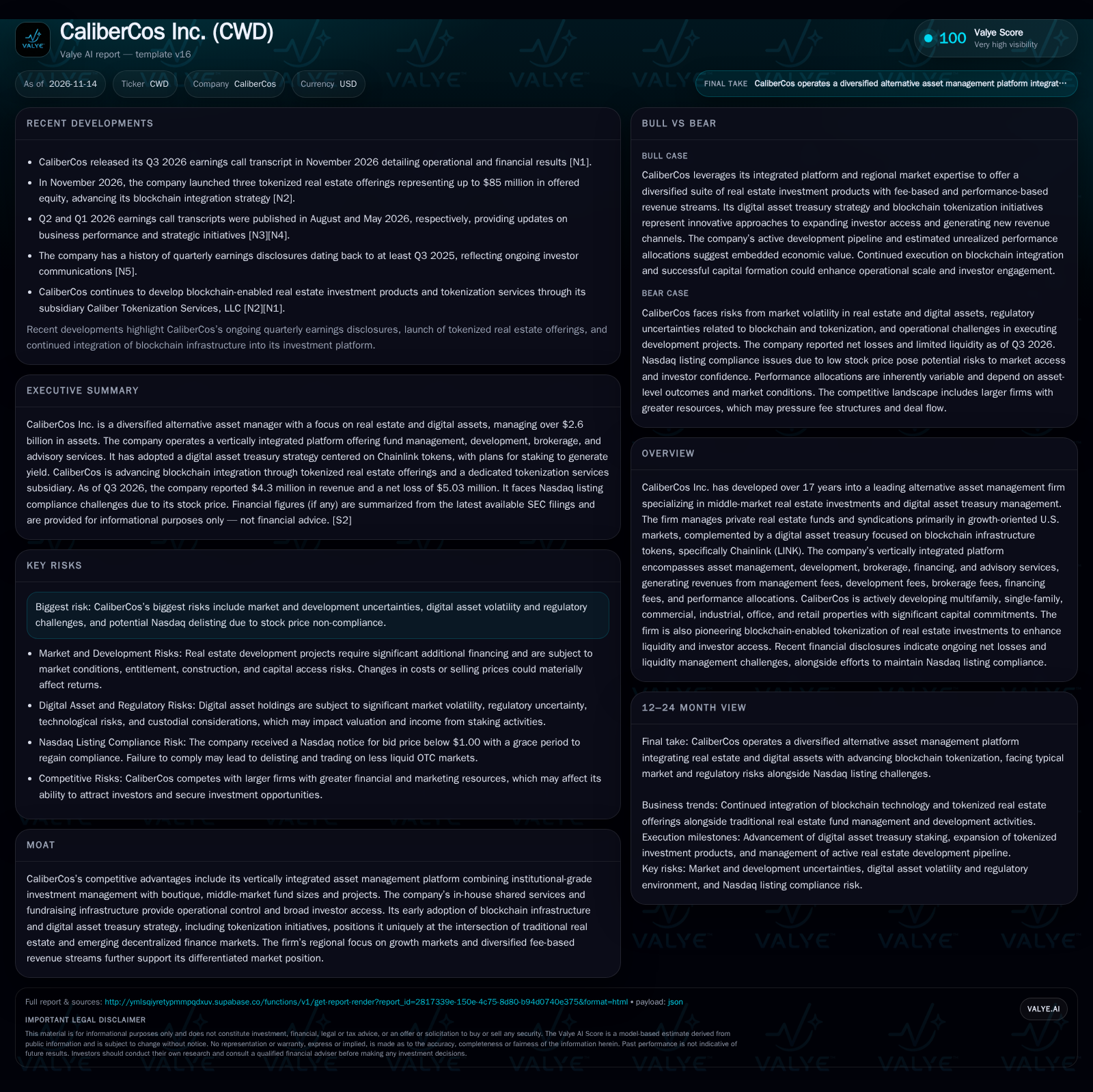
CaliberCos manages over $2.6 billion in assets across real estate and digital tokens, recently launching $85 million in tokenized offerings and deepening blockchain integration. Despite these innovations, the company reported a Q3 2026 net loss of $5.03 million and faces ongoing Nasdaq listing compliance pressures, reflecting both the promise and risks of its dual-pronged strategy. [S2] [N2]
CaliberCos stands at the crossroads of two capital-intensive domains: middle-market real estate development and the emerging world of blockchain-based finance. With $2.6 billion in managed and developing assets, a push into tokenized real estate products, and a digital treasury anchored by Chainlink tokens, the company is betting that technological innovation can unlock new sources of growth and investor participation. However, Q3 2026 results show continued net losses and a precarious Nasdaq listing, raising the question of whether CaliberCos’s hybrid model can deliver durable value before competitive and funding pressures force a strategic pivot.
Recent Tokenized Offerings and Financial Pressures Define the Current Landscape
CaliberCos reported $4.3 million in revenue and a net loss of $5.03 million for Q3 2026, with cash and equivalents standing at $2.2 million as of September 30, 2026. The company’s asset base is significant—over $2.6 billion split between $0.7 billion in AUM and $1.8 billion in assets under development—but these resources have yet to translate into sustained profitability. [S2]
In November 2026, CaliberCos launched three tokenized real estate offerings, collectively representing up to $85 million in equity, advancing its blockchain integration strategy. This move formalizes its ambitions to use tokenization for fractional ownership and enhanced liquidity. [N2]
The company received a Nasdaq notice in August 2026 for trading below a $1.00 bid price for over a month, with a 180-day window to regain compliance, putting its listing status in question. [S2]
Multi-Layered Revenue Streams and the Capital Demands of Innovation
CaliberCos generates revenue from a blend of fund management fees (1.0%–1.5% of unreturned capital), organizational, offering, and financing fees, development and construction management fees (up to 6% combined), brokerage fees, and performance allocations (15%–35% of fund cash distributions post-preferred returns). This mix creates both recurring fee income and variable, event-driven upside tied to fund exits and asset sales. [S1] [S2]
The company’s vertically integrated model—spanning asset management, development, brokerage, and advisory—may support operating leverage if asset scale and fund flows grow. However, the heavy capital requirements of real estate development ($1.8 billion in estimated capital costs for the current pipeline) mean that external financing, fundraising, and project execution are critical dependencies.
The digital asset treasury, anchored in Chainlink (LINK) tokens, is intended to generate yield through staking (internally estimated at 3%–9% annually). While this could diversify and supplement income, digital asset returns are volatile and may not offset core operating losses in the near term. [S1] [S2]
Tokenization initiatives, if adopted by investors, could introduce new fee streams (such as technology licensing, servicing, or platform fees), but these are unproven at commercial scale for CaliberCos as of late 2026.
Platform Integration and Blockchain as Differentiators—But Scale and Resource Gaps Remain
CaliberCos’s competitive positioning relies on its vertically integrated platform and early adoption of blockchain-enabled tokenization. By offering both traditional and digital asset-based investment products, the company seeks to appeal to a broader set of investors and to differentiate from conventional real estate managers.
The regional focus on high-growth U.S. markets (Arizona, Colorado, Texas) and hospitality assets nationwide targets areas with strong demographic and economic tailwinds, but exposes the company to cyclical real estate risks and local development hurdles.
Compared to much larger asset management peers, CaliberCos may face higher capital costs, less brand recognition, and more variable deal flow. The ability to attract and retain investors could hinge on whether tokenized offerings deliver tangible benefits—such as liquidity, transparency, and lower minimum investment thresholds—that outweigh incumbent advantages of scale and stability.
Blockchain integration does not automatically result in recurring revenue, pricing power, or switching costs. For these to materialize, CaliberCos would need to demonstrate robust investor demand for tokenized products, seamless technology execution, and regulatory clarity.
If Tokenization Unlocks New Capital and Yields, Platform Economics Could Transform
In a favorable scenario, CaliberCos’s tokenized offerings attract a new cohort of investors—retail and institutional—who value fractional ownership, instant settlement, and secondary liquidity. This could drive higher fund inflows, lower fundraising friction, and incremental fee revenue from tokenization services.
Successful execution on digital asset staking (with realized yields matching or exceeding internal estimates) could supplement fee-based revenue, especially if real estate cycles soften.
If the development pipeline is delivered on time and on budget, and performance allocations (currently estimated at $95.9 million unrealized) begin to crystallize through asset sales or fund exits, the company could achieve positive operating leverage.
Evidence that would support this scenario includes: rapid uptake of tokenized offerings (e.g., oversubscribed launches, high secondary trading volume if available), realized digital asset yields, and a shift to positive net income and cash flow reported in subsequent quarters.
Hybrid Model Drives Experimentation but Near-Term Profitability Remains Elusive
The most plausible outcome is a period of continued experimentation, with CaliberCos gradually scaling its tokenization platform while maintaining its core real estate development and fund management activities. Fee and performance income remain lumpy, with digital asset yields providing only modest diversification.
Operating costs—including development expenses, technology investment, and regulatory compliance—likely keep the company near or below breakeven absent a major asset sale or fundraising event.
Nasdaq listing pressures persist, but management either regains compliance through a share price rebound or executes a further reverse split to retain market access.
Confirmation would come from steady, but not explosive, growth in tokenized product AUM, ongoing net losses or marginal improvement, and periodic updates on development project milestones.
Execution Delays, Weak Digital Asset Returns, and Delisting Could Force Strategic Retrenchment
Should tokenized offerings fail to gain investor traction, CaliberCos may find itself unable to offset the capital intensity and volatility of its development pipeline. If digital asset yields underperform, and the company is forced to liquidate tokens at a loss to cover operating deficits, financial strain could accelerate.
Development project setbacks—such as cost overruns, entitlement delays, or softening demand—could erode unrealized performance allocations and increase the risk of covenant breaches or distressed asset sales.
Failure to regain Nasdaq compliance would move the stock to OTC markets, reducing liquidity, investor access, and potentially raising capital costs—further constraining growth and innovation.
This scenario would be confirmed by weak or declining revenue from both traditional and tokenized products, digital asset impairment charges, missed development milestones, and delisting notices.
What Will Define CaliberCos’s Value Proposition in the Next Phase?
Subscription and secondary market activity for newly launched tokenized real estate offerings—if disclosed—would indicate investor acceptance and the commercial viability of blockchain integration.
Realized digital asset staking yields versus internal estimates; actual income from LINK token staking would help test the diversification thesis.
Progress and costs on major development projects, including unit completions, cost overruns, and sales or leasing velocity, as these drive both fee and performance allocation realization.
Quarterly revenue and net income trends, especially any inflection toward profitability or sustained positive cash flow.
Nasdaq listing status and management’s response if compliance is not regained—such as further reverse splits, uplisting attempts, or strategic alternatives.
Fundraising velocity and the ability to launch and close new funds or syndications in a competitive middle-market environment.
Updates on regulatory developments affecting digital asset custody, tokenization, and real estate securities, as these could materially impact both risk and adoption.
Disclaimer: This is research-only, informational analysis and not investment advice. It may include AI-generated interpretation and general industry context. Always verify important details using primary sources.

Comments