
Research Alliance Corp IV: Early-Stage SPAC Economics, Capital Structure, and the Road to a Business Combination
Research Alliance Corp IV (RACD) completed its IPO in mid-2026, raising $75 million now held in trust and generating initial net income purely from interest income. With no operating business and its future contingent on executing a successful merger, RACD’s economics and risks should be viewed through the lens of SPAC structure, capital preservation, and the looming challenge of identifying and consummating an attractive acquisition.
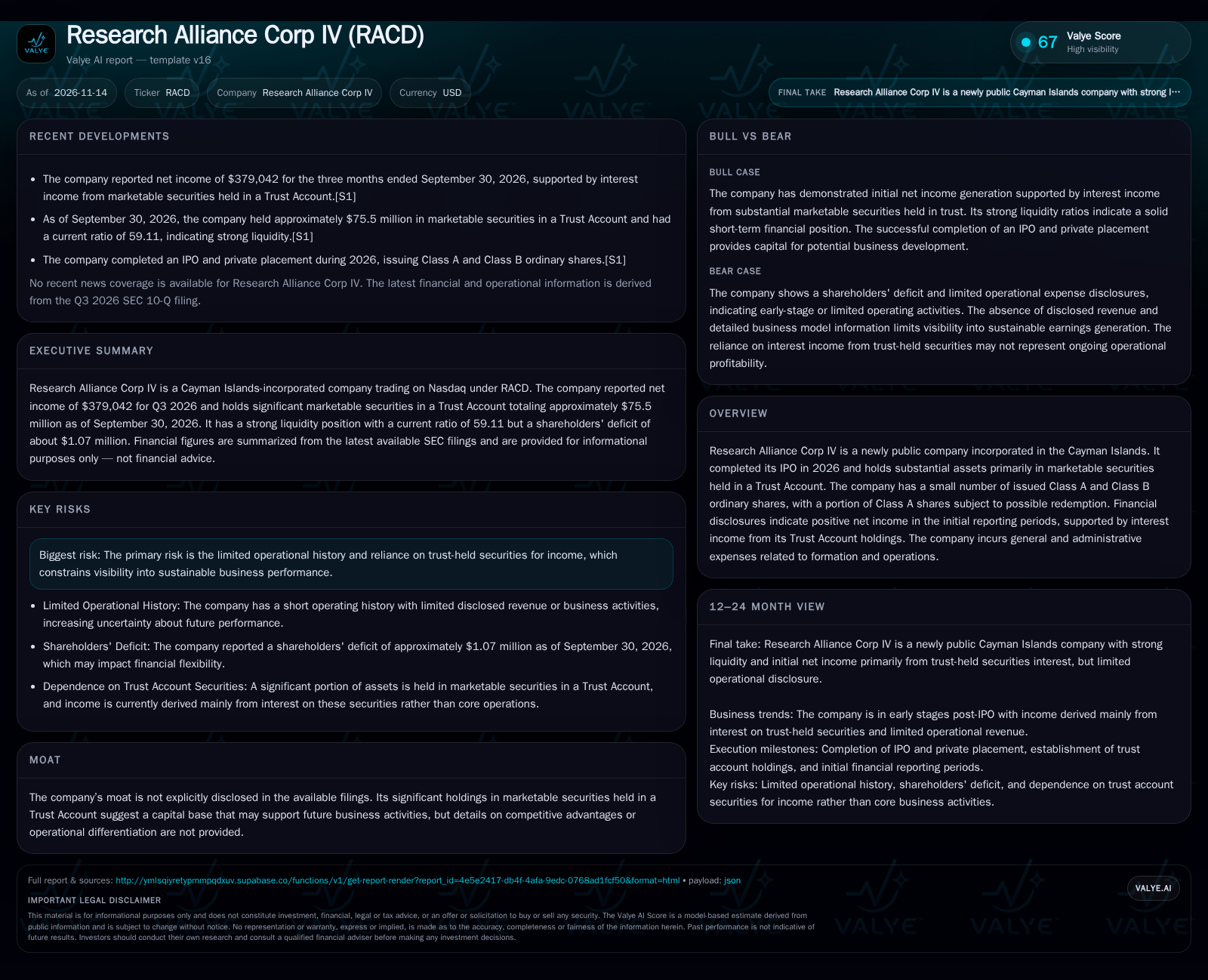
RACD is a newly formed SPAC holding $75.5 million in trust, reporting early net income solely from interest on those assets. Its future value depends entirely on its ability to identify, negotiate, and close a business combination before its SPAC timeline expires. The current structure offers capital protection for redeeming shareholders, but no operational upside until a merger is completed.[S1]
Research Alliance Corp IV (RACD) exemplifies the archetypal early-stage SPAC: flush with IPO proceeds, holding nearly all assets in a trust account, and reporting initial net income solely from interest on those funds. With no operations or identified acquisition target as of Q3 2026, RACD’s only value proposition is its potential to consummate a business combination before the SPAC timeline expires. Investors should focus less on current financials and more on the mechanisms, risks, and incentives that will shape the company’s next move—from deal sourcing and negotiation to shareholder redemption dynamics and the possibility of a liquidation scenario.[S1]
Post-IPO Financial Profile: SPAC Structure and Capital Preservation
As of September 30, 2026, Research Alliance Corp IV held approximately $75.5 million in marketable securities in a trust account, with cash and cash equivalents of $935,432 outside the trust. The company reported cash and liquidity metrics for the period; these figures do not by themselves establish operating runway, investment capacity, financial flexibility, or financing capacity. Notably, 7.5 million Class A shares are subject to redemption at $10.07 per share, setting a clear floor for public shareholders, while a shareholders’ deficit of $1.07 million reflects early-stage administrative and formation costs outpacing interest income. These facts underscore RACD’s status as a capital pool with virtually no operating activity or revenue generation outside of trust interest.[S1]
The absence of an identified business combination target or any substantive operating business means that all near-term value for public shareholders is anchored to the trust account and the redemption mechanism. The company’s financials reflect SPAC mechanics rather than ongoing enterprise value creation.
How SPACs Like RACD Create—and Lose—Value
RACD’s economics are determined almost entirely by the mechanics of a special purpose acquisition company (SPAC). The capital raised in the IPO is held in a trust, invested in marketable securities (typically U.S. Treasuries), and accrues interest income—currently the sole source of reported net income. The company’s net operating loss outside of interest income is standard for SPACs in the pre-deal phase.
The primary economic event for RACD will be the completion of a business combination (de-SPAC transaction). If a deal is closed, value creation or destruction will depend on the quality of the target, the merger terms (including dilution from sponsor shares, warrants, and PIPE financing), and post-merger market reception. If no deal is consummated within the SPAC’s allowed timeframe (usually 18-24 months post-IPO), the trust is liquidated and returned to redeeming shareholders, minus any taxes and permitted expenses. Thus, for now, RACD’s asset base is preserved, but the risk/reward profile will change dramatically upon announcement of a potential merger.
SPAC Market Dynamics: Sourcing, Competition, and the Challenge of Target Selection
RACD competes with a crowded field of other SPACs, private equity funds, and strategic acquirers for attractive merger targets. The surge in SPAC IPOs in 2020-2022 led to an oversupply of blank check companies vying for a limited pool of high-quality private businesses willing to go public via merger. This dynamic can force SPACs to overpay or pursue riskier targets, especially as their deal deadlines approach.
RACD’s competitive position will depend on the credibility and networks of its sponsor and management team—the details of which are not disclosed in the current filing. SPACs with experienced sponsors, differentiated sector expertise, or proprietary deal flow have historically been better positioned to source attractive targets and negotiate favorable terms. However, with no identified target, RACD’s competitive edge (if any) remains unproven. Until a letter of intent or definitive agreement is announced, the company’s only differentiator is the integrity and safety of its trust capital.
What Would a Successful De-SPAC Look Like?
The most favorable outcome for RACD shareholders is that the company sources, negotiates, and closes a merger with a high-growth, well-managed private business at a reasonable valuation, with minimal dilution from sponsor promote and additional financings. In this scenario, trust shareholders opt to roll their shares into the new entity rather than redeem, resulting in a robust post-merger trading market and the potential for capital appreciation far beyond the trust redemption value.
Evidence that would support this scenario includes the announcement of a definitive merger agreement with a credible, scalable target, strong PIPE (private investment in public equity) participation to backstop redemptions, and market enthusiasm reflected in post-deal trading above the redemption price. Conversely, failure to announce a deal or low-quality merger terms would quickly falsify the upside thesis.
SPAC Status Quo: Interest Income, Administrative Burn, and the Countdown to a Deal
The most plausible near-term scenario is that RACD continues to operate as a capital pool, incurring modest administrative and public company expenses while searching for a suitable merger target. Interest income on trust assets may continue to marginally offset expenses, but no material value will accrue to shareholders absent a business combination. Over the next 12-18 months, the company will face increasing pressure to announce a deal as its SPAC clock runs down.
Confirmation of this scenario would come from continued reporting of net income driven by trust interest, with no major developments or target announcements. Falsification would occur if the company reveals a merger agreement or, alternatively, if redemptions and liquidation become imminent due to deal failure or timeline expiration.
Deal Failure, Redemptions, and the Liquidation Mechanism
The principal downside risk is that RACD fails to identify or close an acceptable business combination within its allotted SPAC window, triggering liquidation of the trust and return of funds to redeeming shareholders. In this scenario, public holders receive their pro rata share of the trust (minus taxes and permitted expenses), while sponsors lose their at-risk capital and promote. Shareholders who bought in above trust value would incur a loss, and the company would cease to exist.
Confirming evidence would include public filings indicating an inability to secure a deal, shareholder votes on liquidation, or redemptions spiking near deadline. A secondary risk is that RACD consummates a merger with a low-quality or overvalued target, leading to mass redemptions, post-merger underperformance, and potential capital impairment for non-redeeming shareholders.
Milestones That Will Define RACD’s Transition from Cash Shell to Operating Business
Announcement of a letter of intent or definitive agreement for a business combination, including details on target sector, valuation, and expected post-merger structure.
Trends in public shareholder redemptions at the time of deal vote—high redemption rates may signal lack of market confidence or deal quality.
Size and terms of any PIPE or additional financing announced alongside a merger—strong third-party participation would indicate institutional support.
Changes in trust account balance, interest income, or permitted withdrawals for taxes and expenses—material erosion could affect redemption value.
Material amendments to the SPAC’s charter or extension of the merger deadline, which would signal deal execution risk or timetable pressure.
Insider transaction activity was reported in the cited source; this activity does not by itself establish insider confidence.
Breakdown of administrative and due diligence expenses as the SPAC approaches its deadline—rising costs without deal progress may erode net trust value.
Disclaimer: This is research-only, informational analysis and not investment advice. It may include AI-generated interpretation and general industry context. Always verify important details using primary sources.

Comments