
Pasithea Therapeutics: Macrocyclic MEK Inhibitor Ambitions and the Capital-Intensive Road to Clinical Proof
Pasithea Therapeutics is advancing PAS-004, a next-generation macrocyclic MEK inhibitor, across multiple high-need indications including NF1 and MAPK-driven tumors. With reported liquidity position following a major equity raise and regulatory incentives in hand, the company’s trajectory now hinges on clinical progress, capital discipline, and navigating a competitive landscape of established and emerging targeted therapies.
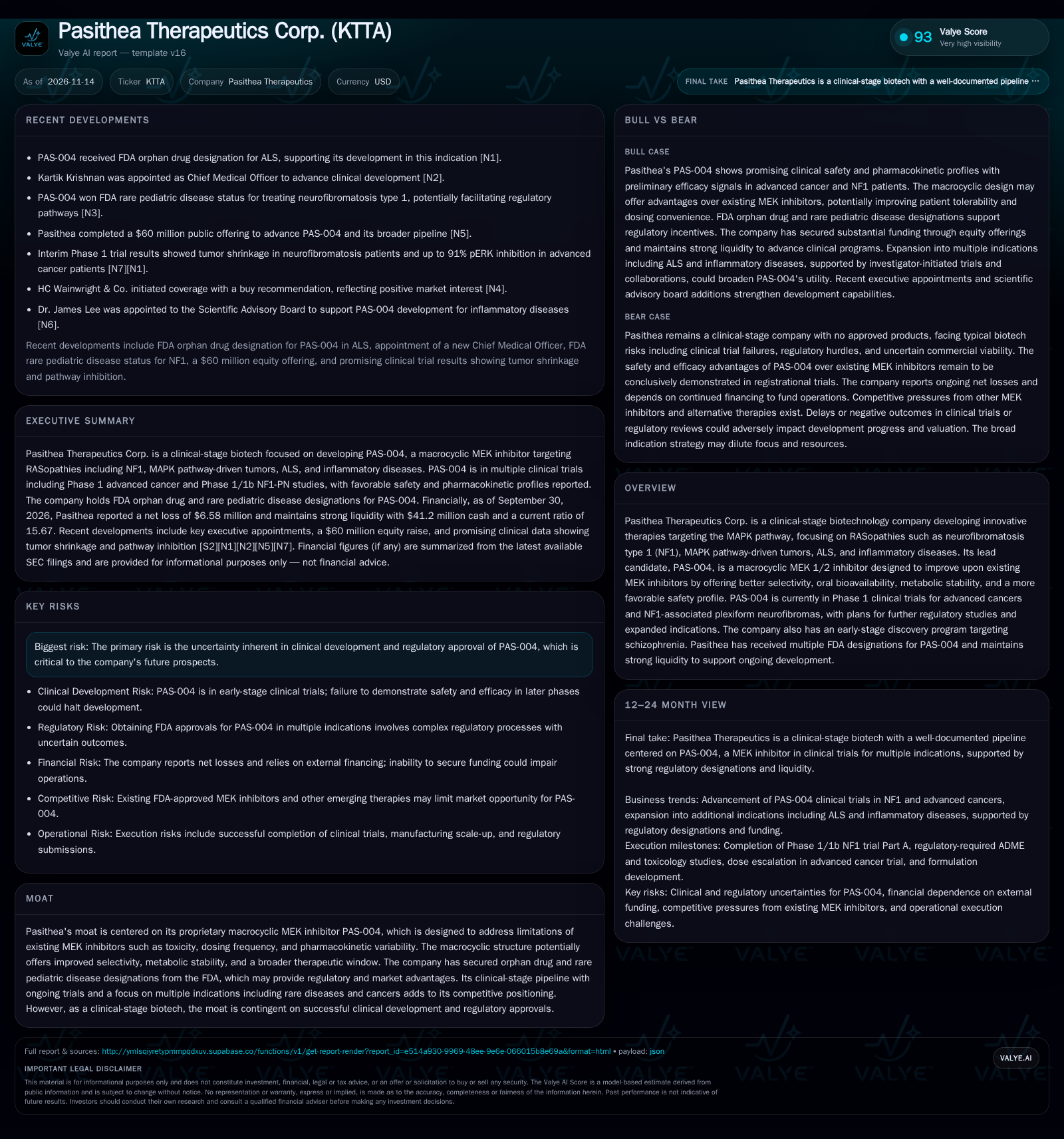
Pasithea Therapeutics is a clinical-stage biotech developing PAS-004, a novel macrocyclic MEK inhibitor with orphan drug and rare pediatric disease designations for ALS and NF1. The company’s current focus is on Phase 1/1b trials for advanced tumors and NF1, with ongoing dose escalation and favorable early safety signals. Its future will depend on translating strong preclinical and early clinical signals into late-stage trial success and eventual commercialization [S1] [S2] [N1] [N3] [N5].
Pasithea Therapeutics stands at the inflection point typical of clinical-stage biotechs: its lead asset, PAS-004, is advancing through early clinical trials with encouraging safety and pharmacokinetic data, while the company leverages regulatory incentives and a recently strengthened balance sheet to pursue multiple high-value indications. The next two years will test whether PAS-004’s macrocyclic MEK inhibitor design can deliver differentiation in a crowded field, and whether Pasithea’s capital can be deployed efficiently enough to reach pivotal trial catalysts before the need for further dilution or partnership.
PAS-004’s Clinical Progress and Funding Shape the Next Strategic Phase
The most material developments for Pasithea Therapeutics are the ongoing clinical advancement of PAS-004, the company’s macrocyclic MEK 1/2 inhibitor, and the maintenance of a reported liquidity position following a $60 million equity offering. [S2] [N5]
PAS-004 is being assessed in a multicenter, first-in-human Phase 1 trial in MAPK pathway-driven advanced tumors, and a Phase 1/1b trial in adult patients with symptomatic, inoperable NF1-PNs, both with ongoing dose escalation and no maximum tolerated dose reached to date [S1]. Early safety data is favorable, with only Grade 1 and 2 adverse events and no dose interruptions. These data points are critical because they set the stage for potentially differentiated dosing and safety in later-stage trials.
Regulatory momentum is evident: PAS-004 has received FDA orphan drug designation for ALS and NF1, and FDA rare pediatric disease status for NF1-PN, unlocking potential for expedited development, fee waivers, and extended market exclusivity if approved [N1] [N3] [S1]. The company also has a preclinical CNS discovery program, but all commercial prospects currently hinge on PAS-004’s trajectory.
Translating Pipeline into Value: Biotech Economics and the Need for Capital Discipline
As a pre-revenue clinical-stage biotech, Pasithea’s business economics are defined by its R&D pipeline and ability to convert clinical progress into future product revenue. The company’s expenses are dominated by clinical trial costs, regulatory studies, and pipeline expansion. With net losses continuing ($6.58 million for the quarter ended September 30, 2026) and no commercial products, Pasithea remains entirely dependent on external capital to fund operations [S2].
If PAS-004 advances through pivotal trials and gains approval, revenue would depend on pricing (influenced by orphan drug status and competitive landscape), patient volumes in targeted rare diseases (such as NF1 and certain tumors), and payer willingness to reimburse. Because PAS-004 is being developed for orphan indications, the economics could allow for premium pricing and relatively high gross margins—common in rare disease therapeutics—should efficacy and safety be established.
The company’s broad indication strategy (oncology, rare genetic, inflammatory, and CNS disorders) could expand the addressable market but also increases complexity and capital requirements. Fixed costs are relatively high due to ongoing trials and regulatory work, but operating leverage would only materialize if a product is approved and commercialized. Until then, dilution risk remains high, and Pasithea must balance pipeline breadth with the runway provided by its current liquidity.
Can Macrocyclic MEK Inhibition Carve Out an Edge in a Crowded Therapeutic Arena?
Pasithea’s potential competitive edge lies in PAS-004’s macrocyclic structure, which is designed to offer improved selectivity, oral bioavailability, and metabolic stability compared to first-generation MEK inhibitors. If these attributes translate into better tolerability and dosing convenience, PAS-004 could differentiate itself in both rare disease (NF1) and oncology markets, where existing MEK inhibitors are often limited by toxicity or suboptimal dosing schedules.
However, the competitive landscape is formidable. Existing MEK inhibitors are already approved for some MAPK-driven tumors and NF1-related conditions, and several large biopharma companies are actively developing next-generation targeted therapies, including allosteric and combination approaches. In addition, gene therapies and other pathway modulators may represent future substitutes, especially if they demonstrate superior efficacy or durability.
Regulatory designations (orphan, rare pediatric disease) provide some insulation via potential market exclusivity, but these advantages are contingent on successful clinical development and are not absolute barriers to competition. The company’s ability to establish differentiation will depend on head-to-head data, long-term safety, and ultimately, payer and prescriber adoption once commercialized.
Pathway to Clinical Validation: What Would a Breakout Look Like?
A favorable scenario for Pasithea would see PAS-004 demonstrating clear clinical efficacy and a superior safety/tolerability profile in ongoing and upcoming trials for NF1 and MAPK-driven tumors. The absence of dose-limiting toxicities, coupled with evidence of meaningful tumor shrinkage or symptomatic improvement in NF1, would support rapid progression to Phase 2/3 studies.
Regulatory incentives could accelerate timelines and reduce development costs, while positive clinical data might attract strategic partnerships or non-dilutive funding. If PAS-004 shows efficacy across multiple indications (oncology, rare disease, inflammatory), the addressable market would expand, increasing the potential for blockbuster status.
Confirmation would come from successful completion of dose escalation, demonstration of clinical benefit in interim analyses, and regulatory feedback supporting advancement to pivotal trials. Additional evidence could include new partnerships, licensing deals, or grant awards in response to strong data.
Clinical Progression Continues, but Dilution and Execution Risks Remain High
The most plausible outcome is that Pasithea advances PAS-004 through Phase 1/1b trials, with ongoing dose escalation and safety monitoring, but faces the typical delays and setbacks of early-stage drug development. While regulatory designations provide support, the path to pivotal trials is likely to be protracted, with multiple rounds of clinical and regulatory de-risking required.
Execution risk is heightened by the broad indication strategy, which could stretch resources and management attention.
This scenario would be confirmed by steady clinical enrollment, periodic positive safety updates, and incremental regulatory progress, but with no near-term inflection point in valuation or commercial visibility. Negative indicators would include slow enrollment, emerging safety concerns, or lack of partnership interest.
Clinical or Regulatory Setbacks Could Trigger Dilution and Strategic Retrenchment
The main adverse scenario is failure to demonstrate sufficient efficacy or safety in ongoing clinical trials, leading to program delays, increased costs, or even discontinuation. Setbacks could arise from unexpected toxicities, lack of clinical benefit in key patient populations, or regulatory requests for additional data that extend timelines and inflate expenses.
Given Pasithea’s pre-revenue status and reliance on external funding, any major trial setback could force the company to raise capital under unfavorable terms, resulting in significant dilution or requiring strategic retrenchment—such as narrowing pipeline focus or seeking out-licensing deals from a position of weakness.
This scenario would be confirmed by adverse clinical updates, trial holds, failed interim analyses, or explicit warnings regarding going-concern risk or capital constraints. Downside risk is further amplified by the competitive landscape, where rivals could leapfrog PAS-004 with superior data or expedited approvals.
Milestones That Will Define Pasithea’s Clinical and Strategic Trajectory
Progression and completion of dose escalation in Phase 1 and 1/1b trials for PAS-004 in MAPK-driven tumors and NF1; confirmation of maximum tolerated dose (if disclosed) would clarify development timelines.
Emergence of objective clinical efficacy signals—such as tumor shrinkage, symptomatic improvement, or biomarker changes—in ongoing studies.
Updates on regulatory interactions, especially IND clearance for new indications or advancement to Phase 2/3 trials.
Cash burn rate versus projected runway; quarterly disclosures of R&D spend and liquidity will test capital discipline.
Any new strategic partnerships, licensing agreements, or non-dilutive funding, particularly in response to strong interim data.
Competitive developments: approvals or major clinical readouts from other MEK inhibitors or MAPK pathway modulators targeting similar indications.
If disclosed, patient enrollment rates and trial site activation pace, reflecting operational execution and ability to meet timelines.
Updates on the PAS-001 schizophrenia program, including preclinical milestones or any indication of pipeline prioritization or deprioritization.
Disclaimer: This is research-only, informational analysis and not investment advice. It may include AI-generated interpretation and general industry context. Always verify important details using primary sources.

Comments