
Nuvve’s Vehicle-to-Grid Ambitions: AI, Aggregation, and the Challenge of Commercial Scale
Nuvve's AI-driven vehicle-to-grid (V2G) platform aggregates EV and stationary batteries into virtual power plants offering grid services.
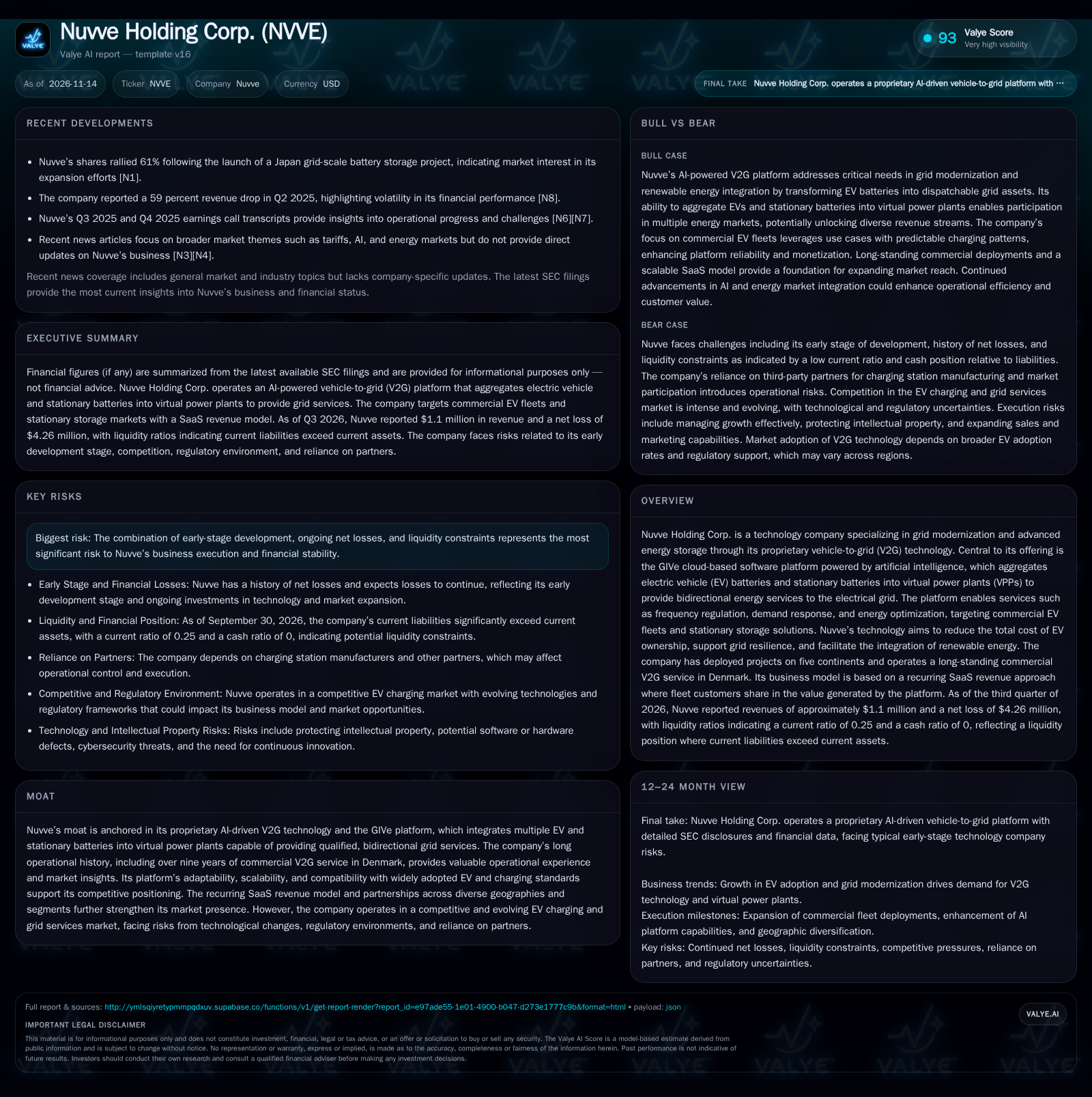
Nuvve's AI-driven vehicle-to-grid (V2G) platform aggregates EV and stationary batteries into virtual power plants offering grid services. Despite operational experience in Denmark and a SaaS model targeting commercial fleets, the company reported a $4.26M net loss and a current ratio of 0.25 for Q3 2026, underscoring severe liquidity pressures. The key question is whether Nuvve can scale V2G revenue and secure funding before market adoption and regulatory support materialize at scale. [S2]
Nuvve Holding Corp. stands at the intersection of electric vehicle fleet management and grid modernization, aiming to unlock new value streams through its AI-powered vehicle-to-grid (V2G) platform. By aggregating EV and stationary batteries into virtual power plants, Nuvve aspires to address grid balancing challenges and monetize distributed energy assets. The coming quarters will test whether the company can convert technical capability and early market traction into scalable, sustainable economics.
Liquidity Constraints and Commercial Progress Define Nuvve’s Present
Nuvve reported Q3 2026 revenue of $1,088,992 and a net loss of $4,259,672, reflecting continued operating losses typical of early-stage technology ventures. The company’s cash position was just $37,202, with current assets of $4.18M versus current liabilities of $16.94M, resulting in a current ratio of 0.25 and a cash ratio of 0. This means that Nuvve’s short-term obligations far exceed its liquid resources, highlighting acute liquidity stress. Against this financial backdrop, the company continues to operate its Denmark V2G fleet, which has generated an average of $2,600 per car per year in market revenue over more than nine years—demonstrating technical and commercial feasibility for its core platform. [S2]
How Nuvve’s Platform Could Monetize Grid Flexibility and EV Assets
Nuvve’s economics are built around a SaaS model that monetizes the aggregation of distributed EV and stationary battery assets for grid services. The company’s GIVe cloud platform enables fleet operators to participate in frequency regulation, demand response, and wholesale market bidding by leveraging the bidirectional flow of energy in EV batteries. Revenue is generated by sharing the value created from these grid services with commercial fleet customers, theoretically aligning incentives for both Nuvve and its clients.
The platform’s recurring revenue potential depends on several factors: the volume of EVs under management, the frequency and value of grid service participation, and the platform’s ability to optimize charge-discharge cycles. Fixed costs include continued investment in software development, AI/ML optimization, and support infrastructure; variable costs are tied to customer acquisition, integration, and ongoing operations. If Nuvve can scale deployments, operating leverage could drive improved margins, but current financials reveal negative operating leverage due to insufficient revenue scale and high fixed costs. Capital needs remain acute given the current liquidity profile, and future expansion will likely require additional external funding or strategic partnerships.
The monetization of grid flexibility through Nuvve’s platform hinges critically on the interplay between energy market dynamics and the technical capabilities of the AI optimization engine. The value extracted from frequency regulation or demand response depends on real-time grid conditions, market pricing volatility, and regulatory frameworks that determine compensation mechanisms. If these external factors evolve favorably, the platform’s ability to aggregate dispersed assets into a reliable virtual power plant could command premium pricing. Conversely, if market prices for grid services decline or regulatory incentives diminish, the revenue per vehicle could compress, undermining unit economics. Therefore, the scalability of Nuvve’s SaaS model is contingent not only on internal operational efficiency but also on external energy market trends and policy environments.
Competitive Moats and Counterforces in Vehicle-to-Grid Services
Nuvve’s competitive advantage centers on its proprietary, AI-driven GIVe platform and its operational history in Denmark, providing both technical credibility and market insight. The platform’s adaptability and scalability are positioned as strengths, aiming to accommodate a range of fleet types and evolving grid requirements. However, the market for EV charging and grid services is highly competitive, with established energy management firms, EV charging network operators, and utilities pursuing similar aggregation and optimization models.
Switching costs for fleet operators may be modest unless Nuvve can lock in customers through superior integration, proven value delivery, or long-term contracts. The key counterforces include rapid technological change, regulatory complexity, and the risk that larger, better-capitalized competitors could replicate or out-market Nuvve’s offerings. Reliance on third-party partners for charging hardware and market access introduces additional execution risk and potential for margin compression.
Nuvve’s competitive positioning must also be assessed in light of potential ecosystem shifts, such as the increasing integration of renewable energy sources and the electrification of commercial fleets. As more players enter the V2G space, differentiation may increasingly depend on proprietary AI algorithms’ effectiveness in maximizing revenue streams while minimizing battery degradation. Moreover, the company’s reliance on third-party hardware partners introduces a layer of vulnerability; if these partners fail to innovate or align strategically, Nuvve’s ability to offer seamless end-to-end solutions could be compromised. The evolving regulatory landscape adds further complexity, as compliance requirements and grid interconnection standards vary by jurisdiction, potentially raising barriers to entry or scaling. In this context, Nuvve’s ability to build robust partnerships and maintain technological leadership will be pivotal to sustaining its competitive moat.
Accelerated EV Fleet Adoption Unlocks Platform Scale
If commercial EV fleet adoption continues to accelerate and regulatory frameworks increasingly reward grid services provided by aggregated EV assets, Nuvve could see rapid growth in both customer base and grid market participation. The company’s long-term Denmark operation suggests technical viability and a working revenue model at the fleet level. Should Nuvve secure new partnerships or large fleet contracts—particularly in North America or Asia—recurring SaaS revenue could scale, improving operating leverage and potentially attracting further investment or strategic acquirers.
Confirmation of this scenario would require evidence of new, sizable deployments, rising customer counts, and meaningful revenue growth outpacing fixed cost expansion. Additional proof points would include the successful launch of new geographic markets, demonstrable increases in ARPU, and the signing of multi-year commercial agreements with major fleet operators or utilities.
Moderate Expansion Amid Ongoing Losses and Funding Needs
The most plausible near-term outcome is that Nuvve continues to expand its platform footprint incrementally, adding new fleets and modestly growing recurring revenue, but remains constrained by funding challenges and the slow pace of broad V2G adoption. Operating losses persist as the company invests in platform development, customer acquisition, and market education. Liquidity constraints may force Nuvve to seek additional financing, restructure obligations, or enter into deeper partnerships to ensure continuity.
This scenario would be confirmed by steady but unspectacular revenue growth, ongoing net losses, and regular capital-raising activity. A lack of major new deployments, slow ARPU growth, or delays in regulatory support would reinforce the view that scale and profitability remain several years away.
Liquidity Crisis or Market Stagnation Threatens Ongoing Operations
In an adverse scenario, Nuvve’s acute liquidity shortfall becomes unmanageable before the company can scale revenue or secure additional funding. If commercial fleet adoption of V2G remains tepid, regulatory incentives fail to materialize, or competitive pressures intensify, Nuvve could face operational retrenchment, asset sales, or even insolvency. Dependence on partners could exacerbate execution risk, particularly if hardware or integration issues disrupt customer deployments.
Falsifying this scenario would require clear evidence of near-term funding secured, a step-change in customer adoption, or significant cost reduction initiatives that materially extend the company’s financial runway. Conversely, any disclosure of missed payroll, deferred obligations, or the need for emergency financing would confirm heightened distress.
What Will Determine Whether Nuvve’s V2G Model Can Scale
Net new commercial fleet deployments, especially in North America and Asia, would help validate demand and platform scalability.
Quarterly revenue growth rates and the degree to which recurring SaaS revenue outpaces operating expenses—if disclosed—will reveal the path to operating leverage.
Updates on cash position, new financing, or strategic investment will be essential for assessing near-term viability.
Average revenue per vehicle and per customer, particularly outside Denmark, would help test the replicability of the Denmark model.
Evidence of multi-year commercial agreements or partnerships with major utilities or fleet operators would support recurring revenue visibility.
Expansion into new geographies and regulatory environments, and the company’s ability to secure market access or regulatory approval.
Customer retention and renewal rates—if disclosed—would provide insight into switching costs and platform stickiness.
Disclosures on partner dependencies, hardware integration challenges, or supply chain disruptions could signal execution risk.
Disclaimer: This is research-only, informational analysis and not investment advice. It may include AI-generated interpretation and general industry context. Always verify important details using primary sources.

Comments