
Health In Tech: AI-Enabled Insurance Platform Navigates Profitability Pressures and Market Expansion Ambitions
Health In Tech, Inc. leverages AI-driven underwriting to streamline self-funded health benefits and stop-loss insurance for employers, but faces profitability headwinds, Nasdaq listing risks, and dilution concerns as it seeks scalable growth in a complex, competitive market.
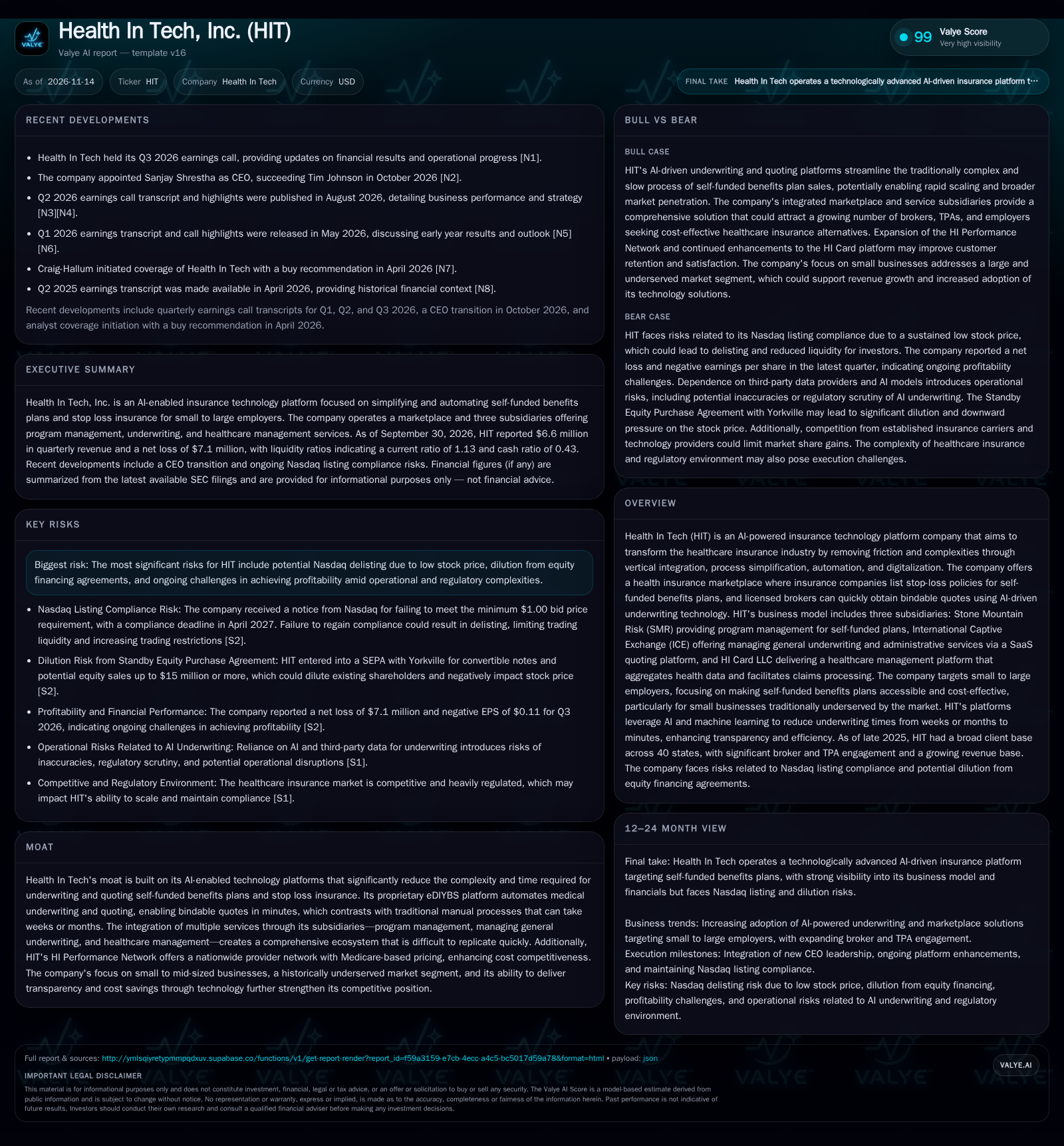
Health In Tech operates an AI-powered insurance marketplace targeting the self-funded health benefits space, reporting rapid revenue growth but also a significant net loss in its latest quarter. The company’s platform aims to democratize access for small businesses, but challenges include listing compliance, dilution from equity agreements, and the operational risks of AI-based underwriting. A recent CEO transition may signal a strategic pivot as HIT attempts to capture share in a large but competitive segment.
Health In Tech, Inc. sits at the intersection of AI innovation and insurance market disruption, promising to streamline the convoluted world of self-funded health benefits for employers. Its AI-powered marketplace and vertical integration aim to cut underwriting times from weeks to minutes, a potentially transformative value proposition for brokers, TPAs, and businesses, especially in the underserved small-employer segment. Yet, while revenue has soared, the company’s recent net loss, looming Nasdaq delisting risk, and prospective equity dilution underscore the operational and financial pressures that could shape its near-term trajectory.
Latest Operational Realities: Growth, Profitability, and Compliance Pressures
Health In Tech reported a 71% year-over-year revenue increase from 2024 to 2025 and generated $6.6 million in revenue in Q3 2026, but posted a net loss of $7.1 million and a negative EPS of -$0.11 for the same quarter [S1] [S2]. This juxtaposition of high growth and continued losses highlights a classic scaling dilemma in insurance technology: rapid topline expansion does not immediately translate to profitability, especially when investing in platform and market buildout.
The company’s stock price has remained below $1.00 for over 30 days, resulting in a Nasdaq compliance notice with a deadline for remediation by April 2027 [S2]. Delisting risk may affect investor confidence and capital access.
HIT entered a Standby Equity Purchase Agreement with Yorkville for up to $15 million in convertible notes and potential equity sales, raising the specter of shareholder dilution as the company seeks additional funding for its growth plans [S2].
Leadership has shifted, with Sanjay Shrestha appointed CEO in October 2026, a change that may influence strategic direction and operational focus during a pivotal period [N2].
Deconstructing HIT’s Revenue Model and Economic Leverage
Health In Tech’s core business model is built around a digital marketplace for self-funded health benefits and stop loss insurance, supported by three vertically integrated subsidiaries. Revenue is likely generated through a mix of platform fees, commissions or overrides on policies placed, and potentially SaaS fees for access to its quoting and healthcare management tools. However, the exact revenue composition and margin structure are not disclosed.
The company’s AI-powered eDIYBS platform dramatically reduces underwriting cycle time, with 80% of bindable quotes issued without manual intervention [S1]. This suggests a scalable, high-throughput model with the potential for lower variable labor costs relative to traditional underwriters. If HIT can drive higher volumes through its marketplace, fixed platform investments could yield operating leverage over time.
The need for continual investment in AI, compliance, and customer acquisition (brokers, TPAs, and employers) suggests a relatively high fixed cost base in the near term. The company’s negative net income and reported cash balance ($6.5 million as of September 30, 2026) highlight the importance of balancing growth investments with eventual margin capture [S2].
While vertical integration (program management, MGU, and healthcare management) could enable the company to capture more value per transaction and control the user experience, it also introduces complexity and may require additional working capital or regulatory capital depending on the risk retained.
Technology as Differentiator—But How Durable Are HIT’s Advantages?
HIT’s principal claim to differentiation is its AI-driven, rapid-quoting capability for self-funded plans and stop loss insurance, a sector historically plagued by manual processes and long sales cycles. By reducing quote turnaround from weeks to minutes, HIT may win share among brokers and TPAs seeking efficiency and improved client responsiveness.
The company’s broad network (HI Performance Network) and aggregation of health data via HI Card could help deepen employer and broker engagement, potentially improving retention or cross-sell opportunities. However, switching costs in insurance platforms can be modest if competitors match HIT’s technology or offer superior integration with established carriers.
Major counterforces include competition from traditional insurance carriers digitizing their own processes, insurtechs with similar automation ambitions, and regulatory scrutiny of AI-based underwriting. Large incumbents may have deeper relationships and the ability to bundle products, while smaller insurtech peers may compete aggressively on price or product innovation.
HIT’s focus on the underserved small business segment could be an advantage if it can efficiently acquire and serve these customers at scale. However, this segment is often cost-sensitive and may present higher churn if cost savings are not sustained or if regulatory complexity increases.
If AI-Driven Underwriting and Marketplace Network Effects Take Hold
The most favorable scenario for HIT is one in which its AI-enabled quoting and underwriting platform becomes the preferred channel for brokers and TPAs serving self-funded employers—particularly in the small business segment. As more brokers and TPAs adopt the platform, quoting volumes could rise, reinforcing the value of HIT’s data and improving AI model performance.
If HIT’s vertical integration leads to higher margins per policy and enables bundling of value-added services (e.g., claims management, data insights), the company could see both revenue and margin expansion. Network effects could emerge if the HI Card ecosystem becomes a default conduit for health data, claims, and provider access.
Evidence that would confirm this scenario includes: accelerating broker and TPA onboarding, increased policy volumes per broker or TPA, rising platform revenue per client, and positive operating leverage (declining expense ratio as a percentage of revenue). Sustained improvements in client retention and expansion of the HI Performance Network would also support the thesis.
Falsification would come from stalled network growth, inability to monetize new features, or competitive platforms outpacing HIT in product innovation or distribution reach.
Balancing Growth Ambitions with Capital and Profitability Constraints
The most plausible near-term outcome is that HIT continues to expand its broker and TPA footprint and grows topline revenue, but faces persistent pressure on profitability and capital needs. Revenue may rise as more small and mid-sized employers adopt self-funded plans through the platform, but customer acquisition costs and ongoing investment in technology, compliance, and network expansion could keep the company near break-even or in modest loss territory.
The company may draw on its Standby Equity Purchase Agreement to support operations and growth, at the cost of shareholder dilution and potential stock price pressure. The new CEO may prioritize operational efficiency and focus on converting broker and TPA relationships into recurring, higher-margin business.
Confirmation of this scenario would be steady, but not exponential, growth in platform users and revenue, stable or modestly improving gross margins, and controlled operating expense growth relative to revenue. Falsification would include a sharp reversal in client additions, escalating losses, or operational disruption from regulatory or technology failures.
When Scaling Costs, Capital Dilution, and Regulatory Friction Dominate
In a negative scenario, HIT’s aggressive expansion and platform investments fail to yield sufficient market share or operating leverage, while competitive or regulatory headwinds increase. If policy volumes do not scale as anticipated, or if brokers/TPAs revert to incumbents or alternative insurtechs, revenue growth could stall while fixed costs remain high.
Heavy reliance on external capital (via the SEPA) could lead to substantial dilution, further eroding shareholder value, especially if the company is unable to regain Nasdaq compliance and faces delisting. Regulatory scrutiny of AI underwriting or data practices could disrupt operations or require costly remediation.
Early warning signs would include deteriorating client retention, a sharp drop in broker/TPA engagement, negative gross margin trends, or evidence of adverse regulatory findings. Persistent net losses without a clear path to breakeven would further undermine the investment case.
Benchmarks to Gauge HIT’s Traction, Resilience, and Strategic Execution
Quarterly growth in bindable quotes issued and the proportion generated solely by AI—would help test adoption and automation leverage if disclosed.
Net policy volume growth per broker, TPA, and agency—provides insight into marketplace engagement and repeat usage.
Gross margin evolution and operating expense trends relative to revenue—critical for assessing operating leverage and the path to profitability.
Client retention and renewal rates among employers and brokers—would clarify whether the platform is driving sticky, recurring business if disclosed.
Dilution impact and actual draws under the Standby Equity Purchase Agreement—measures shareholder risk and funding trajectory.
Nasdaq compliance status and any material developments regarding listing or delisting risk—directly affects capital access and public market visibility.
Evidence of regulatory inquiries or changes to AI underwriting rules—could materially affect HIT’s cost structure or go-to-market strategy.
Updates on HI Card ecosystem usage and expansion of the HI Performance Network—would signal progress in value-added services and potential network effects.
Disclaimer: This is research-only, informational analysis and not investment advice. It may include AI-generated interpretation and general industry context. Always verify important details using primary sources.

Comments