
Columbus Circle Capital Corp II: SPAC Strategy, Execution Pressure, and the Elroy Air Inflection Point
Columbus Circle Capital Corp II’s $230 million trust, seasoned SPAC management, and pending Elroy Air deal frame both the opportunity and the time constraints of its blank-check model. The outcome now hinges on deal execution, dilution dynamics, and the ability to convert recent traction into a value-creating business combination.
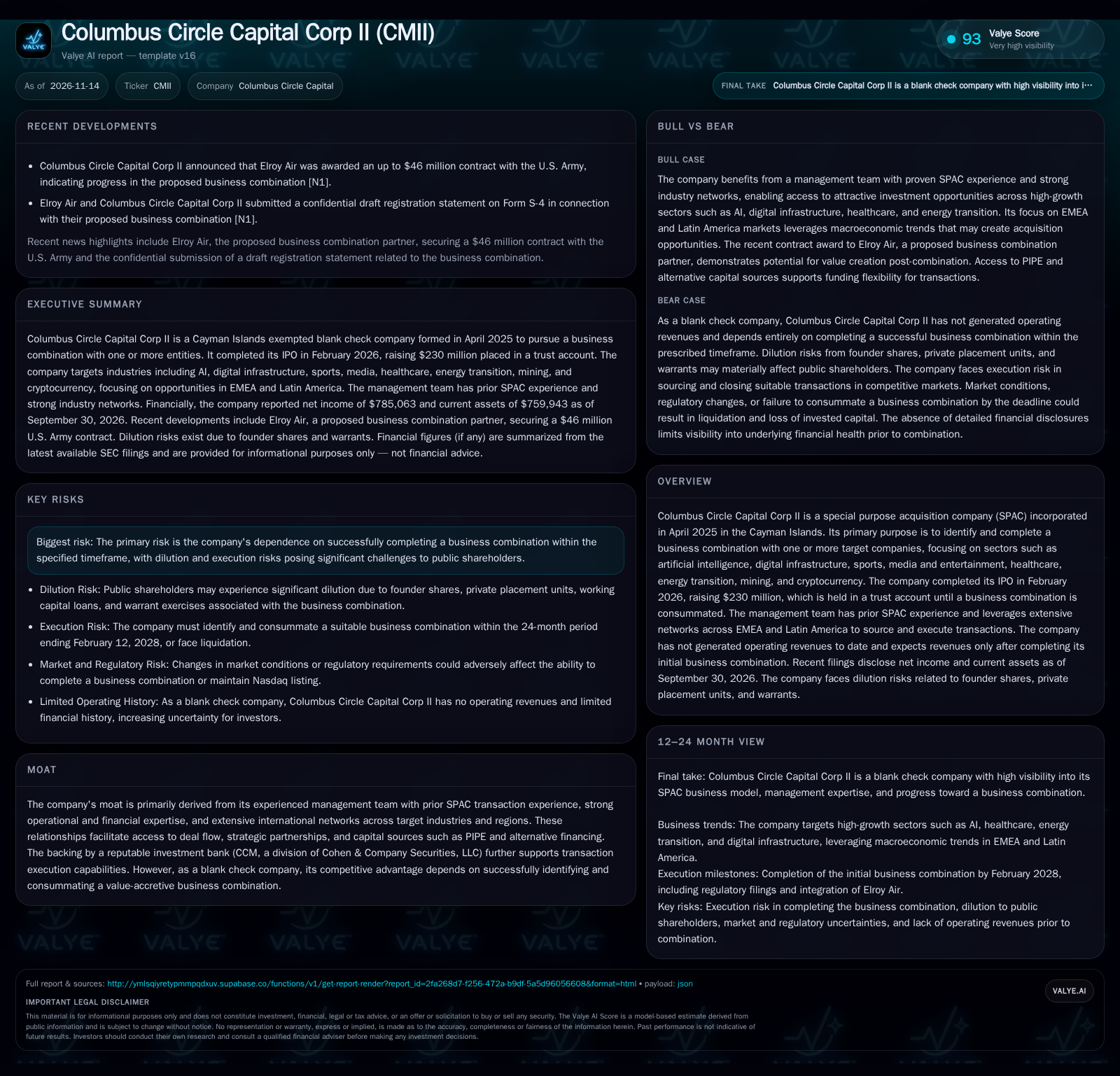
Columbus Circle Capital Corp II is a SPAC with $230 million in trust, an experienced management team, and a pending business combination with Elroy Air, which recently secured a $46 million U.S. Army contract. The company must complete a business combination by February 2028 or liquidate. Shareholder dilution and execution risks are material, with value realization dependent on successful deal closure and post-merger performance.[S2]
Columbus Circle Capital Corp II, a SPAC formed in April 2025, currently sits at a pivotal juncture. With $230 million in trust and a ticking clock to complete a business combination by February 2028, its fate is intertwined with the outcome of its proposed merger with Elroy Air—a target that just landed a $46 million U.S. Army contract. The company’s ability to deliver value to shareholders will hinge on execution: closing the deal, navigating dilution, and realizing the operational promise of its chosen partner in a competitive and time-sensitive SPAC landscape.
Recent Milestones and Immediate Decision Points
Columbus Circle Capital Corp II completed its IPO in February 2026, raising $230 million from the sale of 23 million units at $10 per unit, further supplemented by a $6.65 million private placement. These proceeds are held in a trust account, earmarked exclusively for a business combination.[S2]
The company’s pending merger with Elroy Air has gained visibility: Elroy Air was recently awarded a U.S. Army contract valued up to $46 million, potentially increasing the attractiveness and perceived credibility of the deal.[S2]
With a legal obligation to complete a business combination by February 12, 2028, Columbus Circle faces a hard deadline, after which it must liquidate and return trust funds if no transaction is finalized. This time constraint sharply focuses management’s priorities and compresses the window for deal execution.[S2]
How the SPAC Model Shapes Financial Outcomes
Columbus Circle Capital Corp II’s economics are dominated by the SPAC structure: the company generates no operating revenue until a business combination closes and its sole asset is the $230 million in trust.[S2] The trust is typically invested in short-duration government securities or money market funds, preserving capital but offering minimal return.
The primary value-creation mechanism is identifying an acquisition target that can deliver outsized growth or public market re-rating upon de-SPAC. If the Elroy Air merger closes, the combined entity’s economics will depend on Elroy’s ability to convert recent military contracts into scalable, recurring revenue streams.
Dilution is a central concern: founder shares, private placement units, and warrants will reduce the effective ownership of public shareholders post-combination. The degree of dilution depends on redemptions, deal structure, and the use of additional capital (such as PIPEs) to close the transaction.
Operating leverage for the post-combination entity will be driven by the target’s cost structure and capital intensity. For capital-heavy sectors like aerospace or digital infrastructure, significant follow-on investment may be needed, potentially pressuring near-term margins and requiring further capital access.
Deal Sourcing, Differentiation, and the SPAC Field
Columbus Circle’s competitive positioning rests on its management’s prior SPAC experience and access to a global deal sourcing network, particularly in EMEA and Latin America. This breadth may allow it to identify targets overlooked by U.S.-centric peers.
However, the broader SPAC market remains crowded, with many blank-check companies chasing a limited pool of high-quality targets. This competition can inflate valuations, reduce negotiating leverage, or force SPACs to pivot toward riskier or less mature companies.
The recent Elroy Air contract win provides a potential differentiator: few SPAC targets have secured sizable government contracts before closing. However, the true test will be whether Elroy can convert this validation into a durable commercial platform, and whether Columbus Circle can close the transaction before competitors or market volatility intervene.
Alternative funding sources—such as PIPE investments—may help Columbus Circle bridge valuation gaps or reduce redemption risk. However, PIPE investors often demand favorable terms, adding another layer of complexity to deal structuring.
If Elroy Air Delivers: Unlocking Value Through Execution and Scale
In a favorable scenario, Columbus Circle Capital closes its business combination with Elroy Air in a timely manner. The $46 million U.S. Army contract acts as a catalyst, demonstrating product-market fit and unlocking further government or commercial contracts.
If Elroy Air successfully scales operations, leverages its defense relationships, and demonstrates recurring revenue growth, the newly public entity could command a premium valuation. The SPAC shareholders—despite dilution—may still benefit from the re-rating and growth trajectory.
Evidence that would confirm this scenario includes: rapid contract execution by Elroy Air, follow-on customer wins, minimal redemptions during the de-SPAC process, and positive post-merger trading performance. Additional PIPE investment on favorable terms would further validate the market’s confidence.
A Realistic Trajectory: Navigating Dilution and Execution Risk
The most plausible path is that Columbus Circle closes a business combination—likely with Elroy Air—within the regulatory window, but faces significant shareholder redemptions and dilution from founder shares, private placements, and warrants.
Elroy Air, as the operating company, may require additional capital to fulfill its contract backlog and scale, pressuring near-term margins and raising the need for PIPE or follow-on financing. The combined entity’s public market valuation may be modest, reflecting execution and integration risk.
Confirmation of this scenario would include: announcement of a finalized business combination, SEC effectiveness of the S-4 registration statement, notable but not overwhelming redemptions, and a period of post-merger volatility as the market digests dilution and Elroy Air’s early financial performance.
Deal Failure or Redemptions Trigger Liquidation Risk
In a negative outcome, Columbus Circle fails to close a business combination by February 2028, either due to regulatory delays, inability to secure PIPE financing, or excessive shareholder redemptions that leave insufficient cash for the merger.
Alternatively, even if the Elroy Air deal closes, a failure to convert the Army contract into broader commercial traction—or operational missteps—could lead to weak post-merger trading and further capital needs, diluting shareholders further or eroding value.
Downside evidence would include: protracted delays in S-4 effectiveness, public signals of insufficient PIPE or capital commitments, high redemption rates approaching trust levels, or outright announcement of liquidation and trust fund return.
Milestones That Will Define Columbus Circle Capital’s Outcome
Progress on the SEC review and effectiveness of the S-4 registration statement for the Elroy Air business combination.
Level of shareholder redemptions at the time of the de-SPAC vote; a useful metric would be the pro forma cash retained versus trust value.
Securing PIPE or alternative capital commitments on terms that support, rather than overly dilute, existing public shareholders.
Elroy Air’s ability to execute and recognize revenue from the U.S. Army contract within expected timelines.
New customer wins or contract announcements by Elroy Air prior to or soon after the business combination.
Clarity on the post-merger capital structure—including founder, PIPE, and public shareholder ownership—once final deal terms are disclosed.
Any changes to the SPAC’s combination deadline, extension proposals, or signals of liquidation risk.
Disclaimer: This is research-only, informational analysis and not investment advice. It may include AI-generated interpretation and general industry context. Always verify important details using primary sources.

Comments