
American Exceptionalism Acquisition Corp. A: SPAC Liquidity and Execution Dynamics Ahead of a Potential Business Combination
AEXA sits at a critical juncture as a blank-check company: notable sponsorship and positive trust interest income offset a zero-cash, subpar-liquidity profile, with the SPAC’s value proposition hinging entirely on its ability to secure and close a viable merger before deadlines and market conditions shift.
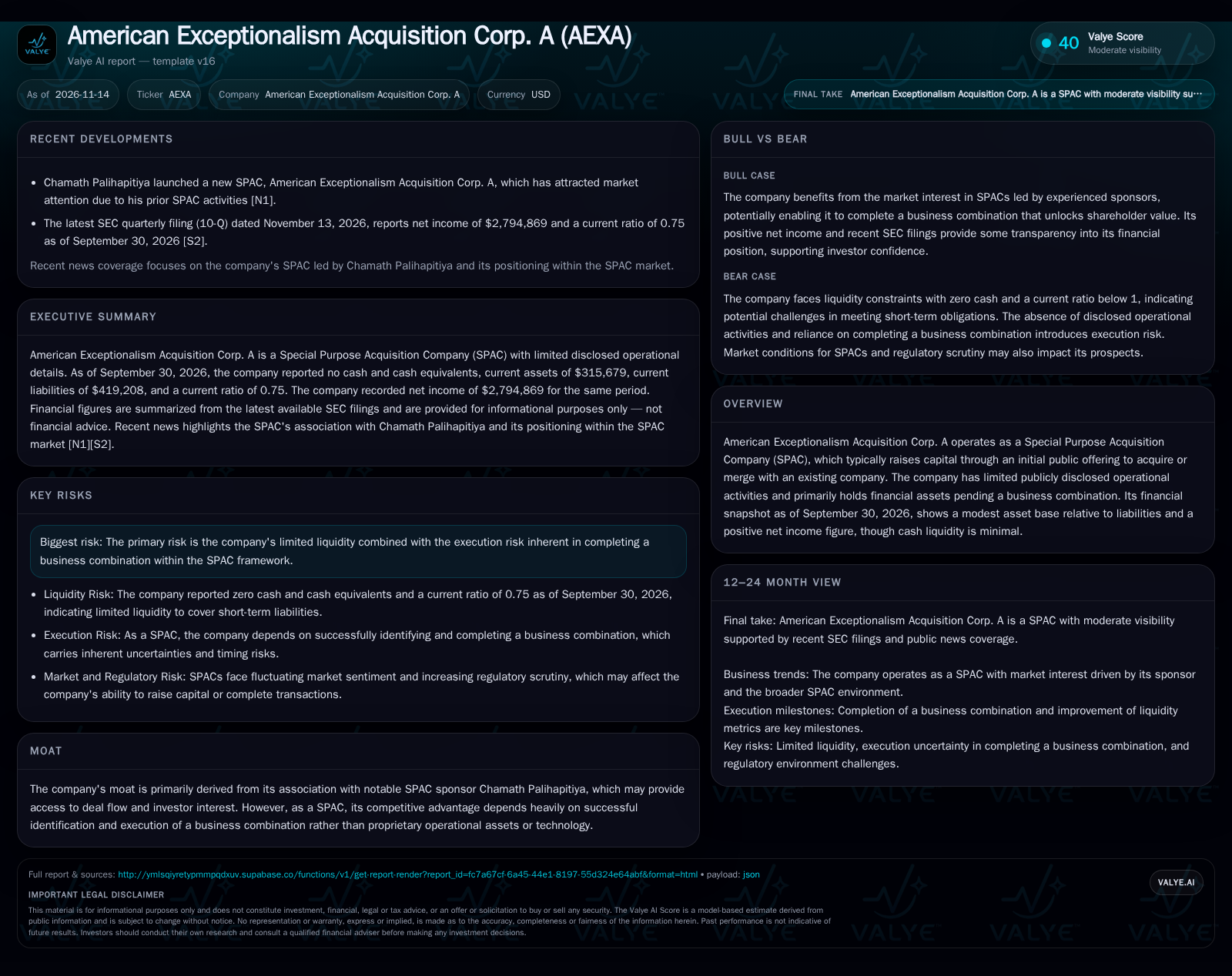
American Exceptionalism Acquisition Corp. A (AEXA) is a SPAC with no operating activities to date, zero cash on hand, and a current ratio of 0.75 as of September 30, 2026. Its net income reflects trust account interest, not business operations, and its future depends wholly on completing a business combination within regulatory and market constraints. [S2]
American Exceptionalism Acquisition Corp. A (AEXA) exemplifies the binary risk/reward profile of SPACs in a tightening regulatory and capital environment. Despite a headline net income for Q3 2026, the company’s financials reveal a complete absence of cash and a current ratio well below 1.0—an unusual situation for a SPAC still seeking a deal. With no operating revenues or target identified, the company’s trust account remains its only real asset, generating interest income but offering no cushion for operational expenses. The ultimate outcome for investors now hinges on whether AEXA’s sponsor, leveraging their reputation and networks, can source and close a value-creating merger before time and liquidity run out. [S2]
Financial Snapshot: Trust Interest, Zero Cash, and No Target in Sight
As of September 30, 2026, AEXA reported current assets of $315,679, current liabilities of $419,208, and zero cash or cash equivalents, for a current ratio of 0.75 and a cash ratio of 0. The company posted net income of $2,794,869 for the quarter, entirely from interest income on trust account securities. Critically, AEXA has not entered into any discussions with potential business combination targets and has no revenue-generating operations. The company reported cash and liquidity metrics for the period; these figures do not by themselves establish operating runway, investment capacity, financial flexibility, or financing capacity. [S2]
SPAC Economics: Trust Account Yield Versus Operating Burn
AEXA’s economics are typical of a SPAC in pre-deal limbo: the trust account, originally capitalized at $345 million from the IPO and private placement, earns interest (recently a material contributor to net income) but cannot be used for general operating expenses until a business combination closes. Day-to-day costs—legal, audit, regulatory, diligence—must be funded by sponsor loans or working capital outside the trust. With zero cash and a negative working capital position, the company must rely on sponsor support or additional financing for ongoing expenses.
The fixed costs of compliance and deal search are largely non-deferrable, while potential upside is entirely back-loaded and binary: success is realized only upon closing a favorable business combination. The trust account provides a notional asset base, but without a deal, those funds are ultimately returned to shareholders less expenses. This structure creates a high degree of operating leverage—if a deal is completed, sponsors and public shareholders can participate in substantial upside; if not, the sponsor’s investment and operating advances may be lost.
The interplay between the trust account yield and operating burn rate is a critical dynamic that shapes the SPAC's runway and strategic options. Since the trust funds are restricted and cannot be tapped for operational costs, the sponsor's willingness and capacity to provide bridge financing become pivotal. This dependency introduces a conditional risk: if the sponsor faces capital constraints or shifts focus to other ventures, the SPAC may struggle to sustain necessary expenses such as legal and advisory fees, thereby accelerating the timeline pressure. Moreover, the interest income generated by the trust account, while beneficial, is inherently limited by prevailing market rates and the size of the trust, and thus cannot offset significant operational outlays or compensate for delays in deal closure.
Another layer of complexity arises from the timing and structure of potential business combinations. The economics of SPACs inherently favor deals that can be consummated before the trust account's mandated liquidation date; delays not only erode the sponsor's capital but also increase the risk of shareholder redemptions, which can dilute deal economics or reduce available capital post-merger. This temporal constraint forces sponsors to balance thorough due diligence and negotiation against the ticking clock of regulatory deadlines. Consequently, the economics of deal sourcing and execution are not only a function of target quality but also of timing efficiency and market receptivity, making the SPAC's economics highly sensitive to external conditions beyond the sponsor's direct control.
Reputational Edge and SPAC Market Crowding
AEXA’s most significant potential advantage is its association with Chamath Palihapitiya, whose prior SPACs and network may help attract higher-quality targets or secure better deal terms. In a market crowded with blank-check companies, sponsor reputation and perceived deal-making ability are increasingly critical differentiators. However, the SPAC landscape has become saturated, with regulatory scrutiny rising and investor enthusiasm for pre-deal SPACs waning since 2021. Many SPACs now compete for the same pool of viable targets, driving up valuations and shrinking the universe of attractive merger candidates.
Without a deal in hand or a sector focus that provides a unique sourcing advantage, AEXA’s competitive edge is reputational rather than operational or structural. If the sponsor can leverage its network to identify an undervalued or high-growth target, AEXA could outperform peers. Conversely, if market conditions deteriorate or regulatory burdens increase, even strong sponsorship may not be enough to secure a value-creating transaction.
Catalyst: High-Quality Target and Favorable Deal Structure
In the best-case scenario, AEXA’s sponsor leverages its network to identify a compelling private company seeking public capital, negotiating favorable terms that create value for both shareholders and the target. A successful merger would unlock the trust account for use in the transaction, potentially deliver immediate market re-rating, and provide the new entity with growth capital. Confirmation of this scenario would require disclosure of a signed letter of intent (LOI), a definitive merger agreement, and market reaction indicating strong redemption rates and post-deal trading performance.
Falsification would be evident if, after announcement, the market reacts negatively, redemptions are high, or the transaction structure is dilutive or fails to attract institutional support.
Most Likely Trajectory: Prolonged Search, Rising Costs, and Uncertain Outcome
The most plausible path for AEXA involves a prolonged search for a target, with ongoing administrative and regulatory costs eroding the non-trust asset base. Sponsor loans or advances may be needed to cover operating shortfalls, increasing the sponsor’s at-risk capital. If a deal is eventually found, it may be in a competitive or less-attractive sector, with the risk that macro conditions or regulatory delays reduce the transaction’s value or feasibility. Confirmation of this scenario would include further SEC filings showing continued negative working capital, additional sponsor loans, or extensions of the SPAC’s deadline to complete a merger.
Falsification would be a sudden announcement of a high-quality deal or a liquidation event if no target is found.
Failure to Close a Deal: Liquidation and Sponsor Losses
The adverse scenario is that AEXA fails to identify or close a business combination before its deadline, resulting in the mandatory liquidation of the trust account. In this case, public shareholders receive their pro rata share of the trust, but sponsors lose their at-risk capital (including private placement shares and any loans made to fund operations). This outcome is increasingly common in a crowded SPAC market, especially for vehicles with limited cash and no identified targets.
This scenario would be confirmed by continued lack of target identification, mounting operating liabilities, or a liquidation notice filed with the SEC.
Milestones That Will Determine AEXA’s Value Creation Potential
Disclosure of a signed LOI or definitive agreement with a business combination target would be a pivotal milestone.
Updates on sponsor loans, working capital infusions, or amendments to the SPAC’s timeline would clarify ongoing liquidity and sponsor commitment.
If disclosed, the quality, sector, and growth prospects of any proposed target company would help assess the likelihood of post-merger value creation.
Redemption rates at the time of merger approval would indicate shareholder confidence and trust account utilization.
Changes in the regulatory environment for SPACs or shifts in redemption/extension rules would affect the feasibility of completing a deal.
A useful metric would be the company’s remaining time to complete a business combination before mandatory liquidation.
Watch for any restatements or adverse audit findings that could impact trust account integrity or delay deal execution.
Disclaimer: This is research-only, informational analysis and not investment advice. It may include AI-generated interpretation and general industry context. Always verify important details using primary sources.

Comments