
QDRO Acquisition Corp.: SPAC Liquidity, Execution Risk, and the Search for a Transformative Deal
The path ahead will be defined by the quality and timing of its initial acquisition, against a backdrop of unchanged risk factors and a crowded SPAC landscape.
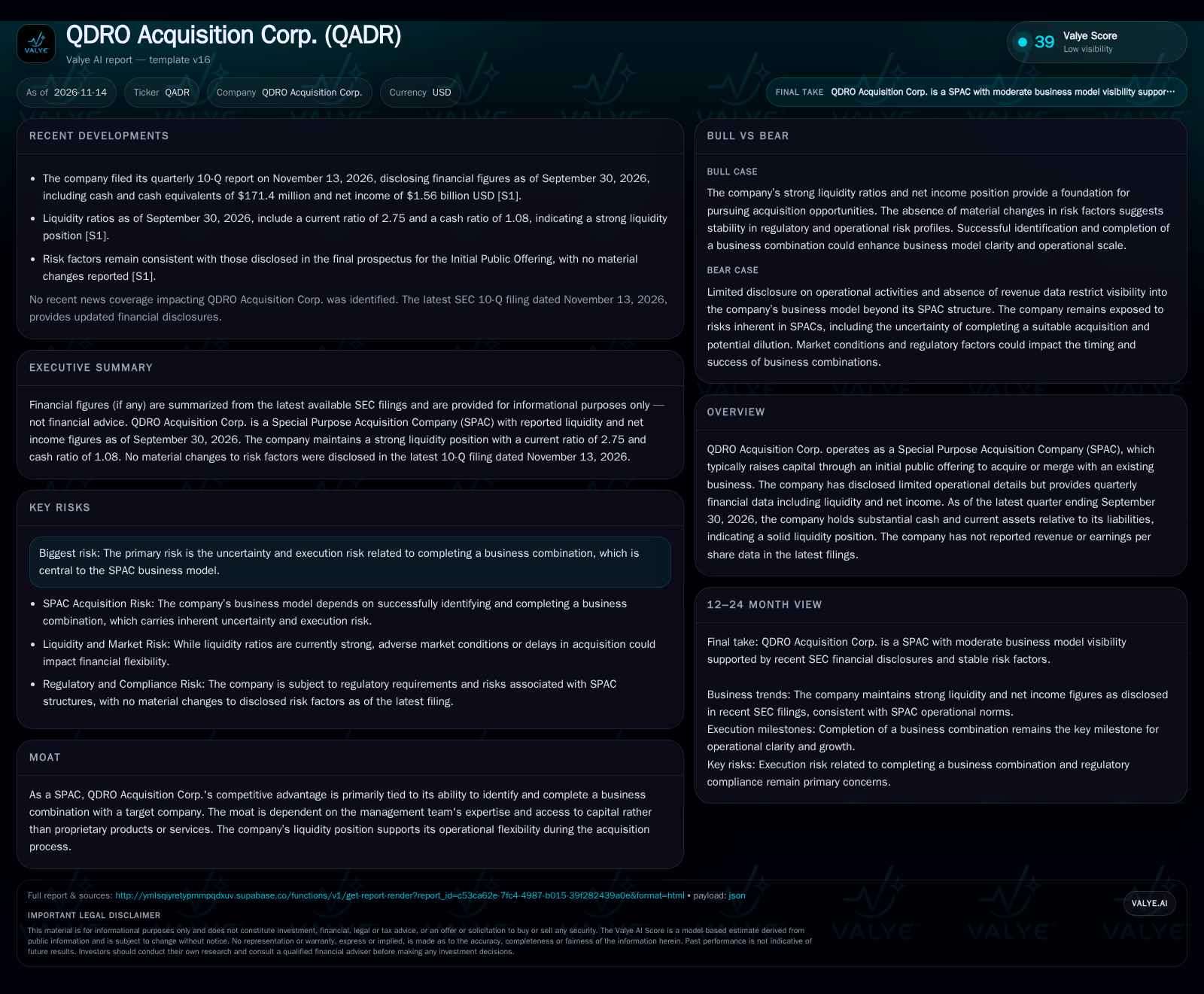
QDRO Acquisition Corp. reports $171.4 million in cash and a current ratio of 2.75 as of September 30, 2026, supporting its SPAC mandate to identify and merge with a target business. Net income is driven by interest income rather than operations, and no business combination has been announced. The company’s ability to create value hinges on deal execution and market conditions, with no material risk-factor changes reported in its latest filings. [S1]
QDRO Acquisition Corp. exemplifies the current state of many post-IPO SPACs: flush with cash, structurally sound on paper, yet awaiting the pivotal business combination that will define its future. While recent filings show a reported liquidity position and net income driven by interest on trust assets, the absence of revenue and operational specifics underscores the binary nature of SPAC investing. The main question for QDRO is not whether it can keep the lights on, but whether it can source a deal that justifies its existence and satisfies investors before the clock runs out.
Liquidity, Income, and the Waiting Game: QDRO’s Current State
As of September 30, 2026, QDRO Acquisition Corp. reported $171.4 million in cash and cash equivalents, current assets of $438.95 million, and current liabilities of $159.38 million, resulting in a current ratio of 2.75 and a cash ratio of 1.08. These figures indicate a reported liquidity position, typical for a SPAC in its pre-acquisition phase. Net income for the quarter was $1.56 million, driven entirely by interest income from trust investments rather than operating activities. No revenues have been reported, and the company’s risk disclosures remain unchanged since its IPO, signaling no new operational or regulatory threats as of the latest filing. The absence of a reported business combination means all strategic value is still prospective, and the company remains in the pre-operational phase. [S1]
How SPAC Economics Shape QDRO’s Value Proposition
SPACs like QDRO Acquisition Corp. are structured as vehicles to raise capital, park it in trust, and seek a business combination—typically within 18 to 24 months of their IPO. Until a deal is completed, income is generated from low-risk investments (such as U.S. Treasuries), and operating expenses are limited to administrative and due diligence costs. The current net income is a function of interest rates and asset balances, not business activity. Upon a successful merger, the economics shift dramatically: the combined entity assumes QDRO’s cash (less redemptions and expenses), while QDRO’s shareholders may face dilution from sponsor shares, warrants, and PIPE financings. The value realization for public shareholders depends on the quality of the target, deal structure, and post-merger execution. If a business combination is not consummated within the specified timeframe, the SPAC must return funds to shareholders, typically at the IPO price plus interest, minus expenses.
The timing of a business combination is critical to SPAC economics, as the limited window for deal completion imposes significant pressure on management teams. If market conditions deteriorate or investor sentiment shifts negatively during this period, the cost of capital and valuation multiples for potential targets may compress, adversely impacting the attractiveness of merger opportunities. Additionally, the structure of the deal often involves complex negotiations around sponsor promote, PIPE financing, and shareholder redemptions, each of which can dilute or enhance shareholder value depending on execution. The interplay between these factors means that even a high-quality target may fail to deliver expected returns if deal terms or market reception are unfavorable.
SPACs in a Crowded Field: Competitive Levers and Limitations
QDRO’s competitive position is defined less by traditional moats or product advantages and more by its ability to source and close an attractive business combination ahead of rival SPACs. The company reported cash and liquidity metrics for the period; these figures do not by themselves establish operating runway, investment capacity, financial flexibility, or financing capacity. Sponsor reputation, deal-sourcing networks, and sector focus (if any) are critical, but no specifics have been disclosed. The company’s future competitive profile will be determined by the quality of its eventual target and the terms of the deal. Until then, QDRO’s only tangible advantage is its cash and the certainty it can provide to a prospective merger partner.
In a crowded SPAC environment, differentiation often hinges on the management team's sector expertise and network access, which can influence deal sourcing and due diligence quality. Absent disclosed sector focus or strategic partnerships, a SPAC may face challenges in competing for premium targets, especially when competing SPACs or strategic acquirers are active in the same space. Moreover, the reputational capital of sponsors can affect the willingness of private companies to engage in merger discussions, as well as investor confidence post-announcement. Therefore, while cash reserves provide a baseline competitive advantage, the intangible assets of relationships and credibility are equally pivotal in securing a transformative transaction.
Transformative Acquisition as a Catalyst for Shareholder Value
The most favorable scenario for QDRO would be the identification and successful merger with a high-growth, scalable business in a sector with strong public-market demand. In this scenario, QDRO deploys its capital efficiently, minimizes redemptions, and delivers a platform with clear operational visibility and upside for public investors. Confirmation would come from a definitive merger announcement with a credible target, positive investor reaction, limited redemption rates, and clear post-merger guidance from the new operating entity. Falsification would be signaled by delays, failed negotiations, or a deal with a low-quality or distressed asset. The main catalyst is the announcement of a business combination with compelling growth prospects and a credible management team.
A Waiting Period of Diminishing Options and Rising Pressure
The most probable path is that QDRO continues its search, incurring administrative costs and earning interest income, while the window for a deal gradually narrows. As time passes, competitive pressure may force QDRO to consider less attractive targets or to offer more investor-friendly terms to minimize redemptions. Confirmation of this scenario would be continued quarterly filings with similar financials and no material business combination news. A shift into active negotiations, a letter of intent, or the announcement of a definitive agreement would mark a transition out of this holding pattern. Falsification would be an unexpected early deal or a sharp change in risk disclosures indicating operational stress or regulatory complications.
Deal Failure, Redemption Risk, and SPAC Wind-Down
If QDRO fails to identify or close a business combination within the required timeframe, it will be forced to liquidate and return funds to shareholders, less expenses. This scenario could be triggered by deteriorating market conditions, a lack of attractive targets, or regulatory headwinds. Confirmation would come from proxy statements regarding liquidation, extension votes, or filings indicating the return of capital. Elevated redemption rates upon deal announcement, a poor-quality target, or shareholder resistance could also drive value erosion. In extreme cases, the cost of maintaining the SPAC and sponsor dilution could leave public shareholders with subpar returns relative to the initial investment.
The risk of elevated redemptions upon deal announcement can create a feedback loop that undermines deal viability. High redemption rates reduce the cash available to the combined entity, potentially forcing the SPAC to seek additional financing on less favorable terms or to scale back the transaction. This dynamic increases uncertainty for all stakeholders and may depress post-merger equity value. Furthermore, regulatory scrutiny or evolving legal frameworks governing SPAC transactions could introduce delays or additional compliance costs, exacerbating execution risk. If sponsors are compelled to extend timelines or restructure incentives to salvage a deal, these actions may signal distress and negatively influence investor sentiment.
Milestones and Metrics That Will Define QDRO’s SPAC Journey
Announced letter of intent or definitive agreement for a business combination: This would provide the first evidence of target identification and deal progress.
Redemption rates upon deal announcement (if disclosed): High redemptions would signal weak investor confidence in the proposed target.
Changes in risk factors or new material disclosures in SEC filings: Any shift could indicate operational, legal, or regulatory developments impacting deal prospects.
Quarterly cash balance trends: A rapid decline could signal rising administrative or due diligence expenses.
Shareholder extension votes or proxy filings: These would indicate timeline pressures or the need for more time to consummate a deal.
PIPE (private investment in public equity) financing terms and participation (if disclosed): Strong PIPE support may validate the quality of an announced target.
Sponsor actions such as additional capital contributions or warrant restructuring: May indicate deal urgency or attempts to align incentives for closing.
Disclaimer: This is research-only, informational analysis and not investment advice. It may include AI-generated interpretation and general industry context. Always verify important details using primary sources.

Comments