
Farmers & Merchants Bancshares: Core Banking Strengths and Profitability Amid Limited Disclosure
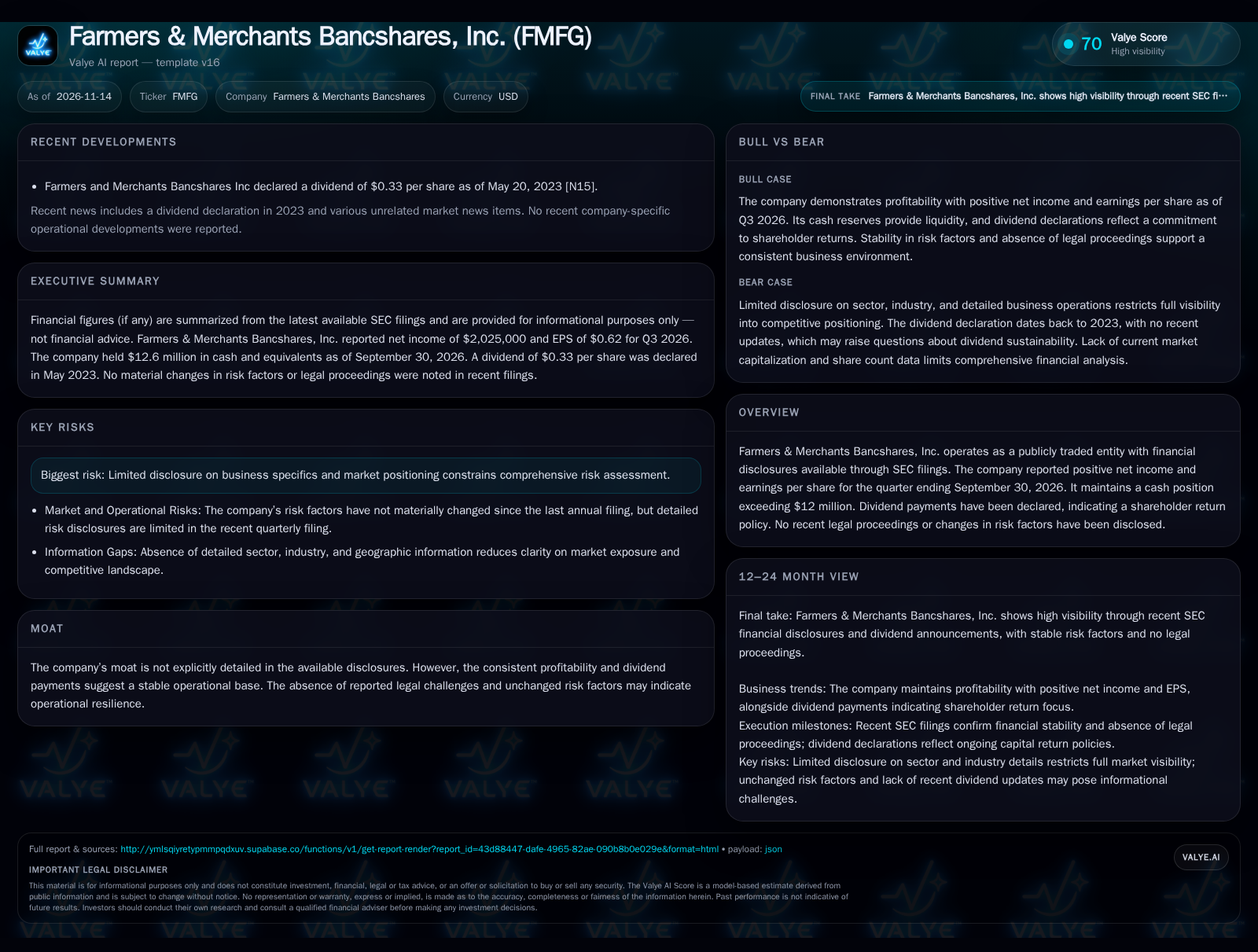
Farmers & Merchants Bancshares, Inc. reported $2.03 million in net income for Q3 2026 on $0.62 EPS, with $12.6 million in cash as of September 30, 2026. While profitability and a stable risk profile are evident, sparse disclosure regarding business lines, sector exposure, and competitive context leaves the underlying drivers—and potential vulnerabilities—open to interpretation.
Farmers & Merchants Bancshares posted positive Q3 2026 earnings and maintains over $12 million in cash, but limited transparency on its business mix and market positioning makes it challenging to assess long-term competitive dynamics or risk exposure. Investors must focus on core banking economics and seek clarity on growth drivers to fully evaluate its trajectory. [S2]
Farmers & Merchants Bancshares, Inc. (FMFG) stands out for its continued profitability, with $2.03 million in net income and $0.62 EPS reported for the third quarter of 2026, alongside a cash balance exceeding $12 million as of September 30, 2026. The lack of legal or risk-factor developments points to operational steadiness, yet the company’s limited disclosure on business lines, customer segments, or geographic reach creates opacity around its true economic drivers. Understanding the mechanisms behind its earnings and the sustainability of its model requires a closer look at traditional banking economics—and a watchful eye on factors not yet detailed in public filings. [S2]
Earnings Update, Liquidity Status, and Transparency Challenges
Farmers & Merchants Bancshares reported net income of $2,025,000 for the third quarter of 2026, with both basic and diluted EPS at $0.62. As of September 30, 2026, the company held $12,618,694 in cash and cash equivalents. No material changes in risk factors or legal proceedings were disclosed in the latest 10-Q filing. These data points demonstrate ongoing profitability and operational stability. However, the absence of detailed sector, product, or regional breakdowns leaves the composition of earnings and potential concentration risks ambiguous. [S2]
The company’s financial reporting cadence and absence of new risk disclosures support a narrative of business-as-usual, but the lack of visibility into business mix, customer base, or market share means that investors must rely on broader industry frameworks to interpret the sustainability and resilience of reported profits.
Examining Core Banking Economics and Potential Leverage Points
In the absence of detailed disclosures, Farmers & Merchants Bancshares likely derives the bulk of its income from traditional community banking activities: net interest income from lending and deposit-taking, augmented by fee-based services if present. The company’s recurring profitability suggests that its interest-rate spread—the difference between yields on loans/investments and the cost of deposits—remains positive. However, the durability of this spread depends on local economic conditions, competitive deposit pricing, and asset quality.
Operating leverage in community banks typically arises from the scalability of branch infrastructure and technology platforms. Fixed costs such as personnel, compliance, and facilities can be leveraged if deposit growth and loan origination outpace expense inflation. Conversely, rising funding costs or credit losses may quickly erode margins. If the bank is exposed to commercial real estate, agriculture, or other cyclical sectors, those exposures would materially affect future earnings volatility.
The interplay between interest rate cycles and loan portfolio composition is critical in shaping net interest income stability. If the bank predominantly holds fixed-rate loans, rising market rates could compress margins unless deposit costs adjust correspondingly. Conversely, a portfolio weighted toward variable-rate loans may benefit from rate hikes but face heightened credit risk if borrowers struggle with increased payments. Additionally, the bank's capacity to reprice deposits swiftly or attract low-cost funding sources can mitigate margin pressure. Understanding the duration and repricing gaps within assets and liabilities would illuminate sensitivity to interest rate fluctuations and the potential for earnings volatility.
Another leverage point lies in fee income diversification, which can buffer earnings against interest margin compression. While community banks traditionally generate modest noninterest income, expanding services such as wealth management, payment processing, or loan servicing fees could enhance revenue resilience. However, these initiatives require investment and operational capabilities that may not scale easily. The bank’s ability to cross-sell fee-based products to an established customer base could improve profitability without proportionally increasing risk. Conversely, overreliance on volatile fee streams or one-time gains could introduce earnings unpredictability, underscoring the importance of balanced revenue sources.
Community Banking: Structural Strengths and Competitive Pressures
Farmers & Merchants Bancshares likely operates within the traditional community or regional banking segment, where customer relationships, local market knowledge, and service quality can provide defensible advantages. A long-standing presence and established trust often translate into sticky deposits and repeat lending relationships, creating inertia against customer churn.
However, the bank faces structural headwinds shared by peers: fintech entrants offering higher-yield deposits or more convenient digital services, consolidation among larger banks that can outspend on technology, and potential regulatory tightening. Without information on Farmers & Merchants’ product innovation, digital adoption, or niche focus, it is unclear whether the company can maintain or expand its market share against these evolving threats. The absence of legal or regulatory issues is a positive, but not a moat in itself. Over time, margin compression and customer attrition are plausible if the bank does not invest in digital transformation or defend its local franchise.
Growth Opportunities from Lending Expansion and Digital Transformation
A favorable scenario would see Farmers & Merchants leverage its existing customer relationships to expand lending—potentially in underserved local markets or niche sectors. If the bank can grow its loan book without sacrificing underwriting standards, and if funding costs remain contained, net interest income could rise faster than expenses, driving meaningful operating leverage.
Additional upside could arise from investments in technology platforms that lower customer acquisition costs, improve retention, or enable new fee-based products. Confirmation of this scenario would require disclosure of sustained loan growth, improving efficiency ratios, or evidence of digital service adoption (such as mobile app usage or online account openings). Announcements of new product launches, partnerships, or entry into higher-growth geographies would further support the upside case. Conversely, stagnation in interest income, rising nonperforming loans, or lack of investment in digital capabilities would weaken this scenario.
Maintaining Performance with Controlled Growth and Margin Focus
The most plausible trajectory, given current disclosures, is continued modest profitability rooted in traditional banking activities. Farmers & Merchants may grow incrementally by deepening relationships with existing customers, maintaining disciplined expense control, and prudently managing credit risk. Earnings could track local economic conditions and interest-rate trends, with limited room for outsized gains or losses barring external shocks.
Evidence confirming this scenario would include stable or slightly growing net interest income, steady efficiency ratios, low levels of nonperforming assets, and consistent dividend payments if declared. Falsifying evidence would be a sudden spike in credit losses, sharp compression in net interest margins, or regulatory findings that reveal hidden operational risks.
Risks from Margin Erosion, Credit Quality, and Market Disruptions
A negative scenario would unfold if Farmers & Merchants faces rising funding costs (due to competitive deposit pricing or higher market rates) while demand for loans weakens or credit quality deteriorates. This twin pressure could compress net interest margins and erode profitability. Additional risk could stem from asset concentration—such as heavy exposure to commercial real estate or a specific sector—if local economic conditions sour.
Adverse developments might also include regulatory changes increasing compliance costs, cyber incidents affecting operations, or customer migration to digital-first competitors. Evidence supporting this scenario would be declining net interest income, rising provisions for loan losses, or a notable drop in earnings per share. A material outflow of deposits or negative regulatory findings would further confirm downside risks.
Factors Influencing the Bank’s Earnings Sustainability and Resilience
Disclosure of loan portfolio composition and credit quality metrics would help assess asset concentration risk and potential credit losses.
Net interest margin trends, if reported, would clarify the sustainability of core earnings in changing rate environments.
Updates on deposit growth, mix, and cost would indicate funding stability and competitive positioning.
Efficiency ratio and noninterest expense trends would provide insight into operating leverage and cost discipline.
Evidence of digital banking adoption (mobile/online service penetration, technology investments) would signal adaptability to industry shifts.
Any reported changes in regulatory status, risk factors, or legal proceedings would serve as early warnings of emerging vulnerabilities.
A useful metric would be customer retention rates or new account growth, if disclosed, to track franchise vitality.
Disclaimer: This is research-only, informational analysis and not investment advice. It may include AI-generated interpretation and general industry context. Always verify important details using primary sources.

Comments