
AtlasClear’s Fintech Ambitions Confront Execution Hurdles After NYSE Suspension
AtlasClear Holdings seeks to disrupt legacy clearing and banking with a modern, API-driven B2B fintech platform, but faces acute visibility and funding headwinds following its NYSE delisting and must navigate complex acquisition integrations to realize its potential.
AtlasClear Holdings targets underserved financial services firms with an integrated fintech platform for trading, clearing, and banking. The company’s ability to scale hinges on successful deal closures and platform adoption among smaller financial institutions.
AtlasClear Holdings, Inc. is positioning itself as a next-generation fintech provider for small- and mid-sized financial services firms, aiming to automate and streamline the traditionally cumbersome processes of trading, clearing, settlement, and banking. However, its recent NYSE suspension and transition to the OTC Pink Limited Market have intensified execution and funding risks just as the company pursues transformative acquisitions. AtlasClear’s future now hinges on its ability to close and integrate these deals, deliver on its technology promise, and win market share in a highly regulated, competitive landscape.
NYSE Delisting and Pending Acquisitions Define AtlasClear’s Near-Term Landscape
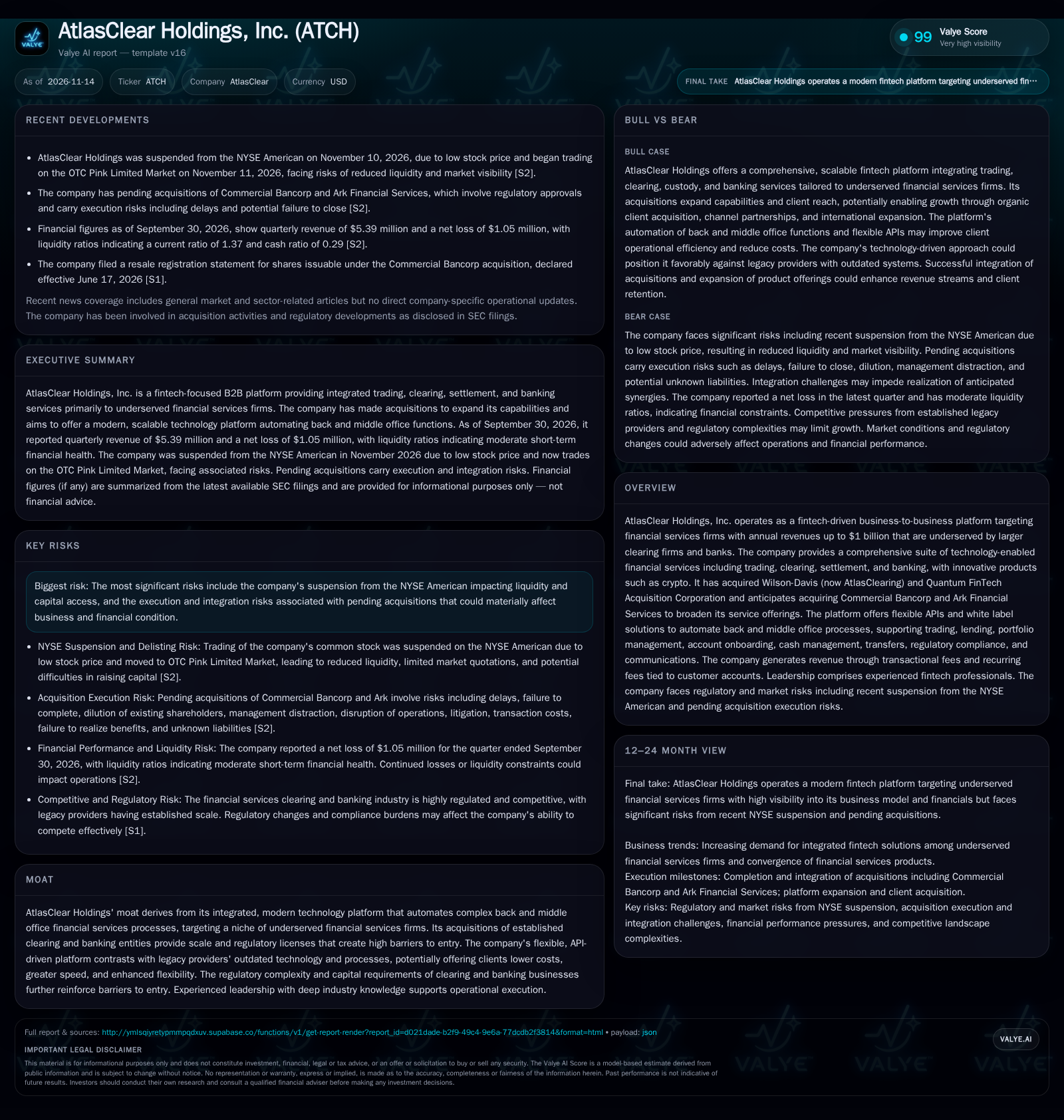
AtlasClear Holdings was suspended from the NYSE American on November 10, 2026, due to a persistently low stock price, and began trading on the OTC Pink Limited Market the following day. This shift immediately reduces liquidity, narrows market visibility, and may impede access to capital at a critical juncture for the company [S2].
At the same time, AtlasClear is pursuing the acquisitions of Commercial Bancorp (a federal reserve member bank) and Ark Financial Services (parent of Dawson James Securities), both of which remain subject to regulatory approvals and face risks of delay or failure to close. These transactions are central to AtlasClear’s strategy of expanding its clearing, banking, and investment banking capabilities [S2].
The company’s financial snapshot as of September 30, 2026, shows quarterly revenue of $5.39 million, a net loss of $1.05 million, and reported liquidity position with a current ratio of 1.37 and cash ratio of 0.29 [S2].
AtlasClear also filed a resale registration statement for shares tied to the Commercial Bancorp acquisition, signaling preparation for deal completion but also potential dilution and integration challenges [S1].
How AtlasClear’s Platform Could Unlock Value for Underserved Financial Firms
AtlasClear’s core business model is built around providing technology-enabled clearing, trading, settlement, and banking services to financial services firms with annual revenues up to $1 billion—entities typically overlooked by larger clearing banks and custodians [S1]. The platform aims to automate back and middle office workflows, offering APIs for trading, portfolio management, compliance, and cash movement. This approach could materially lower operating costs for clients and create stickier, integrated relationships.
Revenue is generated through a mix of transactional fees (for clearing, execution, and banking services) and recurring fees (platform minimums, asset-based fees, account maintenance, and securities lending). The number of active customer accounts is a meaningful proxy for revenue potential, as both transaction volume and recurring fee pools grow with client adoption [S1].
The economics of the clearing and banking businesses are capital-intensive, with fixed costs for regulatory compliance, technology infrastructure, and risk management. Operating leverage may emerge if client growth accelerates, as incremental accounts and transaction volume can be absorbed by the existing technology platform with modest additional cost. However, the need for ongoing investment in compliance, cybersecurity, and platform enhancements remains persistent.
Pending acquisitions could add banking and investment banking fee streams, expand the asset base for interest and lending income, and potentially improve net interest margins if integration is successful. However, integration costs, potential dilution from share issuance, and the risk of unknown liabilities from acquired entities could offset anticipated synergies.
AtlasClear’s Prospects Against Legacy Clearing and Banking Providers
AtlasClear targets a market segment underserved by the largest clearing banks and custodians—namely smaller brokerages, hedge funds, RIAs, and family offices. Its pitch is a modern, API-driven platform that automates workflows and reduces manual errors and costs. This could resonate with clients frustrated by legacy systems and slow onboarding from incumbent providers.
The company’s main competitors remain established clearing banks, correspondent clearing firms, and integrated fintech service providers. These incumbents benefit from scale, established regulatory relationships, and deep client rosters. However, they often run on outdated technology stacks and may be less nimble in serving niche or emerging client needs.
Switching costs in clearing and banking are high, driven by regulatory friction, operational risk, and the pain of data migration. AtlasClear’s success will depend on its ability to demonstrate clear cost or efficiency benefits, manage onboarding risk, and maintain regulatory compliance. Its acquisition of a registered broker-dealer (AtlasClearing) and pursuit of a federal reserve member bank (Commercial Bancorp) provide regulatory licenses and infrastructure that are major barriers to entry for new competitors.
A credible threat comes from other fintechs pursuing B2B financial infrastructure, as well as legacy providers modernizing their offerings. The question is whether AtlasClear can build sufficient client trust and critical mass before incumbents respond or market conditions shift.
If AtlasClear Closes Its Acquisitions and Delivers Platform Synergies
The most favorable scenario for AtlasClear is one in which it successfully completes the acquisitions of Commercial Bancorp and Ark Financial Services, integrates them without major disruption, and realizes the anticipated synergies in technology, product breadth, and cost of capital. This would allow AtlasClear to offer a full-stack solution—trading, clearing, custody, banking, investment banking—on a modern, unified platform.
With expanded regulatory permissions and a broader product suite, AtlasClear could accelerate client acquisition among its target segment. If the company can demonstrate lower transaction costs, faster onboarding, and seamless API integrations, it may attract clients seeking to escape the inertia and limitations of legacy providers.
Confirmation of this scenario would come from rapid growth in customer accounts, higher recurring fee revenue, successful onboarding of new channel partners, and improvement in operating margins as scale economies kick in. Evidence of completed acquisitions, smooth integration, and expanded product uptake would strongly support the upside thesis.
Falsification would be indicated by persistent integration delays, client attrition, regulatory setbacks, or continued operating losses even after acquisitions.
A Transitional Period with Incremental Progress but Ongoing Headwinds
The most plausible near-term outcome is a transitional period marked by incremental client and revenue growth, ongoing operating losses, and slow progress on acquisition integration. AtlasClear may close one or both pending deals, but realize only partial synergies due to integration complexity, regulatory hurdles, or cultural friction between acquired entities.
Revenue may grow modestly as the platform gains limited traction with smaller financial firms, but competitive pressure from incumbents and other fintechs likely constrains pricing power and client switching. Operating leverage could remain elusive until the client base reaches critical mass.
Liquidity remains a concern following the NYSE suspension, as reduced market visibility and OTC trading status limit capital-raising options. The company may need to rely on private placements or partner financing to support ongoing investments and integration costs.
Evidence confirming this scenario would include steady but unspectacular growth in customer accounts and revenue, continued net losses, and periodic capital raises at modest terms. Falsification would be signaled by a major acquisition failure, abrupt client or partner departures, or a surprise return to profitability and rapid scaling.
Delayed Acquisitions, Funding Constraints, and Market Erosion Threaten Viability
In a negative scenario, one or both pending acquisitions are delayed or fail to close, depriving AtlasClear of the regulatory infrastructure and product breadth needed to compete. Integration difficulties could result in higher-than-expected costs, operational disruption, or even expose the company to unknown liabilities from the acquired entities.
The NYSE suspension and OTC Pink trading status may further constrain access to equity capital, especially if investor confidence erodes or trading liquidity deteriorates. This could force the company into dilutive financings or force asset sales to raise cash.
Competitive pressure from both legacy providers and nimble fintechs could accelerate client attrition or impede new client wins, especially if AtlasClear is unable to deliver a compelling value proposition or maintain regulatory compliance. Fixed costs and compliance burdens could quickly outpace revenue, leading to deepening losses and potential recapitalization or restructuring.
Evidence confirming this scenario would include missed acquisition deadlines, escalating net losses, shrinking client base, adverse regulatory findings, or public disclosures of going concern risk.
Milestones That Will Determine AtlasClear’s Strategic Trajectory
Progress toward closing the Commercial Bancorp and Ark Financial Services acquisitions, including regulatory approvals and deal completion dates.
Integration milestones—such as platform unification, cross-selling of banking and clearing products, or realization of cost synergies—if disclosed.
Quarterly trends in customer account growth and client retention, which would indicate adoption and stickiness of the AtlasClear platform.
Recurring fee revenue as a percentage of total revenue, as a proxy for platform engagement and revenue visibility.
Updates on capital-raising activity or changes in liquidity position, especially following OTC Pink market transition.
Evidence of new channel partnerships or international client wins, signaling the platform’s scalability and appeal beyond initial core markets.
Any regulatory or legal developments affecting the company’s broker-dealer, banking, or acquisition activities.
Disclosures regarding integration costs, unknown liabilities, or post-acquisition operating performance.
Disclaimer: This is research-only, informational analysis and not investment advice. It may include AI-generated interpretation and general industry context. Always verify important details using primary sources.

Comments