
Apnimed’s Sleep Apnea Ambitions: Profitability, IPO Firepower, and the FDA’s Decisive Role
Apnimed, Inc. enters a pivotal period after swinging to profitability and completing a major IPO; with reported liquidity position and a pending FDA decision on its lead product AD109, the company’s trajectory now hinges on regulatory and commercial execution.
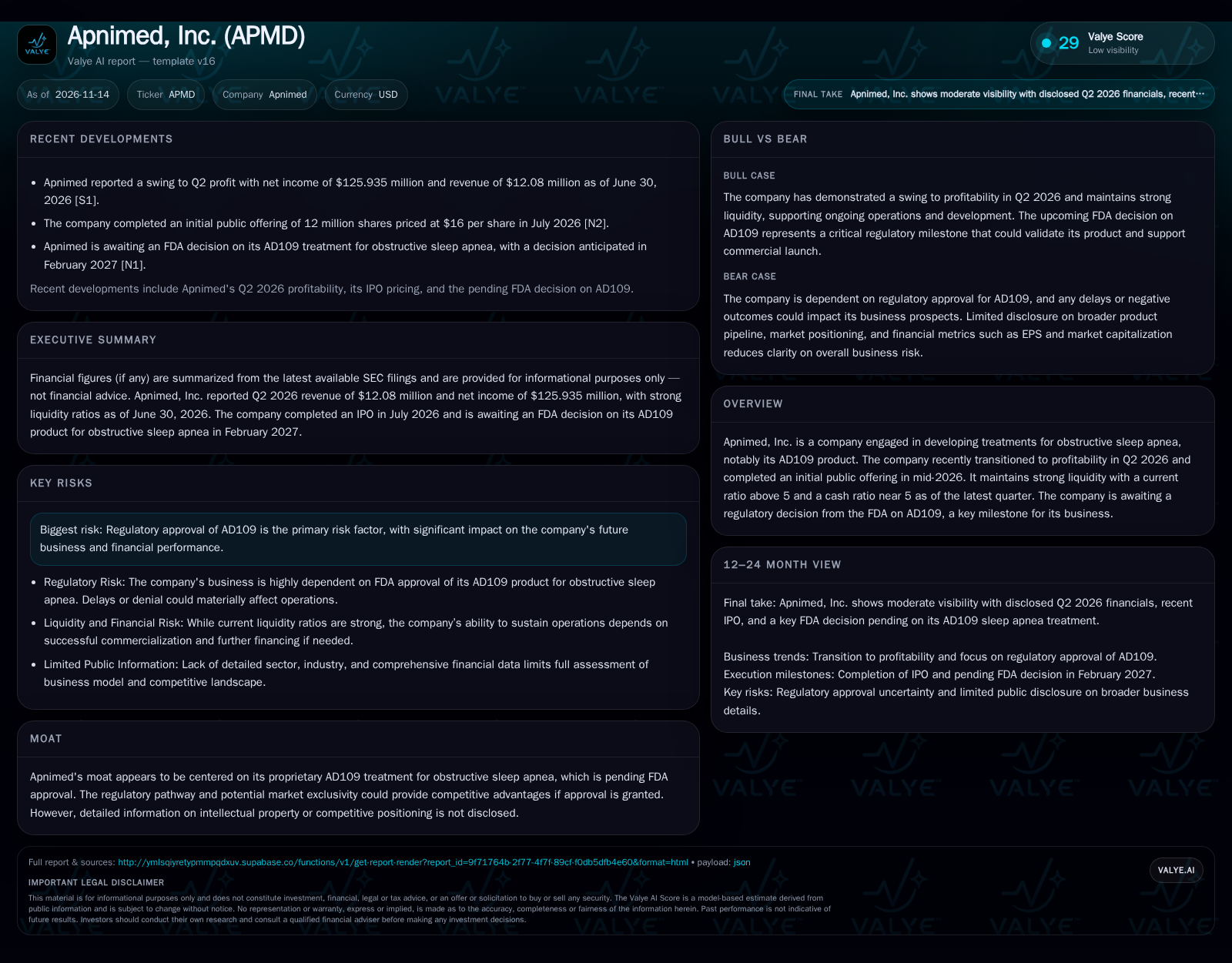
Apnimed reported Q2 2026 revenue of $12.08 million and net income of $125.935 million, completed a $16/share IPO, and holds over $170 million in cash, but its future depends on the FDA’s February 2027 verdict for AD109, its obstructive sleep apnea drug. The next 12-18 months will test whether Apnimed can transition from a development-stage pharmaceutical to a commercially viable enterprise, leveraging its liquidity and recent profitability.
Apnimed, Inc. has rapidly advanced from late-stage clinical development to a potentially transformative moment: in Q2 2026, the company achieved profitability and soon after completed a high-profile IPO, arming itself with substantial liquidity. Yet the ultimate determinant of Apnimed’s trajectory is not its balance sheet, but the fate of its lead drug candidate, AD109, for obstructive sleep apnea—a condition with significant unmet need and commercial potential. With an FDA decision expected in early 2027, Apnimed’s near-term future will be defined by regulatory milestones and its ability to execute a successful product launch in a competitive, evolving market.
Recent Profitability, IPO Proceeds, and the Regulatory Countdown
Apnimed posted a dramatic swing to profitability in Q2 2026, reporting $12.08 million in revenue and net income of $125.935 million as of June 30, 2026 [S1]. This marks a notable inflection for a company previously characterized by operating losses common to late-stage biotech. Shortly after, Apnimed completed an IPO of 12 million shares at $16 per share in July 2026, significantly bolstering its cash reserves [N2]. As of June 30, 2026, the company reported $172.804 million in cash and equivalents and a current ratio of 5.19 [S1]. However, Apnimed’s business remains anchored to a single clinical asset: AD109 for obstructive sleep apnea, with an FDA decision anticipated in February 2027 [N1]. The convergence of new capital, recent profitability, and a looming regulatory milestone defines Apnimed’s current context and sets the stage for a binary outcome in the coming quarters.
How Apnimed’s Model Could Generate Durable Profits—If Approval Arrives
Apnimed’s business model, like many emerging pharmaceutical companies, is highly leveraged to the success of a single drug candidate. The economics of an approved specialty pharmaceutical in sleep apnea could be attractive: obstructive sleep apnea (OSA) is a prevalent, chronic condition, and current standard of care (such as CPAP devices) faces issues with patient adherence, leaving room for alternative therapies. If AD109 receives FDA approval, Apnimed could monetize it via specialty drug pricing—likely at a premium to generic therapies, but requiring payer acceptance and formulary access. The scale of the potential OSA market supports a high-volume opportunity, but the mix of commercial success will depend on insurance coverage, prescriber adoption, and patient retention.
Fixed costs—such as R&D and regulatory—are front-loaded, while variable costs (manufacturing, distribution, and sales force) will ramp with commercial launch. Gross margins for branded specialty pharmaceuticals are typically high, but initial commercialization requires substantial investment in marketing and education. Operating leverage could emerge as revenue scales, but the company may need to expand its infrastructure and field force to penetrate the sleep medicine and respiratory specialist markets. Capital needs could increase if launch costs or post-marketing studies are higher than anticipated. The company reported cash and liquidity metrics for the period; these figures do not by themselves establish operating runway, investment capacity, financial flexibility, or financing capacity.
Potential Differentiators and Competitive Pressures in Sleep Apnea Therapeutics
Apnimed’s competitive position is defined by its proprietary AD109, targeting a large and underserved market. The treatment landscape for OSA is dominated by device-based solutions (notably CPAP), with limited pharmacological options currently available. If effective and well-tolerated, AD109 could carve out a niche for patients unwilling or unable to use CPAP, or as an adjunct for partial responders. Barriers to entry for new drugs in OSA include clinical efficacy, safety, ease of use, and payer willingness to reimburse. Intellectual property protections and regulatory exclusivity (if granted) could provide a temporary moat, but competitors may pursue similar mechanisms or combination therapies.
Potential substitutes include other investigational drugs, device innovations, and surgical interventions. Established device manufacturers and large pharmaceutical companies could enter or intensify competition if the market opportunity is validated. Apnimed’s ability to defend its market share will likely hinge on clinical differentiation, real-world outcomes, and speed of commercial execution. Long-term, the durability of its advantage depends on follow-on pipeline development or lifecycle management of AD109.
What a Successful FDA Decision Could Unlock for Apnimed
If the FDA approves AD109 as anticipated in February 2027, Apnimed could rapidly transition from a development-stage company to a commercial-stage revenue generator. A favorable regulatory outcome would validate its clinical approach, trigger milestone payments (if any partnerships exist), and enable broad marketing of AD109. Early adoption by sleep specialists and positive coverage decisions by payers would accelerate uptake, especially if real-world data confirms efficacy and tolerability advantages over current treatments.
Confirmation of the upside scenario would include strong initial prescription volumes, formulary wins, and positive updates on post-marketing surveillance. Further, Apnimed might attract strategic interest from larger pharmaceutical companies seeking exposure to the OSA market, or could use its cash and public currency to expand its pipeline through partnerships or acquisitions. Conversely, slow uptake, payer resistance, or safety concerns would challenge the upside thesis.
A Probable Path: Commercial Ramp and Execution Hurdles Post-Approval
Competition from entrenched device players may limit initial penetration, and real-world data will be critical in establishing AD109’s place in therapy.
Evidence supporting the base case would include a measured build in quarterly sales, incremental payer coverage announcements, and manageable launch expenses relative to existing cash. If disclosed, metrics such as prescription growth rates, channel mix, and gross-to-net pricing would provide further clarity. Downside risks would surface if launch costs outpace revenue or if early adoption lags expectations.
How Regulatory Setbacks or Launch Missteps Could Derail Momentum
Even with approval, significant safety concerns, adverse events, or lack of payer reimbursement could sharply limit commercial prospects. Anemic initial sales or high rates of discontinuation would pressure the company’s ability to sustain operations without new financing.
Confirmation of the downside would include an FDA complete response letter, negative safety signals, or the company announcing strategic pivots, cost-cutting, or additional capital raises. Persistent net losses, dwindling cash, or failure to gain payer traction would further undermine the thesis.
Milestones and Metrics That Will Define Apnimed’s Post-IPO Trajectory
Progress and outcome of the FDA review for AD109, including any advisory committee meetings, label discussions, or potential delays.
Details on initial commercial launch plans: sales force buildout, marketing strategy, and timing post-approval—if disclosed.
Early prescription and revenue trends for AD109 following approval; a useful metric would be quarterly prescription growth and channel mix.
Updates on payer coverage, formulary wins, and reimbursement rates for AD109.
Any safety updates, adverse event reports, or post-marketing study requirements from the FDA.
Expansion of the product pipeline or disclosure of additional clinical assets that could diversify revenue sources.
Cash burn rate and runway post-launch, especially if commercialization expenses are higher than anticipated.
Strategic partnerships, licensing deals, or M&A activity that could accelerate growth or diversify risk.
Disclaimer: This is research-only, informational analysis and not investment advice. It may include AI-generated interpretation and general industry context. Always verify important details using primary sources.

Comments