
Seritage Growth Properties: Asset Sales, Debt Restructuring, and the Search for a Sustainable Business Model
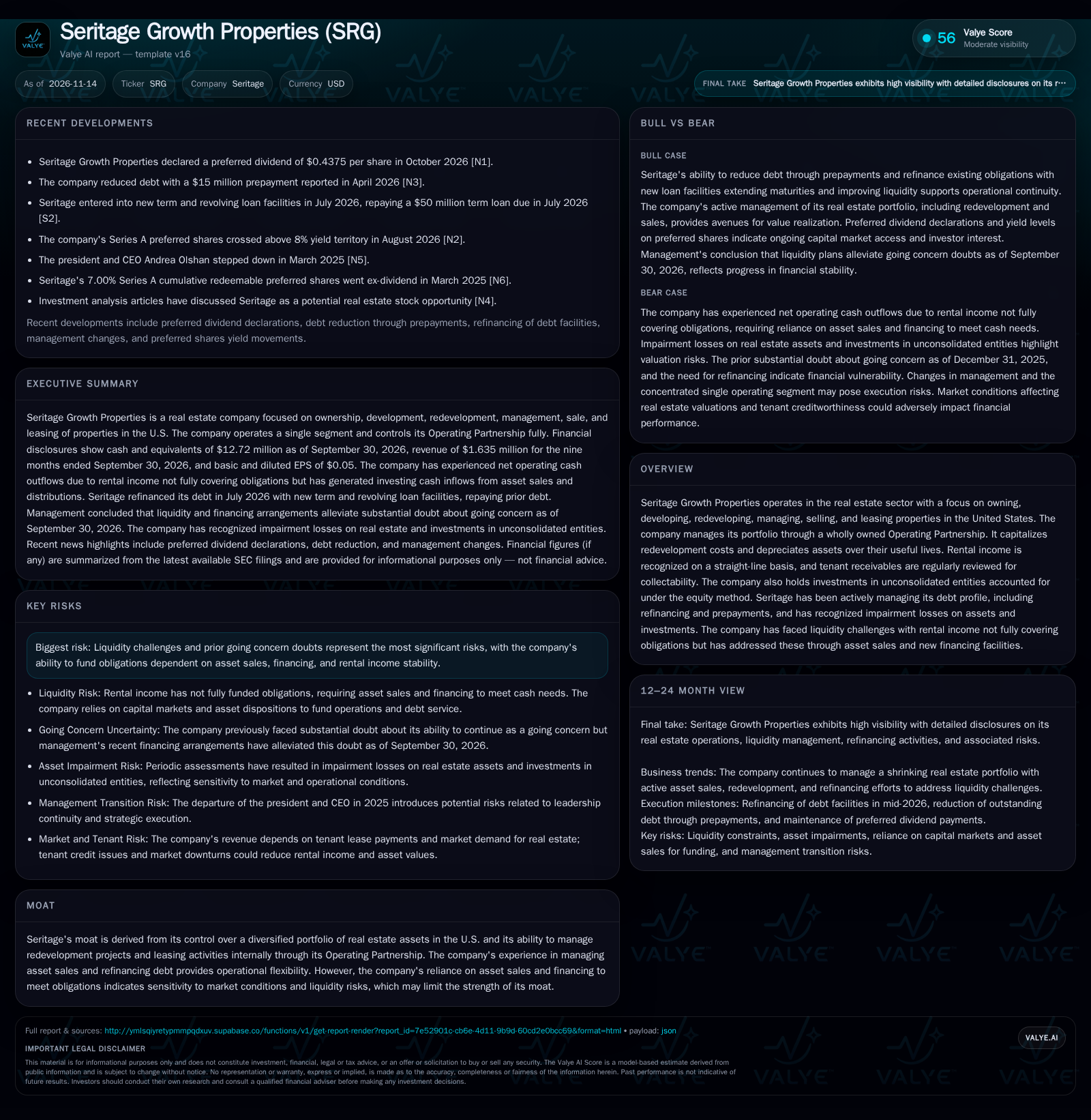
Seritage Growth Properties continues to shrink its real estate footprint, leveraging asset sales and refinancing to meet obligations as rental income lags. Recent debt prepayments, refinancing, and preferred dividend maintenance highlight both progress and structural pressures as the company navigates a transition from legacy retail assets to a more flexible, but uncertain, future.
The company's long-term viability hinges on its ability to unlock value from its remaining portfolio amid ongoing management transition and market risks. Preferred dividend continuity and reduced debt signal progress, but structural challenges remain.[S2] [N1] [N3]
Seritage Growth Properties stands at a critical juncture, balancing its shrinking real estate portfolio, ongoing asset sales, and the need to refinance obligations amid insufficient rental income. Recent milestones—including a $15 million debt prepayment, new loan facilities, and the continued payout of preferred dividends—underscore management’s tactical progress in alleviating near-term liquidity concerns. Yet the company’s reliance on monetizing assets and its exposure to market conditions, compounded by leadership transition, raise fundamental questions about the sustainability of its business model as its legacy Sears and Kmart-derived portfolio winds down.
How Recent Debt Moves and Asset Sales Shape Seritage’s Financial Outlook
Seritage Growth Properties has recently executed several material financial maneuvers. In April 2026, the company prepaid $15 million in debt, followed by the refinancing of its capital structure in July with new term and revolving loan facilities that replaced a $50 million term loan maturing in the same month.[S2] [N3] While these actions alleviated immediate refinancing risk and enabled management to declare that substantial doubt about going concern had been lifted as of September 30, 2026, the underlying business remains challenged. The cited source reports dividend-related activity; that disclosure alone does not establish dividend-policy continuity, management confidence, or a material constraint on capital flexibility. [S2] [N1] [N2]
Asset Monetization as a Core Economic Engine—and Its Limits
Seritage’s business model centers on extracting value from a legacy portfolio through asset sales, redevelopment, and selective leasing. The economics are fundamentally driven by the timing and pricing of property dispositions rather than recurring rental income, which remains insufficient to support ongoing obligations.[S2] The company capitalizes redevelopment expenditures, but these investments only translate to value if properties can be sold or leased at attractive terms—a dynamic that introduces lumpiness and dependence on external market conditions. Fixed costs include property holding, debt service, and corporate overhead, while variable costs are associated with redevelopment activities. This structure creates high operating leverage: asset sales and successful redevelopments can rapidly improve liquidity, but slowdowns in transaction activity or market downturns quickly expose cash shortfalls. The need for periodic refinancing or asset sales to fund obligations suggests that Seritage’s capital needs are ongoing, and the company is structurally exposed to real estate market cycles and interest rate shifts.
The reliance on asset monetization as the primary economic driver inherently creates a cyclical vulnerability for Seritage. Given that property dispositions are subject to timing and market sentiment, the company’s liquidity profile can fluctuate significantly, introducing volatility into its financial planning. Moreover, the capital-intensive nature of redevelopment projects requires upfront investment without guaranteed returns, meaning that any delays or cost overruns can exacerbate cash flow constraints. This dynamic necessitates a careful balance between preserving capital for debt servicing and allocating sufficient resources to value-enhancing activities. In addition, the structural reliance on external capital markets to bridge funding gaps exposes Seritage to macroeconomic risks, including interest rate volatility and credit availability, which can materially impact refinancing costs and access.
Navigating a Crowded Real Estate Market with a Legacy Portfolio
Seritage’s competitive environment is defined by its position as a legacy retail property owner in a market increasingly dominated by mixed-use, logistics, and multifamily redevelopment. Its portfolio was originally derived from Sears and Kmart sites, many of which require substantial repositioning to attract new tenants or buyers. While Seritage’s ability to control redevelopment internally via its Operating Partnership offers some flexibility, it faces competition from diversified REITs, opportunistic private equity real estate funds, and local developers—all of whom may have greater scale, lower cost of capital, or more specialized expertise. The value of Seritage’s assets is highly sensitive to local demand, tenant creditworthiness, and broader real estate capital market conditions. As the company shrinks its portfolio to manage liquidity, it may lose bargaining power with tenants and buyers, further challenging pricing and mix. Moreover, its reliance on asset sales as a funding mechanism exposes it to periods of illiquidity or unfavorable market sentiment.
Seritage’s competitive positioning is further complicated by the evolving preferences of commercial real estate tenants and investors. The shift towards experiential retail, mixed-use developments, and last-mile logistics hubs demands redevelopment strategies that are both capital efficient and market responsive. If Seritage’s redevelopment pipeline cannot adapt quickly to these trends or lacks the scale to achieve cost efficiencies, it risks underperforming relative to competitors with more diversified or modern portfolios. Additionally, the company’s legacy assets may face higher capital expenditure requirements to meet contemporary environmental, social, and governance (ESG) standards, which could increase holding costs or delay repositioning efforts. Such factors could widen the valuation gap between Seritage’s properties and those of more agile or better-capitalized market participants.
Unlocking Hidden Real Estate Value Through Opportunistic Sales and Redevelopment
A favorable outcome for Seritage would see the company successfully executing timely asset sales at or above book value, redeveloping select properties to attract higher-quality tenants or buyers, and using proceeds to further reduce debt and return capital to shareholders. The causal chain would involve: (1) stabilization or growth in commercial real estate demand for its asset types, (2) successful completion and leasing/sale of redevelopment projects, and (3) the maintenance of favorable capital market access for refinancing. Evidence supporting this scenario would include above-expectation asset sale proceeds, a reduction in impairment charges, a shift to net operating cash inflows (not just from investing activities), and increased recurring rental income from redeveloped properties. Confirmation would also come if Seritage could sustain or increase preferred dividends without new asset sales, signaling improved underlying portfolio economics.
Continued Portfolio Shrinkage and Tactical Liquidity Management
The most plausible near-term scenario is that Seritage continues to shrink its portfolio, balancing asset sales, selective redevelopment, and refinancing to meet obligations as they come due. Rental income is unlikely to fully cover fixed costs, so the company remains dependent on opportunistic sales and capital market access. This ‘run-off’ model presumes that asset market conditions remain stable enough to allow orderly dispositions, but that cash flows from operations do not inflect positive. The transition risk from the CEO’s departure may limit strategic shifts or accelerate wind-down behaviors. Falsification would occur if Seritage were able to generate sustained net operating cash inflows or pivot to a growth strategy based on successful redevelopment and leasing.
Market Deterioration and Asset Impairments Trigger a Liquidity Squeeze
The adverse scenario is marked by a deterioration in real estate market conditions, with asset sales slowing or transacting at deep discounts to book value, leading to increased impairment charges and eroded equity. If tenant demand weakens further or financing costs rise, Seritage could face renewed liquidity pressure, potentially forcing distressed sales or dilutive capital raises. Evidence for this chain would include a spike in impairment losses, a halt or reduction in preferred dividend payments, difficulty in refinancing or increased borrowing costs, and a material decline in cash and equivalents. A leadership vacuum or strategic missteps following the CEO’s departure could exacerbate these stresses. This scenario could culminate in renewed going concern warnings or a disorderly wind-down of the portfolio.
What Will Reveal Whether Seritage’s Asset Strategy Yields Lasting Value?
Trends in asset sale proceeds versus book value—if disclosed—will clarify whether Seritage is realizing hidden value or incurring losses on disposition.
Frequency and magnitude of impairment charges on real estate and unconsolidated investments will signal asset quality and the impact of market conditions.
Details on new leases, tenant credit quality, and occupancy rates—if disclosed—would provide insight into the success of redevelopment and leasing efforts.
Refinancing terms, interest rate spreads, and maturity profiles on new debt will reveal external perceptions of Seritage’s credit risk.
Leadership stability and any strategic updates post-CEO transition will help gauge execution risk and adaptability.
Disclaimer: This is research-only, informational analysis and not investment advice. It may include AI-generated interpretation and general industry context. Always verify important details using primary sources.

Comments