
Blue Line Holdings: Development-Stage Beverage Play Faces Liquidity Hurdles and License Constraints in French Market Entry
Blue Line Holdings, Inc. is attempting to carve out a niche in the $26 billion global flavored water market with a France-focused license for CocoLove, but faces severe liquidity pressure, an unproven business model, and structural limitations in its only asset. Its path forward depends on capital access, execution in a competitive channel landscape, and the ability to differentiate amid established giants.
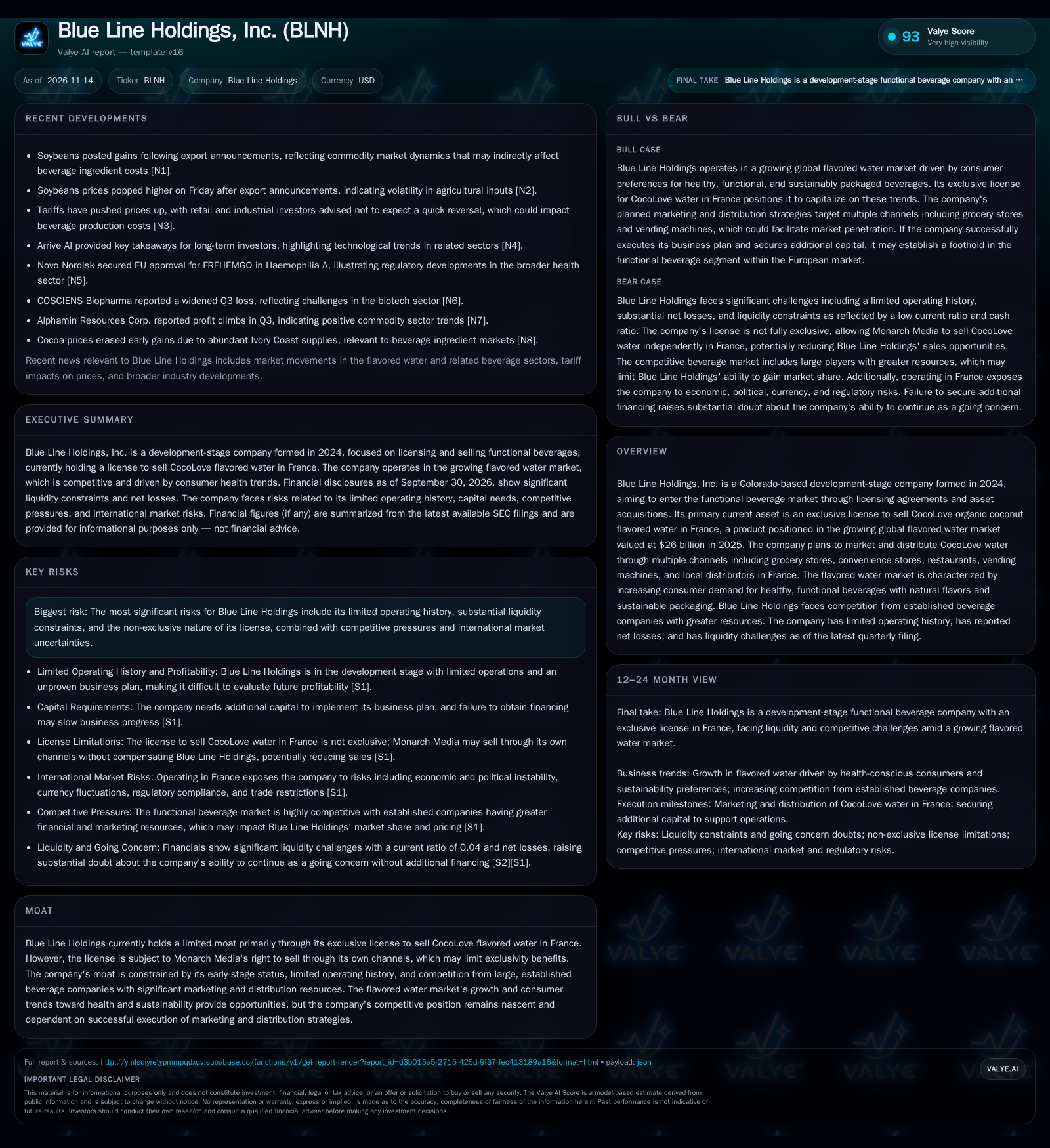
Blue Line Holdings is a newly formed, development-stage company aiming to sell CocoLove organic coconut water in France under a partially exclusive license. Its near-term viability and long-term market relevance hinge on capital raises, effective execution, and the ability to overcome structural and competitive headwinds. [S1] [S2]
Blue Line Holdings, Inc. is targeting the fast-growing functional beverage segment with its exclusive license to sell CocoLove organic coconut water in France. However, its ambitions are sharply constrained by severe liquidity issues, a lack of operational track record, and a licensing arrangement that allows its licensor to compete directly through retained sales channels. Entering the French market pits Blue Line against dominant multinationals and exposes it to the complexities of international consumer goods logistics, marketing, and regulation. The company’s ability to survive and achieve product-market fit will depend on timely capital infusion, disciplined execution, and its capacity to carve out defensible market share despite significant structural and competitive barriers. [S1] [S2]
Liquidity Crisis, Partial Exclusivity, and Unproven Execution Define Blue Line’s Starting Point
As of September 30, 2026, Blue Line Holdings reported just $1.759 million in cash against current liabilities of $94.53 million, yielding a current ratio of 0.04 and a cash ratio of 0.02. The company has incurred a net loss of $12.459 million for the period and faces explicit going concern risk without new financing. [S2] Its only active commercial asset is a license to sell CocoLove coconut flavored water in France, but the licensor, Monarch Media, retains the ability to sell through its own channels, undermining the license’s exclusivity. Blue Line remains in the development stage, with limited operations, no established revenue, and a business model yet to be proven in-market. [S1]
Functional Beverage Unit Economics: Fixed Costs, Channel Complexity, and Early-Stage Capital Needs
At its core, Blue Line’s economic model is predicated on licensing, marketing, and distributing a single branded product in a mature and highly competitive beverage segment. The company has budgeted approximately $100,000 for marketing and distribution of CocoLove in France over the next twelve months, a modest figure relative to the scale of consumer-packaged goods launches. [S1]
In the functional beverage space, gross margins can be attractive for differentiated products, but the economics are heavily dependent on volume throughput, efficient supply chain management, and the ability to secure shelf space or digital visibility. Fixed costs include marketing, distribution agreements, regulatory compliance, and staffing, while variable costs are tied to production, logistics, and channel incentives. Blue Line’s capital needs are acute: with minimal liquidity and heavy liabilities, it is reliant on external financing to fund both working capital and market entry initiatives. If the company cannot quickly generate revenue or secure additional capital, it risks operational paralysis and default.
Structural Barriers and Competitive Intensity: Can a Newcomer Carve Out Share from Beverage Giants?
Blue Line enters a market dominated by global beverage conglomerates such as Nestlé, PepsiCo, and Coca-Cola, all of whom have established functional and flavored water portfolios, deep distribution networks, and vast marketing budgets. The company’s only present advantage is its partially exclusive license for CocoLove in France, but this advantage is muted by Monarch Media’s retained right to sell directly, which could divert key accounts or limit Blue Line’s upside. [S1]
Switching costs for consumers are low—functional beverage buyers can easily trial and abandon new brands. Retailers and distributors tend to favor proven brands with strong pull-through, leaving new entrants to fight for limited shelf space and promotional support. While Blue Line’s focus on organic, sugar-free, and sustainably packaged offerings aligns with current consumer trends, these attributes are increasingly table stakes rather than true differentiators in the segment. Without meaningful brand equity or channel leverage, Blue Line’s competitive position is precarious and execution-dependent.
Rapid Market Penetration via Strategic Partnerships and Brand Resonance
The most favorable scenario for Blue Line would involve securing sufficient financing to execute its marketing and distribution plans at scale. By forging partnerships with major French grocery chains, convenience stores, and foodservice distributors, the company could quickly establish retail presence for CocoLove. If the brand’s organic, sugar-free positioning resonates with health-conscious French consumers—and if marketing campaigns effectively drive awareness—Blue Line could achieve meaningful sales velocity and attract additional capital or licensing opportunities.
Evidence that would confirm this scenario includes signed distribution agreements with leading French retailers, strong initial sell-through rates, repeat purchase data, and positive consumer awareness metrics. If Blue Line can report revenue growth, improved gross margins, and reduced operating losses within the next 12-18 months, it would suggest early traction. Conversely, slow retail adoption, poor sell-through, or inability to raise capital would falsify this scenario.
Incremental Progress Amid Capital Constraints and Channel Fragmentation
The most plausible near-term outcome is that Blue Line secures limited bridge financing, allowing it to launch CocoLove in select pilot channels—potentially regional grocers, vending operators, or university campuses. Market penetration would be gradual, with sales volumes constrained by marketing budget limits and retailer skepticism toward an unproven brand. The company might achieve some modest traction with health-focused consumers, but will likely face margin pressure from promotional incentives, slotting fees, and price competition.
Confirmation of this scenario would come from small-scale retail launches, modest revenue generation, and continued net losses offset by periodic fundraising. Evidence against it would be either a complete inability to launch (due to lack of funds or regulatory issues) or, conversely, unexpectedly rapid channel expansion and brand adoption.
Liquidity Exhaustion, Loss of License, and Competitive Displacement
In a negative scenario, Blue Line fails to secure new financing and exhausts its liquidity before achieving meaningful market entry. The inability to fund marketing or distribution results in missed launch milestones, while fixed liabilities mount. Monarch Media, retaining the right to sell CocoLove through its own channels, could capitalize on Blue Line’s failure and bypass it entirely, rendering the license valueless.
Competitive pressure from entrenched beverage multinationals could further erode any window of opportunity, with new innovations or aggressive promotions crowding out Blue Line’s offering. Evidence confirming this scenario would include further deterioration of liquidity, default on obligations, license termination, or loss of distribution relationships. Falsification would require a successful capital raise and visible commercial progress.
Milestones That Will Reveal Blue Line’s Commercial Viability and Market Traction
Securing new financing sufficient to fund at least 12 months of operations and support initial channel launches.
Signing distribution agreements with major French grocery chains, convenience stores, or foodservice partners—if disclosed.
Reporting initial sell-through and reorder rates for CocoLove water at retail or foodservice points of sale.
Demonstrating meaningful revenue generation and narrowing operating losses over successive quarters.
Evidence of consumer awareness or brand preference in target demographics via survey data or digital engagement metrics—if disclosed.
Monitoring the extent to which Monarch Media utilizes its retained right to sell through its own channels, potentially cannibalizing Blue Line’s addressable market.
Tracking regulatory or compliance developments in France that could delay or complicate product launch.
Disclaimer: This is research-only, informational analysis and not investment advice. It may include AI-generated interpretation and general industry context. Always verify important details using primary sources.

Comments