
Grown Rogue International: Expansion Ambitions Meet Regulatory and Profitability Headwinds
Grown Rogue International Inc. is pushing for market expansion in the regulated cannabis sector through strategic acquisitions and operational scale-ups, but faces significant regulatory approval risks and ongoing net losses. The company’s financial profile shows liquidity coverage for short-term obligations, yet the path to sustainable profitability remains uncertain as it navigates complex acquisition integrations and sector volatility.
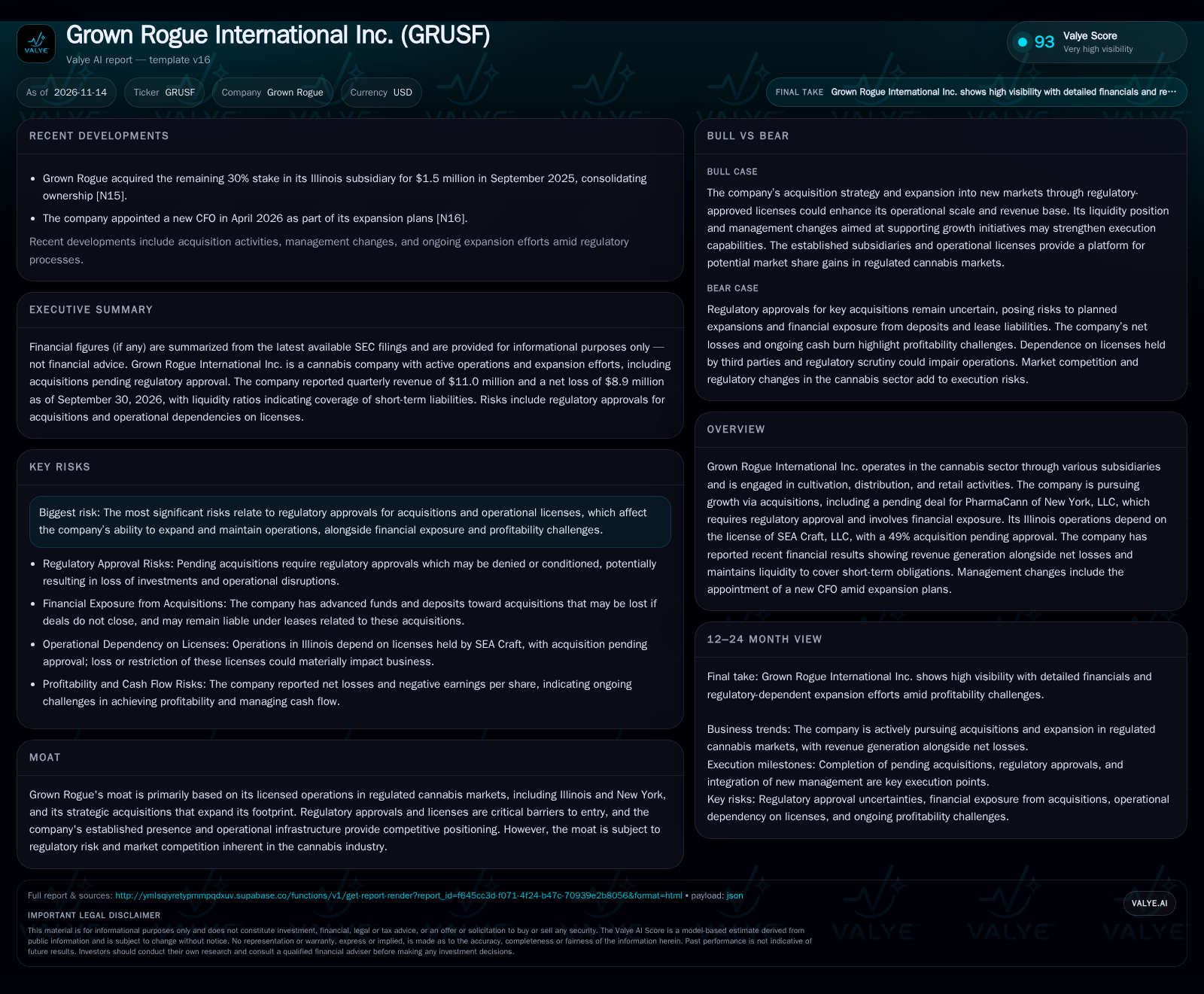
Grown Rogue International Inc. is actively expanding through acquisitions, notably a pending deal for PharmaCann of New York, LLC, but faces regulatory approval risks and ongoing net losses.
Grown Rogue International Inc. is attempting to scale its presence in the regulated cannabis industry by acquiring new assets and expanding operational reach. Its most significant current move—a pending acquisition of PharmaCann of New York, LLC—offers the promise of new market access but also exposes the company to regulatory, financial, and operational risks.
Recent Acquisitions and Financial Performance Shape the Immediate Outlook
Grown Rogue International Inc. reported quarterly revenue of $11.0 million and a net loss of $8.9 million as of September 30, 2026, with basic and diluted EPS of -$0.04 per share. The company reported cash and liquidity metrics for the period; these figures do not by themselves establish operating runway, investment capacity, financial flexibility, or financing capacity. [S2] [S2] The company’s pending acquisition of PharmaCann of New York, LLC (PCNY) is a central development, involving financial exposure through deposits and lease liabilities if the deal does not close. Management changes, including a new CFO, have also been implemented to support these expansion efforts.
Revenue Generation, Cost Structure, and the Capital Intensity of Cannabis Expansion
Grown Rogue’s business model is built around the cultivation, distribution, and retail sale of cannabis products, supplemented by support services and facility subleases. Revenue growth depends on both organic sales in established markets and the success of acquisitions that expand the company’s licensed footprint. However, the company’s net losses indicate that current revenues are insufficient to cover fixed costs, which likely include cultivation infrastructure, regulatory compliance, and lease obligations.
Acquisitions such as PCNY add a layer of capital intensity and financial risk—deposits, integration costs, and potential liabilities under lease agreements present cash flow and accounting challenges. Operating leverage could theoretically improve as scale increases through acquisitions, but sector dynamics (regulatory hurdles, price competition, and high compliance costs) often delay or dilute margin expansion in cannabis. Until integration is achieved and new assets contribute meaningfully to cash flow, Grown Rogue’s economics remain exposed to both top-line volatility and sustained cost pressures.
The capital intensity inherent in cannabis cultivation and retail operations extends beyond initial acquisition costs to ongoing compliance and operational expenditures. Regulatory mandates often require costly facility upgrades, security enhancements, and comprehensive tracking systems, which inflate fixed costs and reduce operating margins. Additionally, the sector’s evolving regulatory landscape can impose unforeseen capital demands, such as adapting to new packaging or testing requirements. These factors collectively heighten the break-even revenue threshold, making scale and operational efficiency pivotal. However, the timing of achieving such scale is uncertain, and delays in integration or regulatory approvals can exacerbate cash burn, underscoring the importance of disciplined capital allocation and contingency planning.
Licensing, Market Access, and the Challenge of Differentiation in Cannabis
Grown Rogue’s competitive position is anchored in its access to regulated markets through licensed operations and acquisitions. Regulatory licenses in states like New York and Illinois function as partial barriers to entry, limiting the pool of direct competitors. However, these barriers are not insurmountable: as more licenses are issued or regulations evolve, new entrants can erode incumbents’ market share.
The company’s acquisition-driven strategy seeks to build scale and geographic reach, but integration risk and execution complexity can offset these advantages. Additionally, the cannabis sector faces persistent pricing pressure, product commoditization, and the threat of substitution from both legal and illicit market players. Without clear brand or product differentiation, Grown Rogue’s moat relies heavily on regulatory and operational execution rather than intrinsic product or customer loyalty advantages.
Market access through licensing provides a temporary competitive moat but also introduces vulnerability to regulatory shifts and policy changes. For example, if regulatory authorities expand licensing or alter operational requirements, the relative advantage of incumbents like Grown Rogue may erode, intensifying competition and compressing margins. Moreover, geographic diversification through acquisitions can mitigate localized regulatory risks but also increases complexity in managing disparate compliance regimes and operational standards. This complexity can dilute management focus and operational consistency, potentially impacting customer experience and cost efficiency. Thus, sustaining differentiation may require investment in brand development, product innovation, or operational excellence beyond mere license aggregation.
Regulatory Approvals and Successful Integration Unlock Growth Leverage
If Grown Rogue secures regulatory approval for its pending PCNY acquisition and efficiently integrates the asset, it could achieve a step-change in revenue and operational scale. The addition of new licenses and facilities would allow the company to expand its product offering, reach new customers, and potentially realize economies of scale—improving gross margins and diluting fixed costs.
Confirmation of this upside would require evidence of timely regulatory approval, smooth operational integration, and sequential revenue and margin improvement from the newly acquired entities. Further, a reduction in net losses or a move toward profitability—driven by higher contribution from acquired operations—would validate the company’s strategy. Falsification would be signaled by regulatory delays, integration setbacks, or continued net losses despite the expanded footprint.
Expansion Proceeds Amid Persistent Profitability and Execution Risks
The most plausible path forward is that Grown Rogue continues to generate revenue from its core and acquired operations but remains constrained by sector-wide profitability challenges and the complexity of acquisition integration. Regulatory approvals may be granted, but the process could be protracted, and the financial benefits may lag as integration costs and operational friction offset initial gains.
Base case confirmation would come from steady revenue growth, maintenance of liquidity coverage for short-term obligations, and incremental progress toward narrowing net losses. However, evidence of persistent negative cash flow, delays in acquisition closures, or unexpected regulatory or operational setbacks would suggest the company is struggling to convert its expansion strategy into sustainable value.
Acquisition Failure and Regulatory Headwinds Exacerbate Financial Strain
In a downside scenario, Grown Rogue fails to obtain regulatory approval for the PCNY acquisition or encounters material integration problems, leading to the forfeiture of deposits and continued liability under master leases. This could result in both direct financial losses and a weakened strategic position, as growth ambitions are curtailed and resources are tied up in non-productive assets.
Further, if sector dynamics deteriorate—through increased competition, regulatory tightening, or price compression—revenue could stagnate or decline, amplifying the impact of persistent net losses. Evidence confirming this scenario would include failed or delayed acquisitions, write-downs of deposits, rising liabilities, and further deterioration of net income and cash flow metrics.
Evidence That Will Determine the Outcome of Grown Rogue’s Expansion Thesis
Timing and outcome of regulatory approvals for the PCNY acquisition and any other pending transactions.
Actual revenue contribution and margin performance from newly acquired or integrated facilities, if disclosed.
Trends in net loss and cash flow from operations over subsequent quarters.
Changes in liquidity ratios and cash balances as expansion proceeds.
Operational cost structure evolution, particularly in SG&A and compliance costs, as acquisitions are integrated.
Retention and turnover of key management, including the new CFO, and evidence of effective execution of integration plans.
Any disclosures or filings related to forfeiture of deposits or liabilities under leases if acquisitions fall through.
Disclaimer: This is research-only, informational analysis and not investment advice. It may include AI-generated interpretation and general industry context. Always verify important details using primary sources.

Comments