
Hines Global Income Trust: Navigating Profitability Pressures with Reported Liquidity Position in an Opaque Operating Landscape
Despite strong cash reserves and meaningful revenue, Hines Global Income Trust faces persistent net losses and limited transparency around its business model and sector exposure, complicating investor assessment of long-term value creation.
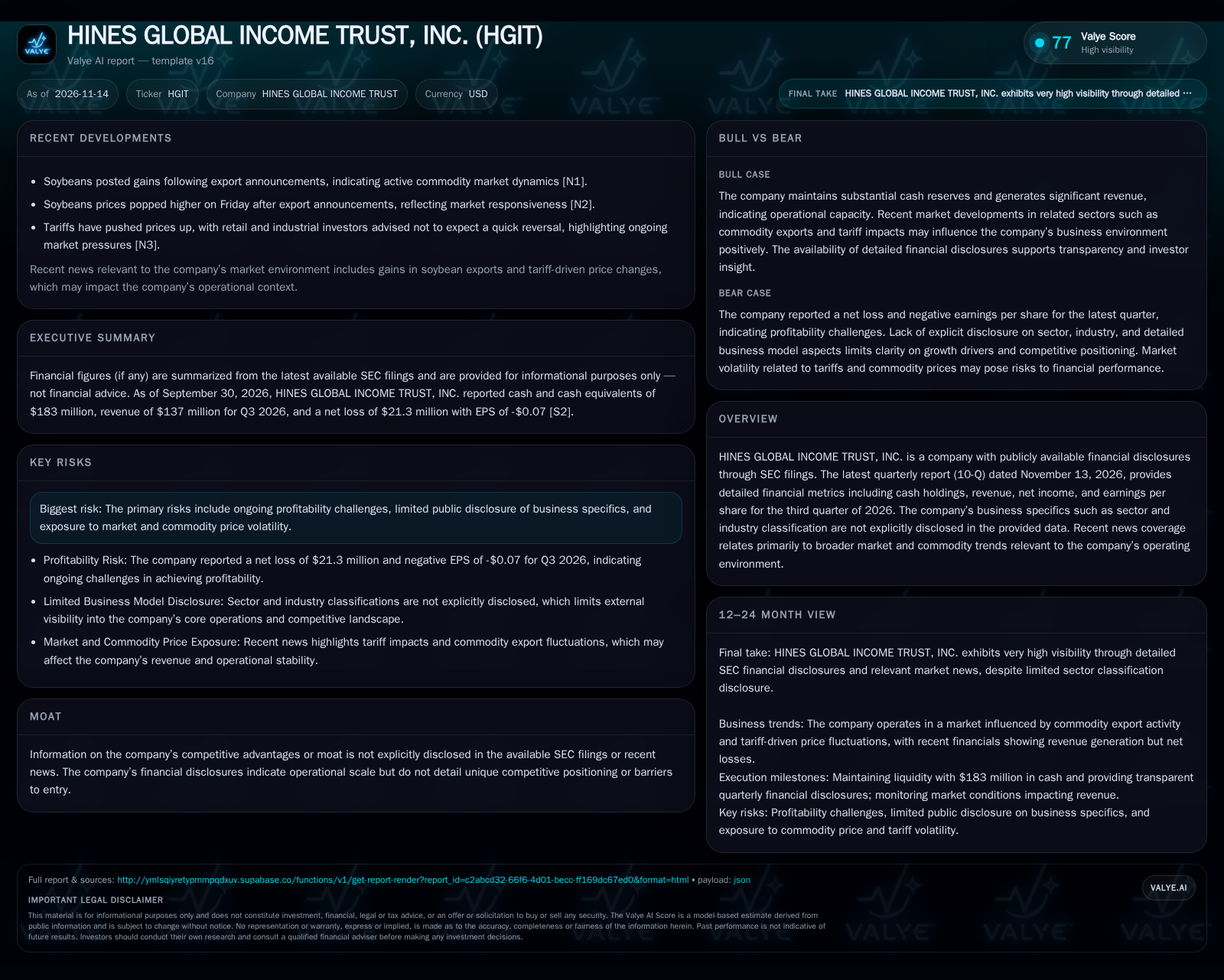
Hines Global Income Trust reported $137 million in Q3 2026 revenue and holds $183 million in cash, but posted a $21.3 million net loss. The lack of disclosed sector or business model specifics clouds evaluation of its economic durability, while market volatility and commodity price exposure introduce further uncertainty. [S2]
Hines Global Income Trust, Inc. presents a challenging analytical puzzle: the company discloses robust quarterly revenue and maintains a sizable reported cash balance, yet continues to report net losses and offers little public detail about its operational focus or competitive dynamics. This combination of financial scale and strategic opacity makes it difficult to assess whether current challenges are cyclical, structural, or symptomatic of deeper business-model issues. The company's exposure to market and commodity price swings further complicates the outlook, underscoring the importance of monitoring both external conditions and any future disclosures that clarify its long-term economic engine. [S2]
Recent Financial Performance and Disclosure Gaps Shape the Investment Picture
As of September 30, 2026, Hines Global Income Trust reported $137 million in revenue for the third quarter but posted a net loss of $21.3 million, translating to a basic and diluted EPS of -$0.07. The company reported cash and liquidity metrics for the period; these figures do not by themselves establish operating runway, investment capacity, financial flexibility, or financing capacity. However, the absence of explicit sector, industry, or business model disclosures in the latest SEC filings leaves significant ambiguity about the drivers of both revenue and losses. This opacity complicates efforts to benchmark performance, understand risk exposures, or assess the path to profitability. [S2]
Beyond headline revenue and net loss figures, a deeper examination of working capital dynamics and cash flow patterns would augment understanding of the company’s operational resilience. For instance, if accounts receivable or inventory levels are rising disproportionately to revenue, this could signal collection challenges or inventory obsolescence risks that pressure liquidity despite reported cash balances. Conversely, consistent positive cash flow from operations, even amid net losses, might indicate non-cash charges are driving accounting losses rather than fundamental business weakness.
Unpacking Potential Revenue Streams and Cost Structure Amid Limited Transparency
Without clear disclosure of the company’s sector or business model, the fundamental economics of Hines Global Income Trust remain speculative. If the company operates as a diversified real estate investment trust (REIT) as the name suggests, revenue might stem from property rental income, asset management fees, or real estate sales. In such a scenario, fixed costs (such as property maintenance and debt service) could be significant, with operating leverage contingent on occupancy rates and rental pricing. Alternatively, if the company is exposed to commodity markets, as recent news context hints, revenue volatility and margin compression could be driven by global price swings and tariff-related impacts.
The persistent net losses indicate that either cost structures are not scaling with revenue, or that asset impairments, interest expenses, or external shocks are weighing on profitability.
If the company’s revenue streams are indeed diversified across multiple asset classes or geographies, this could introduce both risk mitigation and complexity in cost allocation. For example, cross-subsidization between higher-margin and lower-margin segments might obscure true profitability at the business unit level, complicating efforts to identify underperforming assets or growth opportunities. Additionally, the presence of long-term contractual revenue versus spot-market exposure would materially affect revenue stability and margin predictability. Understanding the proportion of fixed versus variable costs, and the company’s ability to flex cost structure in response to revenue volatility, would be critical to assessing the sustainability of current losses and the potential for operational gearing to improve profitability as revenue scales.
Assessing Market Standing in the Absence of Defined Peers
The lack of explicit sector or industry classification in public disclosures makes it difficult to pinpoint Hines Global Income Trust’s competitive set. If the company operates within the real estate sector, it may face competition from both public REITs and private property funds, with differentiation hinging on asset quality, geographic focus, and cost of capital. Should its revenue be linked to commodity exposure, competitors would include trading houses, infrastructure operators, or specialty finance firms.
Without visibility into the company’s asset mix, customer base, or contractual arrangements, it is impossible to assess switching costs, pricing power, or the durability of cash flows. The absence of moat disclosures or evidence of unique capabilities suggests the business may be exposed to competitive pressures and macroeconomic volatility, particularly if it lacks niche positioning or scale advantages.
Competitive positioning also hinges on the company’s capital structure and access to financing, which influence cost of capital and strategic agility. If the company operates in a capital-intensive sector, the ability to secure favorable debt terms or equity funding can create a competitive moat by enabling larger-scale investments or acquisitions that smaller peers cannot match. Furthermore, the degree of regulatory or market entry barriers in the company’s operating environment would affect competitive intensity and pricing power. Without clarity on these factors, investors face difficulty in gauging whether the company’s current losses reflect transient competitive pressures or structural disadvantages that could erode market share over time.
Profitability Inflection if Revenue Drivers Strengthen or Cost Base Adjusts
A favorable scenario would see Hines Global Income Trust leveraging its substantial liquidity to optimize its asset base, reduce costs, or invest in higher-margin opportunities. If the company can improve operational efficiency, renegotiate contracts, or benefit from sector-specific tailwinds (such as rising property values or commodity prices), net losses could narrow or flip to profitability. Evidence supporting this scenario would include a trend toward positive quarterly net income, improving operating margins, and disclosure of strategic initiatives targeting growth or cost containment.
Confirmation would also come from more detailed reporting around business lines, asset performance, or customer retention, enabling investors to track progress and benchmark against sector peers. A reversal in net losses, particularly if accompanied by stable or growing revenue, would signal that management’s actions are gaining traction.
Ongoing Revenue Generation Offset by Structural Profitability Challenges
The most plausible outcome, given current disclosures, is that Hines Global Income Trust continues to generate meaningful revenue but struggles to achieve consistent profitability. However, without a clear catalyst for margin expansion or evidence of a differentiated business model, net losses could persist.
This scenario would be confirmed by continued reporting of quarterly losses, stable or modestly fluctuating revenue, and limited progress in cost reduction or operational efficiency. Absence of new disclosures around business strategy, sector focus, or asset performance would further cement the view that the company is treading water rather than moving toward sustainable value creation.
Liquidity Erosion and Value Dilution if Losses Persist Without Strategic Clarity
Without improved profitability or greater transparency into its operations, investor confidence could weaken, potentially raising the cost of capital or constraining access to new funding. If commodity or property market volatility intensifies, revenue could decline further, compounding losses and forcing asset sales or dilutive capital raises.
Evidence of this scenario would include accelerating cash burn, declining revenue, or new disclosures of asset impairments, debt covenant pressures, or unfavorable refinancing terms. A lack of progress in strategic communication or operational turnaround efforts would reinforce concerns about long-term viability.
Concrete Developments That Could Clarify Hines Global Income Trust’s Trajectory
Quarterly net income trends: Sustained improvement or a reversal to profitability would indicate that operational changes are taking effect. [S2]
Detailed disclosure of business lines, asset mix, or sector focus: Any new information in SEC filings would help investors benchmark performance and evaluate risks. [S1] [S2]
Revenue composition and customer concentration: If disclosed, understanding the sources and durability of revenue would clarify risk exposures.
Operating margin progression: Improvements or continued compression would signal the effectiveness of cost-management efforts.
Cash flow from operations: A shift to positive cash flow would support the case for business model sustainability.
Asset impairments or write-downs: Disclosure of significant non-cash charges could indicate underlying asset quality issues.
External market developments: Noting how commodity price swings, tariffs, or sector-specific shocks impact reported results would help tie external context to company performance.
Disclaimer: This is research-only, informational analysis and not investment advice. It may include AI-generated interpretation and general industry context. Always verify important details using primary sources.

Comments