
CKX Lands: Passive Asset Model Faces Strategic Pivot, Governance Risk, and the Prospect of Transformational Capital
CKX Lands, Inc.’s passive mineral, timber, and surface income business is at a strategic crossroads following a major land sale and a pending $1 billion equity investment. With limited control over most co-owned acreage, exposure to commodity cycles, and material internal control weaknesses, the company’s future hinges on execution of its strategic alternatives and the resolution of governance and operational challenges.
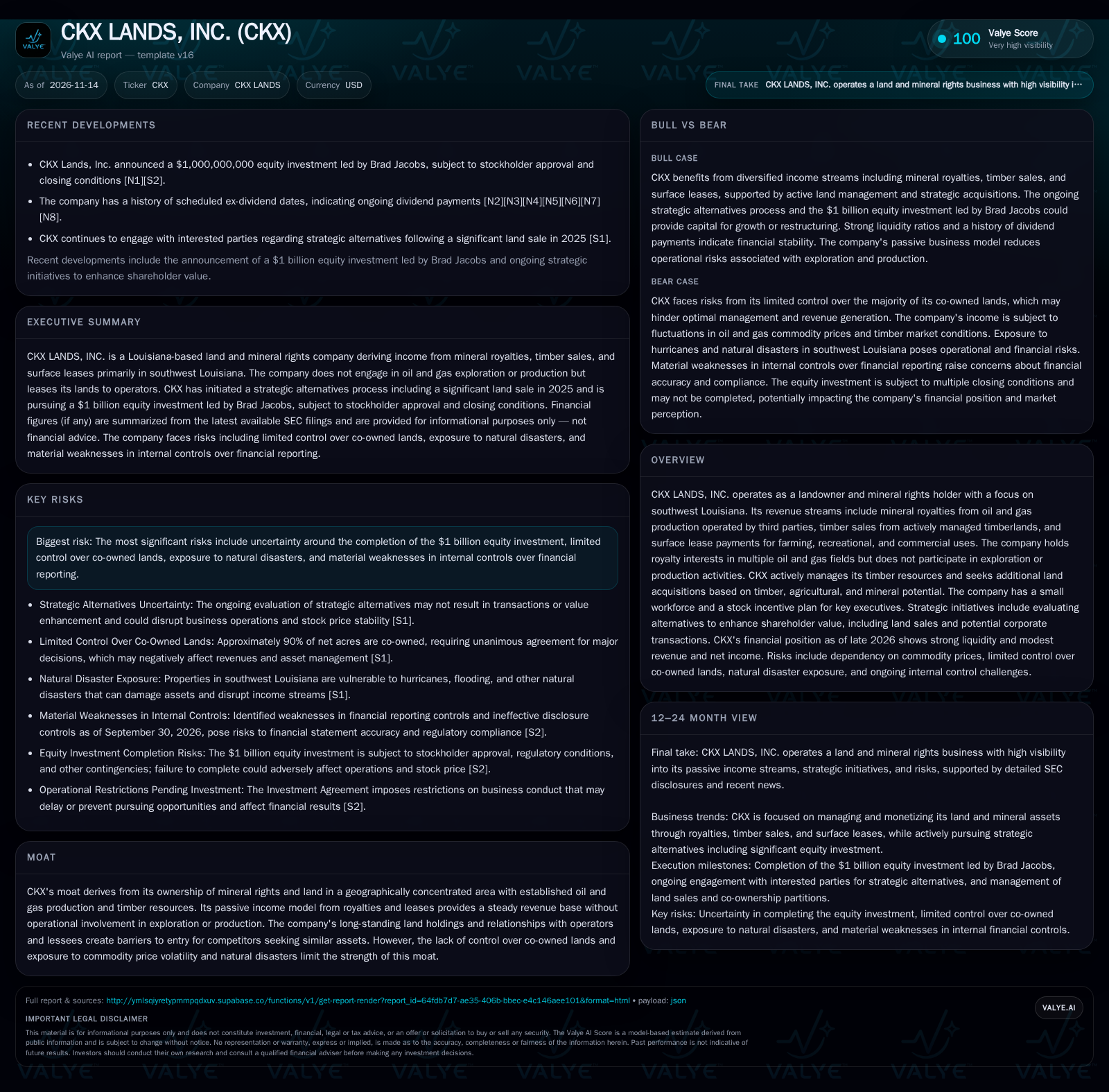
CKX Lands, Inc. is a Louisiana-based land and mineral rights company that generates income from royalties, timber, and surface leases, but controls only a minority of its acreage outright. Following a major land sale and while evaluating strategic alternatives, CKX has entered into a $1 billion equity investment agreement led by Brad Jacobs, subject to approval and closing conditions. The business faces significant risks: limited operational control, commodity and natural disaster exposure, and persistent internal control weaknesses. The outcome of the equity transaction—and the company’s ability to address governance and operational issues—will shape its next chapter. [S1] [S2]
CKX Lands, Inc. stands at a pivotal moment: after decades of passive land and mineral management, the company has both monetized a large tract of land and negotiated a transformative $1 billion equity investment. While its diversified income streams and long-standing asset base provide a degree of stability, CKX’s operational influence is sharply constrained by co-ownership structures, and its financial controls have come under scrutiny. The pending investment, if completed, could radically alter the company’s scale and strategy—but execution, governance, and commodity risks remain front and center.
Strategic Alternatives and Pending Capital Infusion: The New CKX Crossroads
CKX Lands has initiated a series of major strategic shifts since 2025. The sale of approximately 6,548 acres for $8.6 million in cash marked a decisive step in its evaluation of alternatives, reducing the direct land base but potentially freeing capital for other uses. Most consequential, however, is the November 2026 announcement of a $1 billion equity investment led by Brad Jacobs—a transaction that, if approved and closed, would inject unprecedented capital and impose operational restrictions until closing. This deal is subject to stockholder approval and numerous conditions, including the risk of termination fees and possible litigation if it falls through. Meanwhile, the company reports material weaknesses in internal control over financial reporting, with disclosure controls deemed ineffective as of September 30, 2026, raising questions about governance and reliability of its financial data. CKX’s most recent financials show modest revenues ($314,073) and net income ($444,020) for the period, with a cash and short-term investment position totaling over $10 million and minimal current liabilities. [S1] [S2]
How CKX Monetizes Land: Passive Income, Fixed Costs, and Commodity Exposure
CKX’s business model is distinguished by its passive asset management approach. The company derives revenue from three primary streams: mineral royalties (principally oil and gas), timber sales, and surface lease payments. Mineral income is generated through royalties, lease rentals, and geophysical fees, but CKX neither explores for nor operates oil and gas wells itself—instead, it relies on third-party operators to develop its interests. Timber revenues are realized from managed harvests on company-owned land, subject to the maturity of timber stands and prevailing market prices. Surface income is earned through leases for farming, recreation, and commercial uses, as well as one-off payments (e.g., for pipeline rights of way).
This model features low fixed costs—the company has only two part-time employees and minimal corporate overhead—enabling it to maintain profitability even at modest revenue levels. Capital needs are limited absent major acquisitions or development, and the company does not engage in research and development. However, CKX’s economics are highly sensitive to commodity price cycles and the actions of third-party operators. The company’s ability to extract value from its assets is further constrained by co-ownership arrangements, which require consensus for major decisions on 90% of its net acreage. This limits its ability to time timber harvests, negotiate optimal lease terms, or pursue land improvements unilaterally. Revenue visibility is inherently low, as outcomes depend on commodity markets, operator decisions, and natural events.
Land Holdings, Royalty Interests, and the Limits of Asset-Based Moat
CKX’s core competitive advantage lies in its ownership of mineral and surface rights in a region with a history of oil, gas, and timber production. The passive, royalty-based model offers a steady stream of income without the operational risks of exploration or development, and long-standing relationships with operators and lessees can create some degree of stickiness. However, this moat is inherently limited. The company’s interests are geographically concentrated in southwest Louisiana, exposing it to localized risks—especially hurricanes and natural disasters.
Crucially, the co-ownership structure dilutes CKX’s ability to optimize or reposition its asset base. Any significant management or monetization decision on co-owned land requires unanimous consent, which can delay or block value-creating actions. CKX faces competition not from direct operators but from other land and mineral rights holders—such as institutional timberland owners, private mineral trusts, and public land companies—who may have better operational flexibility, scale, or access to capital. The asset base is also vulnerable to commodity price swings and the declining relevance of certain hydrocarbons if energy transition pressures accelerate.
Transformational Capital Deployment: Unlocking Value from a Passive Asset Base
If the $1 billion equity investment closes as planned, CKX could deploy transformational capital to consolidate land holdings, resolve co-ownership frictions, or diversify into new asset classes—potentially shifting from a passive royalty collector to a more active land and resource manager. The additional capital could enable CKX to acquire full ownership of target parcels, invest in timberland improvements, or pursue strategic acquisitions in adjacent markets (such as renewable energy leases or agricultural expansion).
A favorable scenario would see CKX leveraging its cash position to reduce revenue concentration, increase control over its asset base, and drive higher, more stable returns. Confirmation of this scenario would include successful closing of the equity investment, announcements of new acquisitions or buyouts of co-owners, improved internal controls, and evidence of revenue growth decoupled from commodity price volatility. Conversely, failure to deploy new capital effectively, continued governance challenges, or an inability to improve operational control would falsify the upside case.
Status Quo Maintained: Passive Model Persists Amid Ongoing Constraints
The most plausible path is that CKX continues its current passive-income model, with modest growth or decline driven by commodity cycles, operator activity, and the timing of timber harvests. If the equity investment fails to close, or if operational restrictions persist, CKX may remain capital-rich but strategically constrained—unable to move beyond its legacy limitations. Revenue and profitability would remain highly volatile, tied to forces largely outside the company’s control.
In this scenario, the company’s dividend history might continue, but payout levels could fluctuate as cash flows do. Confirmation would come from continued reliance on third-party operators, absence of major land acquisitions or buyouts, limited change in revenue concentration, and persistent internal control weaknesses. Evidence of improved governance, increased asset control, or new strategic initiatives would challenge this baseline.
Operational Gridlock and Governance Risks Trigger Value Erosion
The primary risk is that structural limitations—co-ownership, commodity price dependency, and weak internal controls—combine to erode asset value and investor confidence. If the equity investment is not completed, CKX could face litigation, termination fees, or reputational harm, further restricting its ability to pursue alternatives. Meanwhile, exposure to hurricanes or other disasters could inflict direct asset losses, while a downturn in oil, gas, or timber prices would depress royalty and lease income.
A scenario of operational gridlock could see CKX unable to execute on strategic alternatives, with revenues stagnating or declining, and continued governance deficiencies undermining reporting credibility. Confirmation would include failed investment closing, adverse litigation outcomes, further disclosure of internal control failures, and evidence of asset impairment or revenue concentration worsening.
What Will Shape CKX’s Next Phase: Strategic Execution, Governance, and Asset Control
Closing status and terms of the $1 billion equity investment, including stockholder approval and resolution of any legal or regulatory contingencies.
Progress on remediating material weaknesses in internal controls over financial reporting, with audit or management updates on effectiveness.
Breakdown of revenue by segment (mineral, timber, surface) and by customer, to monitor concentration risk and diversification—if disclosed.
Any announcements regarding new land acquisitions, buyouts of co-owners, or consolidation of fragmented ownership structures.
Disclosures or updates on the impact of hurricanes, flooding, or other natural disasters affecting asset integrity and income streams.
Updates on litigation or termination fees related to the equity investment if closing is delayed or fails.
Management commentary or board actions regarding the company’s strategic direction and use of proceeds if the investment closes.
Disclaimer: This is research-only, informational analysis and not investment advice. It may include AI-generated interpretation and general industry context. Always verify important details using primary sources.

Comments