
American Strategic Investment Co.: Manhattan Office Portfolio, Strategic Restructuring, and the Test of Financial Viability
The company's future now hinges on its ability to stabilize cash flows, execute on asset diversification, and restore operational credibility in a challenged Manhattan office market.
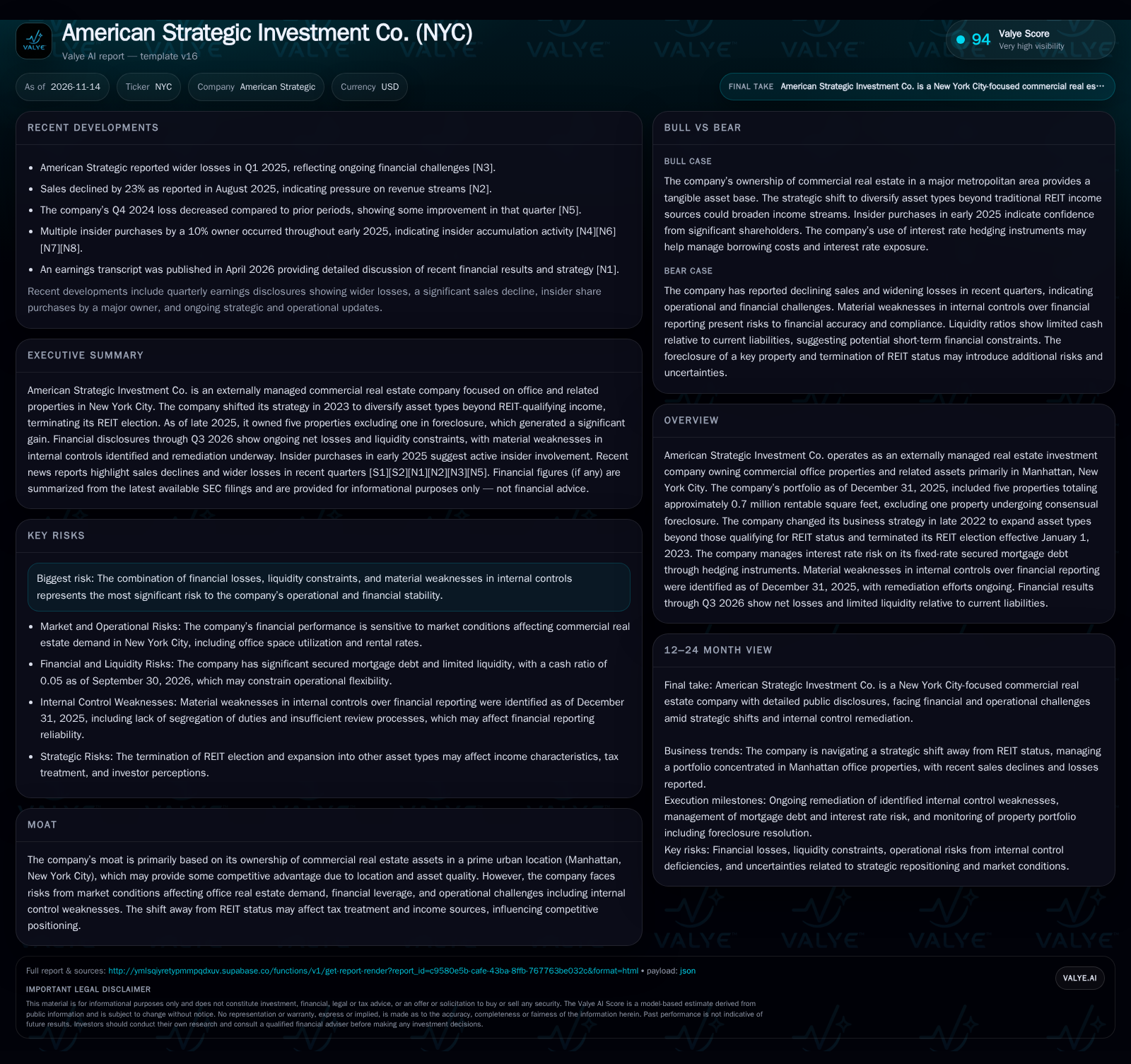
American Strategic Investment Co. owns a concentrated portfolio of Manhattan commercial real estate, having exited REIT status in 2023. Recent periods show persistent net losses, a major property foreclosure (with a related gain), and a cash ratio of just 0.05 as of September 2026. Material weaknesses in internal controls remain under remediation. The company’s prospects depend on its ability to adapt its asset base, address operational weaknesses, and navigate a tough NYC office market.Insider transaction activity was reported in the cited source; this activity does not by itself establish insider confidence. [S1] [S2] [N4] [N6] [N7] [N8]
American Strategic Investment Co. stands at a crossroads after a period of strategic overhaul and operational turbulence. With a portfolio now centered on five Manhattan office properties and related assets, the company has exited its REIT designation and endured the foreclosure of a major asset—highlighting both vulnerability and the potential for portfolio rebalancing. The next phase will test whether management can translate its asset base and strategic pivot into a pathway toward sustainable profitability and operational stability.
Recent Foreclosure, Liquidity Squeeze, and Internal Controls: The Current State
The most consequential recent development is the consensual foreclosure of 1140 Avenue of the Americas, which generated a $47.9 million gain but reduced the company’s property count to five as of December 2025. This event removed a significant asset from the portfolio and may have alleviated some debt pressure, but also shrank the income base. [S1]
Material weaknesses in internal control over financial reporting, notably lack of segregation of duties and insufficient controls over tenant security deposits, remain unresolved as of the end of 2025, with remediation efforts ongoing. These deficiencies can undermine the reliability of reported financials and operational oversight. [S1]
Insider accumulation by a 10% owner throughout early 2025, as evidenced by multiple purchases, signals internal alignment or confidence but does not, on its own, resolve the fundamental operational and financial challenges. [N4] [N6] [N7] [N8]
How Earnings Power Could Evolve: Portfolio Income, Leverage, and the Shift from REIT Structure
American Strategic’s core economics depend on rental income from its Manhattan office and ancillary retail/parking properties. The company’s exit from REIT status in 2023 theoretically opens the door to alternative asset types and non-traditional income streams, but concrete evidence of new revenue lines is not yet observable. [S1]
The company’s cost structure is likely characterized by high fixed costs—debt service, property taxes, and management fees (including those for external management)—with variable costs tied to property occupancy and maintenance. Fixed-rate or swapped-to-fixed-rate mortgage notes totaling $251 million as of December 2025 create substantial leverage, amplifying both upside and downside from asset-level NOI movements. [S1]
Operating leverage is significant: incremental changes in occupancy or rent roll can materially impact bottom-line results due to the high fixed cost base. However, the current net loss profile suggests that, at present occupancy and rent levels, the company is not covering its cost of capital or overhead. [S2]
Liquidity is thin, with just over $5 million in cash and cash equivalents as of September 2026, against $99 million in current liabilities (as of June 2025). No evidence of available revolving credit or alternative liquidity facilities is provided, which may limit the company’s ability to invest in repositioning, tenant improvements, or opportunistic acquisitions. [S2]
Asset Location, Market Headwinds, and the Challenge of Differentiation in NYC Real Estate
The primary source of competitive advantage is the company’s portfolio location—Manhattan, one of the world’s most valuable commercial real estate markets. Prime location can confer pricing power and long-term asset appreciation potential, provided demand for office and retail space remains robust. [S1]
However, Manhattan office markets have faced structural headwinds since 2020, including remote work adoption, elevated vacancy rates, and tenant downsizing. These trends challenge rent growth, leasing velocity, and asset values, particularly for non-trophy or older properties. In this context, American Strategic’s ability to maintain or grow occupancy is likely pressured by both macro trends and competitive supply from larger, better-capitalized landlords.
The company’s external management structure may create cost disadvantages or misalignments versus internally managed REITs or operators, depending on fee arrangements and incentive structures. Without evidence of lower costs, superior tenant retention, or unique asset repositioning strategies, it is difficult to assert a durable operational edge.
The shift away from REIT status removes certain tax advantages and may signal a willingness to take on non-traditional real estate risk, but the path to competitive differentiation in new asset types is unclear until new investments or partnerships are disclosed.
If Asset Diversification and Operational Turnaround Succeed
A constructive scenario would see management successfully deploy the new non-REIT strategy by acquiring or repositioning assets with higher-yielding or more resilient income streams, such as flexible office, life sciences, or mixed-use properties. If new investments generate incremental NOI, the company could stabilize or grow cash flow, reduce reliance on traditional office demand, and begin to deleverage.
Remediation of internal controls could restore confidence in financial reporting and unlock greater operational efficiency, potentially reducing overhead or leakage.
Confirmation of this scenario would include: (1) evidence of new asset acquisitions or repositionings outside traditional office/retail, (2) sequential improvement in occupancy or rent per square foot, (3) narrowing operating losses or return to profitability, (4) resolution of internal control weaknesses in subsequent audit reports, and (5) renewed access to external capital or refinancing on improved terms.
Stabilization with Limited Growth: Navigating a Difficult Market with Existing Assets
The most plausible near-term outcome is operational stabilization rather than robust growth. In this scenario, the company manages to maintain occupancy and rent levels across its five remaining properties, while gradually addressing internal control issues and shoring up credibility with lenders and tenants.
Cash flow remains constrained, limiting the pace of asset diversification. Incremental progress on internal controls and modest improvements in operating metrics may prevent further deterioration but are unlikely to deliver rapid profitability or balance sheet repair.
Evidence supporting this scenario would include: steady or slowly improving occupancy rates, stable or marginally positive cash flow from operations, and auditor attestation that internal control weaknesses are being remediated. Conversely, a sharp drop in occupancy, further property disposals, or persistent material weaknesses would challenge even this modest stabilization thesis.
Liquidity Stress, Unaddressed Controls, and Asset Value Erosion
An adverse scenario would see continued net operating losses eroding the already reported cash balance, potentially forcing distressed property sales or further foreclosures. Inability to remediate internal control weaknesses could trigger lender or regulatory scrutiny, leading to increased borrowing costs or covenant breaches.
If NYC office demand weakens further, the company could face declining occupancy, lower effective rents, and falling asset values—potentially putting additional secured properties at risk of covenant default or foreclosure. The external management structure and thin liquidity would limit options for recapitalization or defensive investment.
Clear signs of this scenario would include: another property entering foreclosure or being sold under duress, a further decline in cash balances without offsetting asset sales or capital raises, persistent or worsening material weaknesses in internal controls, and negative audit findings or regulatory actions.
Milestones and Data That Will Determine Whether American Strategic's Restructuring Delivers
Quarterly occupancy rates and rent per square foot across the five remaining properties—if disclosed—would clarify whether the company is stabilizing its income base.
Disclosure of new asset acquisitions or repositionings outside traditional Manhattan office and retail would provide evidence of strategic diversification.
Progress updates on remediation of internal control weaknesses, as reflected in future audit reports, will be critical to restoring financial credibility.
Net operating income (NOI) and cash flow from operations, on a property-by-property basis if available, would illuminate whether the business is approaching break-even or requires further asset sales.
Status of mortgage debt covenants and any amendments, waivers, or breaches reported in SEC filings—these will signal lender confidence or stress.
Any announced capital raises, refinancing efforts, or new credit facilities would indicate the company’s ability to address liquidity constraints.
Evidence of further insider purchases or sales may provide incremental signals of management and major shareholder alignment, though should be interpreted cautiously.
Disclaimer: This is research-only, informational analysis and not investment advice. It may include AI-generated interpretation and general industry context. Always verify important details using primary sources.

Comments