
Edgemode’s AI Data Center Ambition: Asset Risk, Funding Gaps, and the Challenge of Scaling from Zero Revenue
Edgemode, Inc. aims to leapfrog from a failed crypto mining past into the capital-intensive world of AI data centers, but delinquent payments on its core joint venture threaten both asset control and the viability of its new business model.
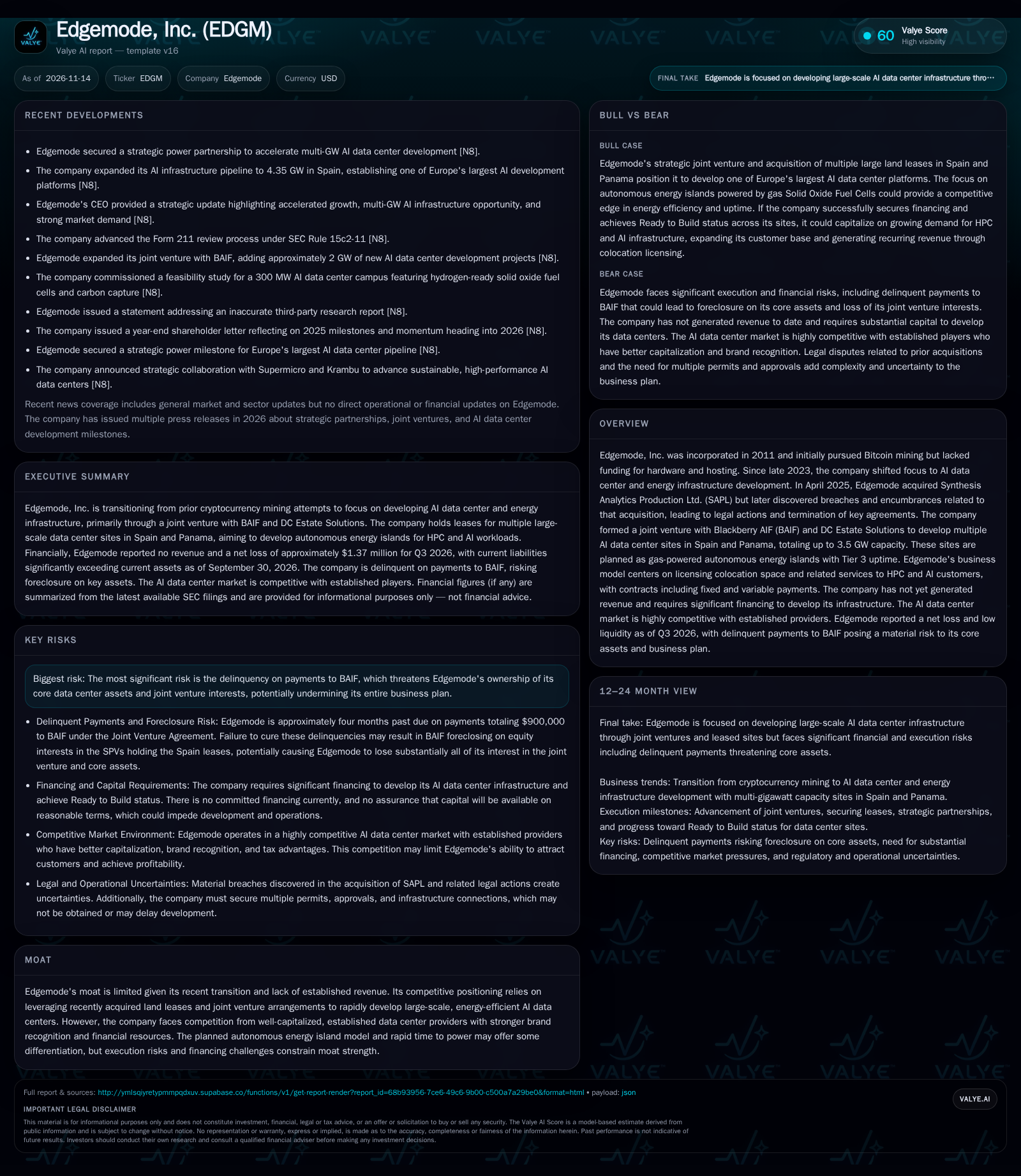
Edgemode is attempting a rapid pivot from cryptocurrency mining to building large-scale AI data centers in Spain and Panama. It holds significant land leases and joint venture interests but has generated no revenue to date. The company is four months behind on payments to its key JV partner, risking foreclosure on its main assets. With current liabilities far exceeding assets, Edgemode faces immediate financial and execution risks in a highly competitive sector dominated by better-capitalized incumbents. Success depends on securing substantial new financing and curing its payment defaults before losing control of its development platform. [S2]
Edgemode, Inc. is betting its future on a pivot from unfulfilled cryptocurrency mining ambitions to building and operating next-generation AI-focused data centers. With ambitious plans for 3.5 GW of capacity across Spain and Panama, its joint venture structure and energy island concept aim to attract high-performance computing and AI customers. However, the company’s lack of revenue, mounting losses, and critical payment delinquencies to its main partner threaten both asset control and the feasibility of its transformation. For Edgemode, the next few quarters will determine whether it can secure the capital and execution prowess needed to survive in one of the most capital-intensive and competitive segments of the infrastructure market. [S2]
Asset Control and Payment Delinquencies Define Near-Term Survival
Edgemode’s most material current facts revolve around its financial distress and existential asset risk. The company reported no revenue and a net loss of approximately $1.37 million for Q3 2026, with current liabilities significantly exceeding current assets as of September 30, 2026. Of immediate concern is its approximately $900,000 in delinquent payments to BAIF, its key joint venture partner, which is now four months overdue. This delinquency threatens foreclosure on Edgemode's equity interests in the special purpose vehicles (SPVs) holding the Spain site leases—assets central to its AI data center ambitions. If BAIF forecloses, Edgemode could lose nearly all of its interest in its core development platform, undermining the foundation of its business plan. [S2]
Colocation Revenue Model Meets Multi-Billion-Dollar Capital Requirements
Edgemode’s intended revenue model centers on licensing colocation space and related services to high-performance computing (HPC) and AI customers. Typical colocation economics in this sector involve a mix of fixed recurring payments (for reserved power/capacity) and variable charges (energy usage, ancillary services). For large-scale, energy-intensive AI workloads, contract structures often span several years, with major customers demanding high uptime, robust connectivity, and energy efficiency.
However, the capital intensity of building multi-gigawatt data center campuses is extreme: land acquisition, site preparation, power infrastructure (in Edgemode’s case, autonomous gas-powered islands), and Tier 3 data center construction require hundreds of millions—if not billions—of upfront investment. Until sites are operational and customer contracts are signed, cash outflows dominate. Operating leverage is high: once built and contracted, incremental revenue can drive substantial margin expansion, but the fixed cost base and financing costs are daunting. Edgemode’s current financials—no revenue, negative net income, and liabilities exceeding assets—underscore its urgent need for external capital and raise questions about its ability to fund even initial construction phases. [S2]
Facing Entrenched Rivals and High Barriers to Entry in AI Data Infrastructure
Edgemode’s competitive landscape is dominated by established data center operators with deep pockets, proven track records, and long-standing customer relationships. These incumbents benefit from economies of scale, access to low-cost capital, and often enjoy tax and regulatory advantages in their operating regions. For a new entrant, differentiators might include unique energy sourcing (such as Edgemode’s planned gas-powered autonomous energy islands), rapid time-to-power for hyperscalers, or innovative site selection. However, these advantages are only theoretical until execution is proven: delays, permitting challenges, and financing shortfalls can erode any first-mover narrative.
Switching costs for customers in this sector can be high once infrastructure is operational, but until Edgemode demonstrates reliability and delivers on its build promises, it will struggle to win meaningful contracts. Furthermore, larger competitors may preemptively lock up major customers or undercut pricing, making entry even more difficult.
If Financing Arrives and Site Milestones Are Met, Scale and Recurring Revenue Could Follow
The optimistic scenario for Edgemode hinges on successfully curing its payment defaults, securing substantial new financing, and achieving 'Ready to Build' status at its Spain and Panama sites. If these milestones are met, Edgemode could leverage its large land holdings and joint venture structure to attract anchor AI/HPC customers seeking scale, energy efficiency, and geographic diversity. Early customer wins could validate the autonomous energy island model, enabling the company to lock in multi-year revenue streams and achieve operating leverage as sites ramp.
Evidence that would confirm this scenario includes public announcements of major funding rounds (debt or equity), successful resolution of payment delinquencies with BAIF, regulatory approvals and permits obtained for site construction, and signed contracts or letters of intent with large AI or hyperscale customers. Conversely, the lack of financing, continued asset risk, or failure to achieve site development milestones would quickly falsify the upside case.
Execution Stalls Amid Persistent Funding Gaps and Competitive Pressures
The most plausible path given current facts is that Edgemode continues to struggle with funding shortfalls and execution delays. Without a near-term cure for its payment delinquency, it risks forfeiting its core Spain assets to BAIF, which would cripple its development platform. Even if a temporary extension or partial funding is secured, the company’s lack of brand, track record, and financial resources makes it difficult to compete with established data center operators for large customers.
In this scenario, Edgemode may spend the next several quarters in a holding pattern: negotiating with creditors, seeking bridge financing, and attempting to retain control of its assets while progress toward construction and revenue is slow or stalled. Confirmation would come from further SEC filings or disclosures showing continued payment issues, lack of new financing, or minimal development activity, while meaningful customer wins or site progress would begin to falsify the base case.
Foreclosure and Asset Loss Unravel the Business Plan
The adverse scenario is already foreshadowed by Edgemode’s four-month payment delinquency: BAIF exercises its rights to foreclose on the SPVs holding the Spain leases, stripping Edgemode of its most valuable assets and effectively unwinding the joint venture. Without these core sites, the company is left with limited or no path to revenue, and its ability to pivot or recapitalize is severely impaired. Creditors could pursue further claims, and any ongoing legal disputes from prior acquisitions (such as the SAPL issue) would only compound uncertainty.
Confirmation of this scenario would come from public notices of foreclosure, asset transfers, or legal actions resulting in loss of site control. A lack of new financing, ongoing litigation, and the absence of customer engagement would reinforce the downside case.
Milestones and Metrics That Will Determine Edgemode’s Viability in the AI Data Center Race
Resolution—or lack thereof—of the $900,000 payment delinquency to BAIF and any related foreclosure proceedings.
Announcements of new debt or equity financing sufficient to cover site development and working capital requirements.
Progress toward 'Ready to Build' status for Spain and Panama sites, including permits, approvals, and infrastructure connections.
Evidence of signed contracts, letters of intent, or customer commitments from AI/HPC tenants (if disclosed).
Updates on the legal status and potential financial impact of the SAPL acquisition dispute.
Changes in current asset and liability balances that materially affect liquidity (if disclosed in future filings).
Movement in site control—such as new joint venture agreements, asset transfers, or loss of leasehold interests.
Any public statements or filings regarding strategic partnerships or technology validation for the autonomous energy island model.
Disclaimer: This is research-only, informational analysis and not investment advice. It may include AI-generated interpretation and general industry context. Always verify important details using primary sources.

Comments