
Armada Acquisition Corp. II: XRP Treasury Ambition, Liquidity Constraints, and the Binary Nature of the SPAC Path
Armada Acquisition Corp. II (Nasdaq: XRPN) stands at a critical inflection: flush with $230 million in trust from its 2025 IPO but facing severe working capital constraints and a ticking clock to close its XRP-related business combination. Success could position the entity at the intersection of public markets and digital asset treasury management, but failure would mean liquidation and loss of potential upside.
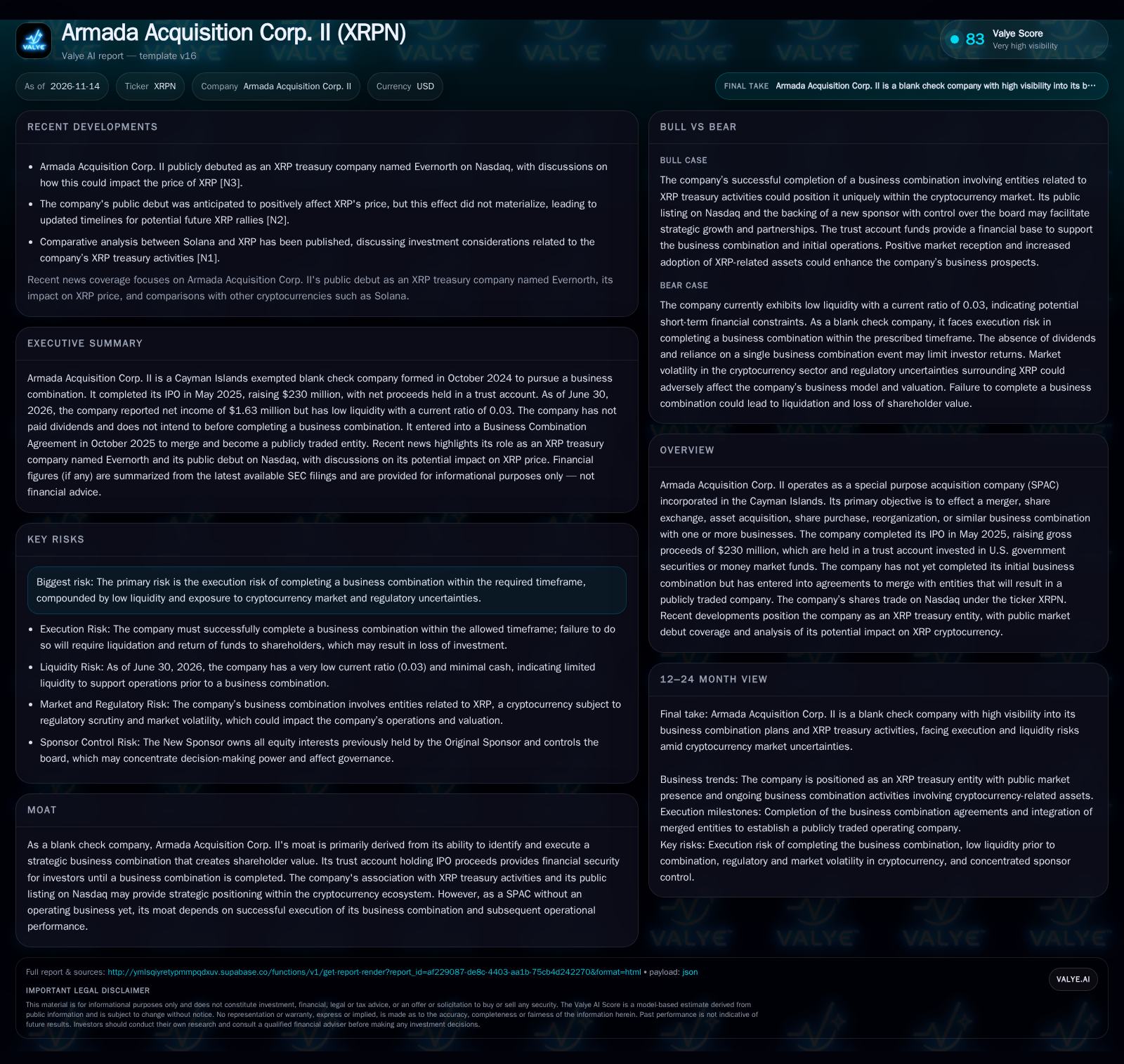
Armada Acquisition Corp. II (XRPN) is a SPAC with $230 million in trust and a pending business combination aiming to create a publicly traded XRP treasury entity. Despite reported net income, its working capital is deeply negative, underscoring the urgency to consummate a deal before the SPAC deadline. The outcome is binary: either value creation through a successful merger in the crypto-treasury space, or forced liquidation if execution falters. Regulatory and market volatility in digital assets remain major external variables. [S1] [S2]
Armada Acquisition Corp. II (Nasdaq: XRPN) illustrates the high-stakes binary nature of the SPAC model—particularly when tethered to volatile, high-profile assets like XRP. With $230 million held in trust and a business combination agreement targeting XRP treasury operations, the company is poised for a potentially transformative public debut. Yet its working capital deficit and scant liquidity underscore the pressure to execute swiftly. The outcome will depend not only on closing the deal, but also on market appetite for regulated crypto-treasury plays and the company’s ability to navigate regulatory and sponsor-control complexities.
Armada’s Financial Position and Pending XRP Business Combination Define Near-Term Reality
Armada Acquisition Corp. II completed its IPO in May 2025, raising $230 million by issuing 23 million units at $10 each. Despite reporting net income of $1.63 million for the period, the lack of operational liquidity means the company is highly dependent on completing its business combination to unlock value and fund ongoing activities. The Business Combination Agreement signed in October 2025 aims to merge Armada with entities focused on XRP treasury functions, which, if successful, would result in a new publicly traded company (PubCo) positioned as an XRP treasury platform. [S1] [S2]
SPAC Economics: Trust Capital, Deal Deadline, and the Crypto-Treasury Opportunity
Armada’s economic model follows the classic SPAC template: IPO proceeds are sequestered in trust, available only for an approved business combination or, if no deal closes, returned to shareholders. This structure creates a fixed pool of capital and a finite window to consummate a deal—typically 18-24 months from IPO. Until a business combination is completed, Armada generates no operating revenue, and expenses must be covered by minimal working capital, not the trust. The reported net income is likely a function of interest earned on trust assets, which is generally available to cover certain administrative costs, but is insufficient for meaningful operations.
If the proposed merger with XRP treasury entities closes, Armada’s economics would pivot dramatically. The new entity’s revenue model would likely depend on managing XRP reserves, facilitating crypto-related treasury solutions for clients, or leveraging digital asset lending, custody, or transaction services. Fee income, yield on digital assets, and potential trading or staking revenues could become core drivers. However, these economics are highly sensitive to the price, volatility, and regulatory treatment of XRP and related assets. Fixed costs may rise post-combination due to compliance, technology, and staffing needs, while variable revenue would track digital asset activity and market adoption. The capital intensity post-merger will depend on the operational scope—if the entity requires significant technology buildout or regulatory capital buffers, ongoing funding needs could be substantial.
Positioning in the Crypto-Treasury Space: Advantages and Counterforces
Armada’s pending transformation into an XRP treasury entity offers potential first-mover visibility in the public markets, especially as institutional interest in crypto-treasury management grows. The Nasdaq listing provides a layer of regulatory credibility and access to mainstream capital markets that private crypto-treasury operators may lack. If the merged entity can deliver secure, compliant digital asset treasury services—whether for enterprises, funds, or institutional investors—it could carve a niche.
However, the competitive landscape is crowded and rapidly evolving. Competing platforms range from pure-play crypto custodians and payment processors to traditional banks building digital asset capabilities. Substitutes include decentralized finance (DeFi) protocols, stablecoins, and multi-asset treasury platforms. Key counterforces include regulatory uncertainty (especially for XRP, which has faced litigation and shifting legal status), rapid technological change, and the risk that enterprises prefer broader or more established digital asset platforms. The company’s moat will depend on its ability to blend regulatory compliance, security, and integration with mainstream financial workflows.
How Successful Deal Execution Could Unlock Public-Market Crypto Treasury Value
A successful close of the business combination, followed by effective integration of XRP treasury operations, could position the new PubCo as a go-to platform for public market exposure to digital asset treasury management. In this scenario, Armada leverages its Nasdaq listing and trust capital to build or acquire technology, attract institutional clients, and offer differentiated services—such as secure custody, real-time treasury analytics, or yield solutions for XRP and potentially other digital assets.
Upside would be confirmed by rapid onboarding of enterprise customers, growing assets under management (AUM), and positive fee or yield income trends. Additional validation could come from partnerships with major financial institutions, licensing or regulatory approvals expanding addressable markets, and coverage by crypto analysts or index inclusion. If the merged entity can demonstrate recurring revenue, margin expansion, and resilience to crypto price volatility, public market appetite could drive a premium valuation.
Most Likely Outcome: Deal Completion Followed by Integration and Market Test
The most plausible trajectory is that Armada completes its business combination close to the SPAC deadline, transitions the trust assets to the new PubCo, and launches as an XRP treasury platform. Early quarters would focus on technology integration, regulatory compliance, and initial customer acquisition. Revenue growth may be modest at first, with operational costs rising as the business scales up compliance, technology, and client-facing teams.
Base case confirmation would come from closing the merger on time, stable post-deal financial reporting, and initial traction in enterprise or institutional treasury services. Falsification would be signaled by delays in deal closure, inability to build or acquire the necessary technology, or limited early customer adoption. Market volatility in XRP or adverse regulatory actions could also pressure the base case.
Deal Failure, Liquidation, and the Loss of Optionality
The primary downside is binary: if Armada fails to close the business combination within the required timeframe, the SPAC will be forced to liquidate, returning trust funds to shareholders (less certain expenses) and wiping out any upside for sponsors and warrant holders. This outcome would also strand any preparatory investment by the would-be target and erode market confidence in similar SPAC/crypto tie-ups.
Even if the deal closes, downside risk remains if regulatory bodies restrict XRP use, if the crypto market contracts, or if the merged entity fails to attract clients. Weak adoption, technology setbacks, or loss of banking or regulatory support could quickly stress the business model. Confirmation of this scenario would come from missed deal deadlines, restatements of trust value, or public statements about liquidation or failed negotiations.
Milestones and Metrics That Will Define Armada’s SPAC-to-Crypto-Treasury Trajectory
Progress and timeline toward closing the business combination, including regulatory and shareholder approvals.
Any public disclosure of post-merger business model specifics—such as intended revenue streams, target customer segments, and technology stack.
Regulatory developments affecting XRP in key jurisdictions, and any resulting changes in the business combination structure or timing.
Announcements of partnerships, pilot customers, or enterprise onboarding for the post-merger entity.
Evidence of initial revenue generation or assets under management (AUM) growth in the merged company, if disclosed.
Any signals of sponsor or board changes, especially if they alter governance or deal execution risk.
Market reaction to the public debut of the merged entity, including volume, valuation, and analyst coverage.
Disclaimer: This is research-only, informational analysis and not investment advice. It may include AI-generated interpretation and general industry context. Always verify important details using primary sources.

Comments