
Infinite Eagle Acquisition Corp.: Assessing SPAC Execution Leverage and the Realities of the De-SPAC Clock
Infinite Eagle Acquisition Corp. (IEAG) enters the late-2026 SPAC market with $345 million in trust and a team boasting deep dealmaking experience. Yet, as the 24-month business combination deadline approaches, the company faces the classic SPAC challenge: leveraging its financial and relational strengths to secure a compelling acquisition before time and market conditions erode its strategic flexibility.
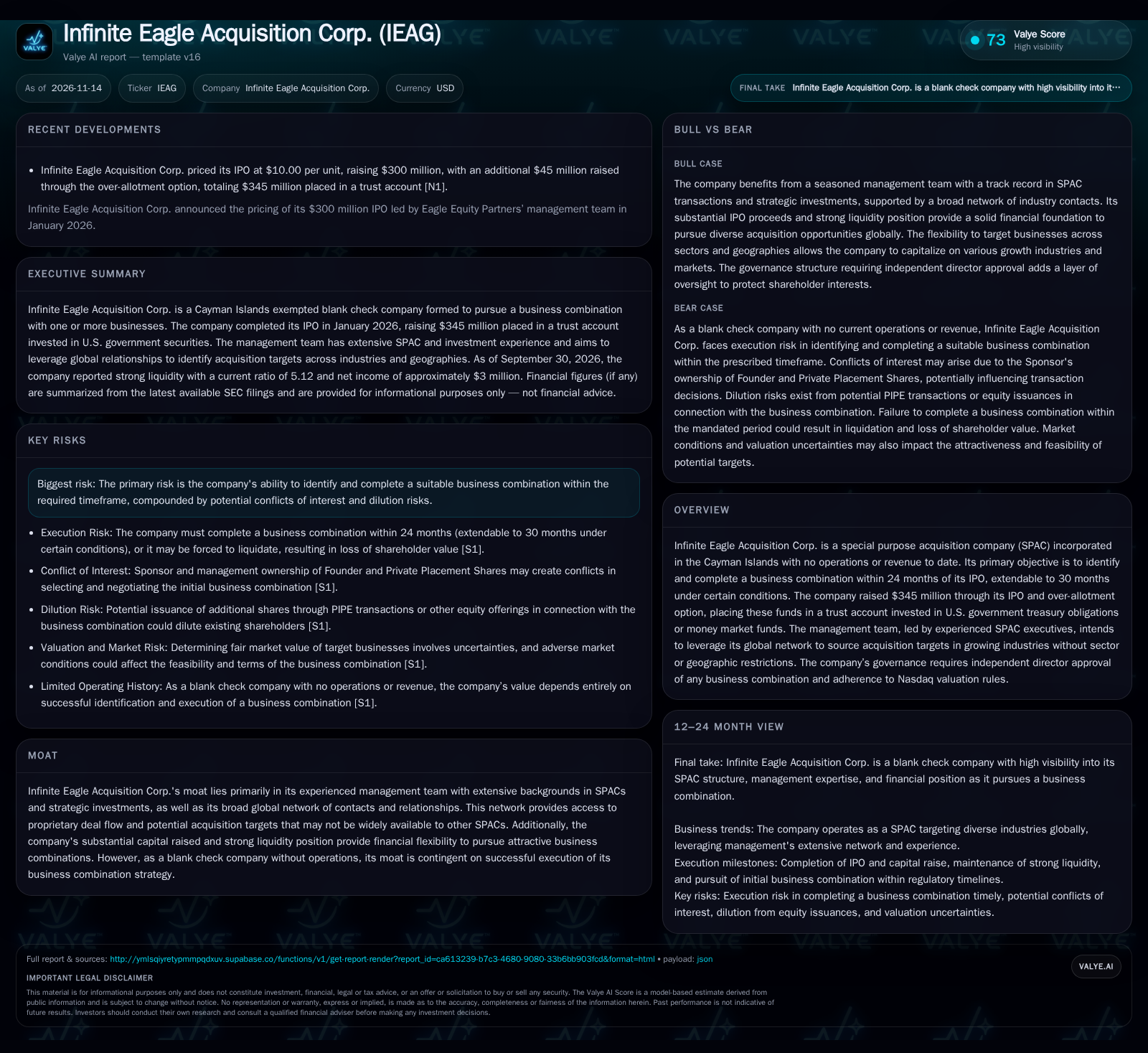
IEAG is a newly public SPAC with $345 million in trust, targeting any sector or geography, guided by a management team with significant SPAC and investment experience. The company has a 24-month window (extendable to 30 months under certain circumstances) to complete a business combination or face liquidation. Its financial position is strong, but the pressure to identify, negotiate, and close a deal—while managing dilution and valuation risk—defines both its opportunity and its vulnerability. The next year is critical for demonstrating sourcing advantage and execution discipline. [S1] [S2]
Infinite Eagle Acquisition Corp. (IEAG) stands at a crossroads common to late-stage SPACs: flush with IPO capital and led by an experienced team, but with the clock ticking to secure a high-quality business combination before regulatory deadlines force a return of funds to shareholders. With $345 million in trust and no sector or geographic limits, IEAG’s flexibility is an asset—but also exposes it to the full range of execution, dilution, and valuation risks endemic to the current SPAC landscape. The next 12 months will be telling as the management team seeks to convert its global relationships and capital base into a deal that justifies both the structure and the opportunity cost for public investors. [S1] [S2]
IEAG’s Trust Capital, Deadline, and Deal Mandate: What Defines Its Next Moves
IEAG completed its IPO in January 2026, raising $345 million (including over-allotment) and placing these funds in a U.S.-based trust account invested in government securities.As of September 30, 2026, the trust held $351.6 million, with a separate unrestricted cash balance of $368,712 and current liabilities of $100,885, giving a reported current ratio of 5.12. The company has not generated operating revenue; its reported net income to date reflects interest income on the trust, not business operations. [S1] [S2]
The most material constraint is time: IEAG must announce and close an initial business combination within 24 months of its IPO (by January 2028), extendable to 30 months if a letter of intent or agreement is signed within the first 24 months. Failure to do so would trigger liquidation and return of funds to shareholders, minus transaction expenses. The company’s mandate is broad—no sector or geographic limits, with a focus on leveraging the team’s global network and SPAC experience. [S1]
The management team, including Harry Sloan and Jeff Sagansky, brings a history of SPAC and investment transactions, which may enable access to proprietary deal flow and negotiation leverage in a crowded market. [S1]
How SPAC Economics Shape IEAG’s Incentives and Risks
IEAG’s economics follow the standard SPAC model: investors provide capital upfront, with funds sequestered in a trust until a business combination is completed. Until then, the company generates only interest income on the trust, while incurring legal, diligence, and compliance expenses. The critical value-creation event is the de-SPAC transaction, where the target company merges with IEAG and assumes its public listing.
The company may use a mix of trust funds, additional equity (PIPEs), or debt to finance the acquisition. Each financing path has trade-offs: equity raises can dilute public shareholders, particularly if the deal is priced aggressively or if redemptions are high; debt can constrain the post-merger entity’s flexibility and raise solvency risk if the operating business underperforms. [S1]
IEAG’s operating leverage is essentially zero until a deal closes; subsequent economics depend entirely on the acquired business’s margin structure, capital intensity, and growth profile. The structure of Eagle Share Rights and Founder Shares means that the Sponsor and management have an embedded incentive to complete a deal, as their shares convert only upon a successful combination—raising the risk that marginal deals may be pursued under deadline pressure. [S1]
Deal Sourcing in a Crowded SPAC Field: Where IEAG Might Carve an Edge
IEAG competes with other SPACs, private equity, and strategics for acquisition targets. In late 2026, the SPAC market remains saturated, with many vehicles chasing a finite pool of attractive targets—particularly those with credible growth trajectories and public-market readiness. IEAG’s lack of sector or regional focus is a double-edged sword: it maximizes flexibility and the potential to pivot into emergent themes (e.g., AI, climate tech, digital infrastructure), but also means the company is competing against both sector specialists and generalists.
The principal source of potential advantage is the management team’s global network and past SPAC execution. If these relationships yield proprietary or off-market opportunities—especially targets that value public listing speed or strategic partnership—IEAG could bypass competitive auctions and secure better terms. However, absent a unique sourcing angle or clear thematic focus, IEAG risks being a price taker in a frothy market or settling for subscale or lower-quality assets.
The structure of Sponsor and Founders’ equity creates possible conflicts of interest: while it aligns management with deal completion, it may also incentivize pursuit of any deal over the optimal deal, especially as the deadline approaches. The governance requirement for independent director approval provides a check, but market history shows this is not always sufficient to prevent value-destructive combinations. [S1]
Scenario: Proprietary Sourcing and Sponsor Leverage Yield a High-Quality, Scalable Target
In a favorable outcome, IEAG leverages its management team’s network to identify a high-growth, scalable business—potentially outside the most crowded U.S. tech or consumer sectors—where public listing brings strategic and capital advantages. The deal is structured with limited dilution, manageable redemption rates, and post-merger economics that support sustained public-market valuation.
Confirmation would come from a deal announcement that: (1) features a recognized, credible target with a differentiated business model; (2) discloses limited reliance on highly dilutive PIPEs or backstops; (3) garners positive market reaction, with low redemption rates and post-merger trading above trust value. Further support would be a clear articulation of the post-merger growth strategy and evidence of Sponsor or management alignment through meaningful rollover equity.
This scenario is most plausible if IEAG can use its flexibility to pursue cross-border or under-the-radar assets, or if market sentiment for SPAC mergers improves, reducing the dilution and valuation penalty typically associated with late-cycle de-SPACs.
Most Likely: Deadline Pressure Drives a Conventional, Moderately Dilutive De-SPAC
The most probable path is that IEAG, under deadline pressure, secures a business combination with a mid-sized, growth-oriented private company. The transaction is enabled by PIPE financing or other equity arrangements, resulting in moderate to high dilution for public shareholders. Redemption rates may be elevated, reflecting broader SPAC market skepticism and the limited time for investor engagement and diligence.
Evidence would include a deal announcement with a less differentiated target, reliance on external PIPEs to meet minimum cash conditions, and post-announcement trading near or below trust value. The Sponsor and management may emphasize their ongoing role, but the deal structure would reflect the typical late-cycle SPAC pattern: value transfer to the target and Sponsors, with public shareholders bearing dilution risk and uncertain upside.
Falsification would require IEAG to announce a truly differentiated, low-dilution deal or, conversely, to announce no deal and return capital upon liquidation.
When the Clock Runs Out: Liquidation or Value-Destructive Deal Becomes the Default
In the adverse scenario, IEAG fails to secure a business combination within the mandated 24-30 month window, leading to liquidation and return of trust funds to shareholders (minus expenses). This outcome may be triggered by deteriorating market conditions, excessive valuation demands from targets, or failure to find a willing PIPE or debt investor to bridge any funding gap.
Alternatively, IEAG may announce a last-minute combination with a subscale or distressed target, primarily to avoid liquidation and secure Sponsor economics. Such a deal would likely involve high dilution, weak post-merger trading, and potential value destruction for public shareholders.
Confirmation would be the absence of a deal announcement as the deadline approaches, or a transaction with clear signs of distress—such as excessive dilution, minimal management rollover, or a target with unresolved operational or financial risks.
What Will Reveal Whether IEAG’s SPAC Model Delivers Shareholder Value
Announcement of a business combination, including identity and sector of the target, and whether it leverages management’s stated network advantage.
Deal structure details: target valuation, mix of cash, equity, and debt, and the extent of dilution to existing shareholders.
PIPE or backstop participation: size, pricing, and terms of any external financing required to close the transaction.
Redemption rates at the time of merger vote, which reflect public investor confidence in the proposed combination.
Post-announcement trading of the combined entity relative to trust value, indicating market validation (or skepticism) of the deal.
Sponsor and management rollover: the proportion of equity retained or reinvested by insiders, which would signal alignment.
Regulatory and Nasdaq compliance, including whether the target meets fair market value and listing requirements.
If disclosed, post-merger financial projections, margin structure, and capital requirements of the target business.
Disclaimer: This is research-only, informational analysis and not investment advice. It may include AI-generated interpretation and general industry context. Always verify important details using primary sources.

Comments