
Evofem Biosciences: Portfolio Expansion, Cost Reset Ambitions, and the Reality of Financial Constraints
Evofem Biosciences has carved out a differentiated niche in women’s sexual and reproductive health with the only FDA-approved hormone-free contraceptive gel and a newly relaunched antimicrobial.
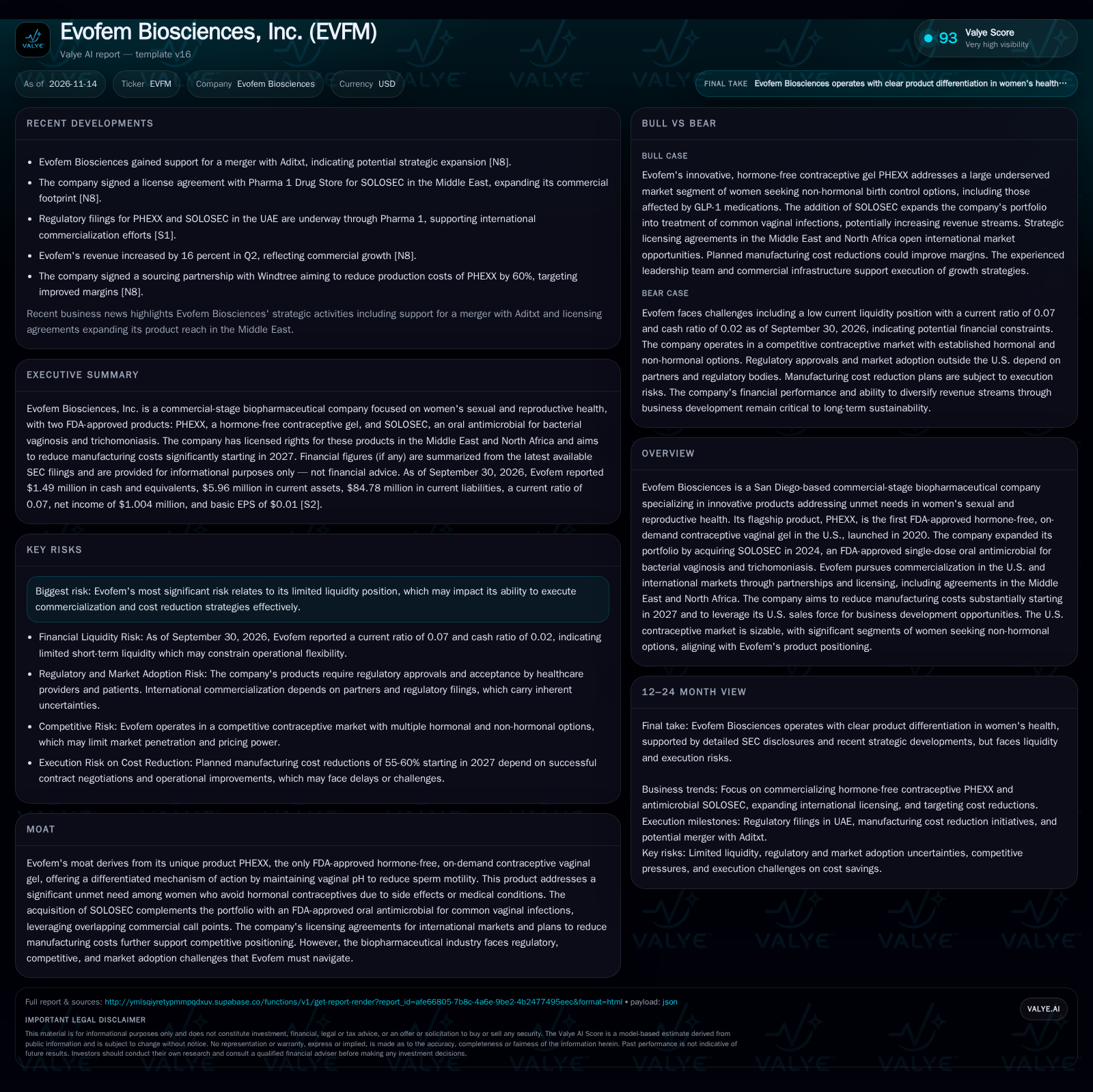
Evofem’s unique product positioning and recent acquisition expand its addressable market, but the company’s extremely low liquidity and high current liabilities frame any operational or strategic progress as contingent on near-term financial solutions and flawless execution. The planned manufacturing cost reset and international licensing offer potential margin and revenue upside, but the company’s ability to capture these opportunities depends on resolving immediate financial pressures and competing effectively in a crowded market [S1] [S2].
Evofem Biosciences is at a strategic inflection point. With a differentiated portfolio targeting major unmet needs in women’s reproductive health, the company is attempting to leverage both U.S. and international markets while engineering a dramatic reset of its cost structure. The question facing investors is whether Evofem’s unique product footprint and cost reduction roadmap can overcome the acute financial constraints and intense market competition it faces.
Liquidity Crisis and Portfolio Expansion Define Evofem’s Present
Two developments dominate Evofem’s current landscape: an acute liquidity crunch and a broadened product portfolio. As of September 30, 2026, the company reported just $1.49 million in cash and equivalents versus $84.78 million in current liabilities, yielding a current ratio of 0.07 and a cash ratio of 0.02 [S2]. The company reported cash and liquidity metrics for the period; these figures do not by themselves establish operating runway, investment capacity, financial flexibility, or financing capacity.
On the product front, Evofem has expanded beyond its flagship PHEXX contraceptive gel by acquiring and relaunching SOLOSEC, an FDA-approved oral antimicrobial for bacterial vaginosis and trichomoniasis, in November 2024 [S1]. Both products are positioned to address significant unmet needs in women’s health and share overlapping commercial call points, potentially enabling cross-selling and cost synergies.
Efforts to reduce manufacturing costs by 55-60% for both products starting in 2027, and the licensing of commercial rights in the Middle East and North Africa (MENA) with regulatory filings underway in the UAE, suggest a dual focus on margin improvement and international growth [S1].
A potential merger with Aditxt adds another layer of complexity and optionality, potentially addressing capital needs and expanding strategic reach if consummated [N8].
How Evofem’s Revenue Model and Cost Structure Could Evolve
Evofem generates revenue through the commercialization of prescription women’s health products—PHEXX and SOLOSEC—primarily in the U.S., with international revenue potential through licensing agreements [S1]. Revenue is driven by unit sales to pharmacies and distributors, subject to payer reimbursement dynamics and out-of-pocket patient payments. Pricing is influenced by the product’s clinical differentiation (hormone-free, on-demand use for PHEXX; single-dose therapy for SOLOSEC), but price realization is limited by coverage variability and competitive pressure.
The company’s gross margins are currently constrained by manufacturing costs, but Evofem plans to reduce these costs by 55-60% starting in 2027 through new manufacturing contracts [S1]. If achieved, this could materially improve unit economics and operating leverage, particularly if sales volumes scale or fixed costs are held flat. However, the benefit is contingent on successful contract execution and stable or growing product demand.
Operating leverage is plausible if the company can expand sales without proportionally increasing SG&A, especially given overlapping call points between PHEXX and SOLOSEC. However, the acute liquidity shortfall risks forced cost cuts or underinvestment, potentially limiting sales force effectiveness or marketing reach.
Capital needs are immediate and non-discretionary, given the mismatch between short-term obligations and available cash [S2]. The company’s ability to execute its strategy is therefore highly dependent on raising external capital, successful business development (including the Aditxt merger), or accelerating cash flow from operations.
Differentiation and Market Barriers in a Crowded Women’s Health Landscape
Evofem’s principal advantage is the unique positioning of PHEXX as the only FDA-approved hormone-free, on-demand contraceptive vaginal gel in the U.S. [S1]. This addresses a sizable subpopulation of women—approximately 15.9 million—who avoid hormonal contraceptives for medical or personal reasons. The company also highlights a $904 million sub-market among GLP-1 medication users who may require non-oral contraceptive options [S1].
However, the broader contraceptive and women’s health markets are highly competitive, with entrenched hormonal methods (oral contraceptives, IUDs, implants), barrier methods, and emerging digital health solutions. Non-hormonal competitors include copper IUDs and condoms, which are well-established and often covered by insurance.
SOLOSEC expands the addressable market into treatments for bacterial vaginosis and trichomoniasis, but faces generic competition and established brands in antimicrobial therapy. Evofem’s ability to cross-sell and leverage shared prescriber relationships may offer incremental advantage, but sustained differentiation will depend on payer coverage, patient adoption, and real-world outcomes.
Internationally, regulatory hurdles, local competition, and the need for effective distribution partners add complexity. Early licensing steps in the MENA region are promising, but market penetration will depend on partner execution and regulatory timelines.
Cost Reset and International Growth Could Unlock Margin and Revenue Expansion
The most favorable scenario for Evofem involves the successful reduction of manufacturing costs by 55-60% starting in 2027, combined with robust adoption of both PHEXX and SOLOSEC in the U.S. and new international markets [S1]. If the company can maintain or grow sales volumes while realizing these cost savings, gross margins could expand significantly, creating positive operating leverage.
International licensing, especially in the Middle East and North Africa, could provide non-dilutive revenue streams if regulatory approvals materialize and local partners execute effectively [S1]. This would diversify the revenue base and mitigate U.S.-centric payer and competitive risks.
[N8] Confirmation of this scenario would require evidence of: (1) successful cost reduction contract execution, (2) accelerating sales growth for both products, (3) regulatory approvals and commercial launches in licensed international territories, and (4) closing of the Aditxt transaction with tangible capital infusion.
Financial Constraints Force Tactical Choices, Limiting Strategic Flexibility
The most plausible near-term scenario is one in which Evofem continues to face acute liquidity pressure, forcing management to prioritize cash-preserving measures and pursue near-term capital raises or partnerships. Sales of PHEXX and SOLOSEC likely grow modestly in the U.S., but the pace is constrained by limited marketing resources and competitive headwinds.
Manufacturing cost reductions remain a future lever, but do not materially benefit margins until at least 2027. International licensing delivers incremental progress, but regulatory approvals and revenue ramp are gradual and subject to partner execution.
The company’s survival and ability to pursue growth hinge on securing additional funding—either via equity, debt, or the Aditxt merger. Evidence supporting this scenario would include continued cash burn offset by periodic financing transactions, moderate but not breakout revenue growth, and incremental progress on international filings and manufacturing contracts.
Liquidity Shortfall Triggers Forced Restructuring or Diminished Operations
In an adverse scenario, Evofem’s acute liquidity crisis is not resolved in time, leading to forced restructuring, asset sales, or a severe reduction in commercial activity. The company may be forced to cut SG&A, limit sales force activity, or delay strategic initiatives, undermining sales momentum for both PHEXX and SOLOSEC.
Failure to execute planned manufacturing cost reductions or delays in regulatory approvals for international markets would further erode the company’s economic outlook. Competitive pressures and payer pushback could accelerate market share loss or require price concessions, compressing margins.
Evidence for this scenario would include further deterioration in liquidity ratios, missed debt or supplier payments, layoffs or restructuring announcements, and stalled progress on international and manufacturing initiatives.
Milestones That Will Determine Evofem’s Ability to Realize Its Strategic Ambitions
Progress toward closing the Aditxt merger, including disclosed transaction terms and capital infusion, would be critical for near-term viability.
Execution of manufacturing cost reduction contracts and public disclosure of realized COGS improvements, starting in 2027, would validate the margin expansion thesis.
Quarterly sales growth rates for PHEXX and SOLOSEC in the U.S., if disclosed, particularly in the context of limited marketing spend, would signal underlying product demand.
Updates on regulatory approvals and commercial launches in the MENA region, especially in the UAE, would test the international expansion opportunity.
Cash burn rate and any new financing transactions, as reported in SEC filings, would indicate whether liquidity pressures are being managed or worsening.
Payer coverage trends for PHEXX and SOLOSEC, including any changes to insurance reimbursement mandates or formulary placement, would impact revenue visibility.
Evidence of cross-selling effectiveness between PHEXX and SOLOSEC, such as prescriber overlap or bundled contracting, would help assess commercial synergies.
Any signs of forced cost-cutting, layoffs, or restructuring would be a negative indicator for operational momentum and strategic execution.
Disclaimer: This is research-only, informational analysis and not investment advice. It may include AI-generated interpretation and general industry context. Always verify important details using primary sources.

Comments