
BioScience Health Innovations: Capital Constraints, Acquisition Mandate, and the Microcap Reality Check
With rising stockholders’ equity but persistent net losses, BioScience Health Innovations, Inc. stands at a crossroads—mandated to secure an operating business while navigating the hazards of reported liquidity position, penny stock status, and a capital base vulnerable to dilution. The company’s future hinges on executing a transformative acquisition and establishing a credible operating model before regulatory and market frictions erode its window of opportunity.
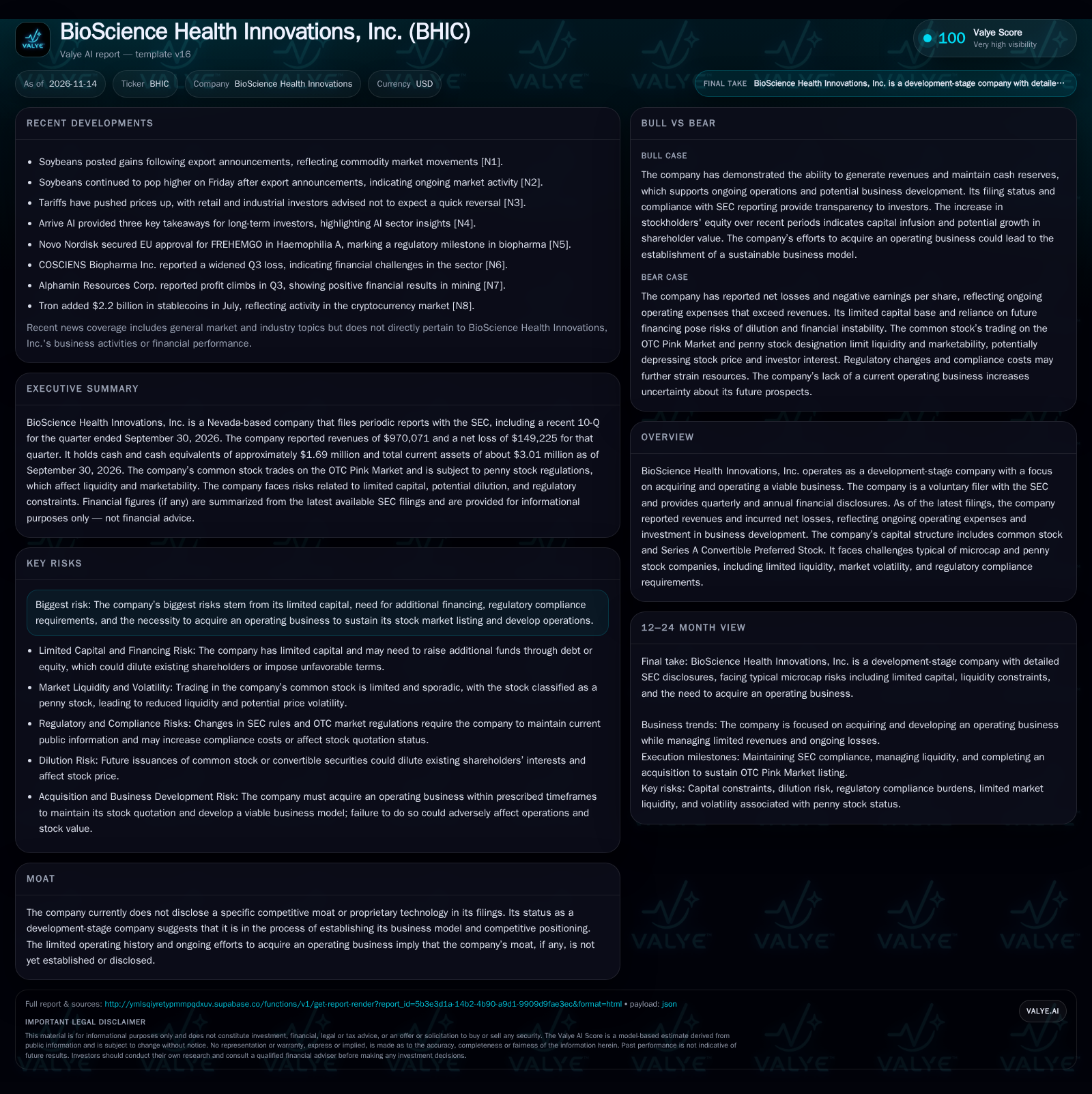
BioScience Health Innovations, Inc. reported $970,071 in quarterly revenue and a net loss of $149,225 for Q3 2026. Stockholders’ equity more than doubled year-to-date, but the firm remains a development-stage entity, required to acquire an operating business to sustain its OTC Pink Market listing. Capital limitations, penny stock status, and the risk of shareholder dilution underscore the urgency and uncertainty of its acquisition-driven strategy. [S2]
BioScience Health Innovations, Inc. typifies the microcap development-stage landscape: modest revenues, ongoing net losses, and an urgent need to secure a viable operating business to preserve its market listing. Despite a more than twofold increase in stockholders’ equity over the past nine months, the company faces a capital structure susceptible to dilution, persistent regulatory headwinds, and a liquidity-constrained trading environment. The next phase for BioScience Health Innovations will be defined by its ability—or inability—to execute an acquisition that transforms it from a shell with periodic revenues to a business with sustainable operations and credible growth prospects. [S2]
Recent Financials Reveal Both Progress and Pressure Points
BioScience Health Innovations, Inc. reported $970,071 in revenue for the third quarter of 2026 and $2,757,381 for the nine months ended September 30, 2026, but continued to post net losses, with a Q3 loss of $149,225. Gross profit for the quarter was $637,564, indicating some margin on its existing activities, yet operating expenses of $785,824 outstripped gross profit, reflecting the ongoing cost of maintaining the corporate shell and pursuing business development. Stockholders’ equity increased to $2,922,712 as of September 30, 2026, from $1,477,330 at the prior year-end, suggestive of recent capital inflows or stock issuance. The company reported cash and liquidity metrics for the period; these figures do not by themselves establish operating runway, investment capacity, financial flexibility, or financing capacity. The company’s shares remain thinly traded on the OTC Pink Market and are subject to penny stock rules, limiting liquidity and increasing volatility. [S2]
Development-Stage Realities: Limited Revenue and Structural Cost Burden
At present, BioScience Health Innovations is not a fully operating business but a development-stage entity with periodic revenue and a structural mandate to acquire a viable operating business. Its cost base is dominated by general and administrative expenses, which comprised $720,121 of the $785,824 Q3 operating expenses. Consulting fees and other professional services also account for a material portion of outlays, reflecting the search for acquisition targets and compliance with SEC reporting. The company’s revenue sources are not detailed in the available filings, making it unclear whether current revenues are recurring, transactional, or opportunistic.
The gross profit margin of roughly 66% for Q3 2026 suggests that, should the company secure a scalable business with a similar or better margin profile, operating leverage could eventually be achieved. However, as long as fixed corporate and compliance costs exceed gross profit, net losses are likely to persist. The capital structure includes both common and Series A Convertible Preferred Stock, which could convert to common equity and further dilute existing shareholders if new capital must be raised. The company’s current assets cover near-term obligations, but the need for further funding—especially to finance an acquisition—remains a central risk.
No Moat Yet: The Challenge of Building Defensible Value
BioScience Health Innovations currently lacks a defined competitive moat or proprietary technology. As a development-stage company, its competitive position is not yet established and will depend entirely on the nature of any future acquisition. In the OTC Pink Market ecosystem, peer companies typically compete on the basis of speed to deal execution, access to capital, and the ability to attract credible management or strategic partners. Larger capital markets competitors, including other SPACs or shell companies, may have stronger sponsor backing, better deal flow, or more established networks. The company’s penny stock status further inhibits its ability to attract institutional investors, strategic partners, or high-quality acquisition targets.
If the company were to acquire a business with intellectual property, regulatory exclusivity, or entrenched customer relationships, it could begin to develop switching costs or network effects. Until such an acquisition is completed and integrated, BioScience Health Innovations remains at a structural disadvantage, with little to differentiate itself beyond its status as a public shell with available cash and SEC filing compliance.
Transformational Acquisition Unlocks Sustainable Business Model
The most favorable scenario for BioScience Health Innovations is a successful acquisition of a high-margin, scalable operating business that leverages its public listing and available cash to catalyze growth. This could occur if the company identifies a target with defensible intellectual property, recurring revenue streams, and a management team capable of executing a credible growth plan. The acquisition would need to be structured to minimize dilution, integrate efficiently, and rapidly demonstrate operating leverage—turning gross profit into positive net income.
Evidence that would confirm this scenario includes the announcement and closing of a binding acquisition agreement, disclosure of pro forma financials showing robust revenue and margin contribution from the target, and subsequent quarters of improved operating performance. Additional confirmation would come from increased trading liquidity, potential uplisting to a more liquid exchange, and a narrowing of the bid-ask spread as investor confidence grows.
Incremental Progress Amid Persistent Constraints
The most plausible near-term outcome is that BioScience Health Innovations continues to operate as a development-stage shell, generating modest periodic revenue while incurring ongoing net losses. The search for a suitable acquisition target may be prolonged, given competition for attractive assets and the company’s limited ability to pay cash or offer liquid stock as consideration. As operating expenses remain elevated relative to gross profit, further equity raises may be required, resulting in shareholder dilution.
Confirmation of this scenario would include continued reporting of modest revenues, sequential net losses, and periodic capital raises or convertible security issuances. If acquisition discussions are disclosed but not consummated, or if targets are announced and subsequently abandoned, this would further support the view that execution risk remains high. The company could retain its OTC Pink Market status but remain stuck in a cycle of compliance-driven cost management and shareholder dilution absent a transformative deal.
Failure to Acquire and Erosion of Listing Status
The adverse scenario is that BioScience Health Innovations fails to secure an operating business within the required timeframe, resulting in the loss of its OTC Pink Market quotation and erosion of residual shareholder value. In this case, ongoing operating expenses would continue to burn through available cash, while the inability to attract new capital or acquisition targets would precipitate a downward spiral of declining liquidity, widening bid-ask spreads, and further stock price volatility.
Evidence for this scenario would include disclosure of missed acquisition deadlines, regulatory warnings, or delisting notices. A sharp drop in reported cash and current assets, coupled with an inability to raise new funds or consummate a deal, would signal that the company’s window of opportunity has closed. In such a scenario, shareholder value would be further impaired by forced asset sales or wind-down costs.
Milestones and Metrics That Will Define BioScience Health Innovations’ Next Chapter
Progress toward signing and closing a definitive acquisition agreement, with details on target business, consideration, and anticipated financial impact.
Quarterly revenue growth, margin expansion, and the degree to which gross profit covers or exceeds operating expenses.
Disclosure of additional capital raises, including terms, size, and resulting dilution to existing shareholders.
Changes in cash and current asset balances, particularly after major deal or financing events.
Any regulatory notices, warnings, or deadlines related to OTC Pink Market listing requirements or SEC compliance.
Liquidity and trading volume in the company’s common stock, especially following major announcements or capital events.
If disclosed, metrics on target company pipeline, customer base, or intellectual property portfolio post-acquisition.
Updates on management composition, board appointments, or strategic partnerships that may signal increased deal execution capacity.
Disclaimer: This is research-only, informational analysis and not investment advice. It may include AI-generated interpretation and general industry context. Always verify important details using primary sources.

Comments