
21Shares Solana ETF: Passive Exposure, Staking Rewards, and the Challenge of Differentiation in Crypto ETPs
21Shares Solana ETF offers investors direct, regulated access to Solana’s native token with the added potential of staking rewards. While the ETF structure provides transparency and operational rigor, the product’s long-term success will depend on competitive fee dynamics, regulatory outcomes for staking, and the evolving landscape of crypto asset ETPs.
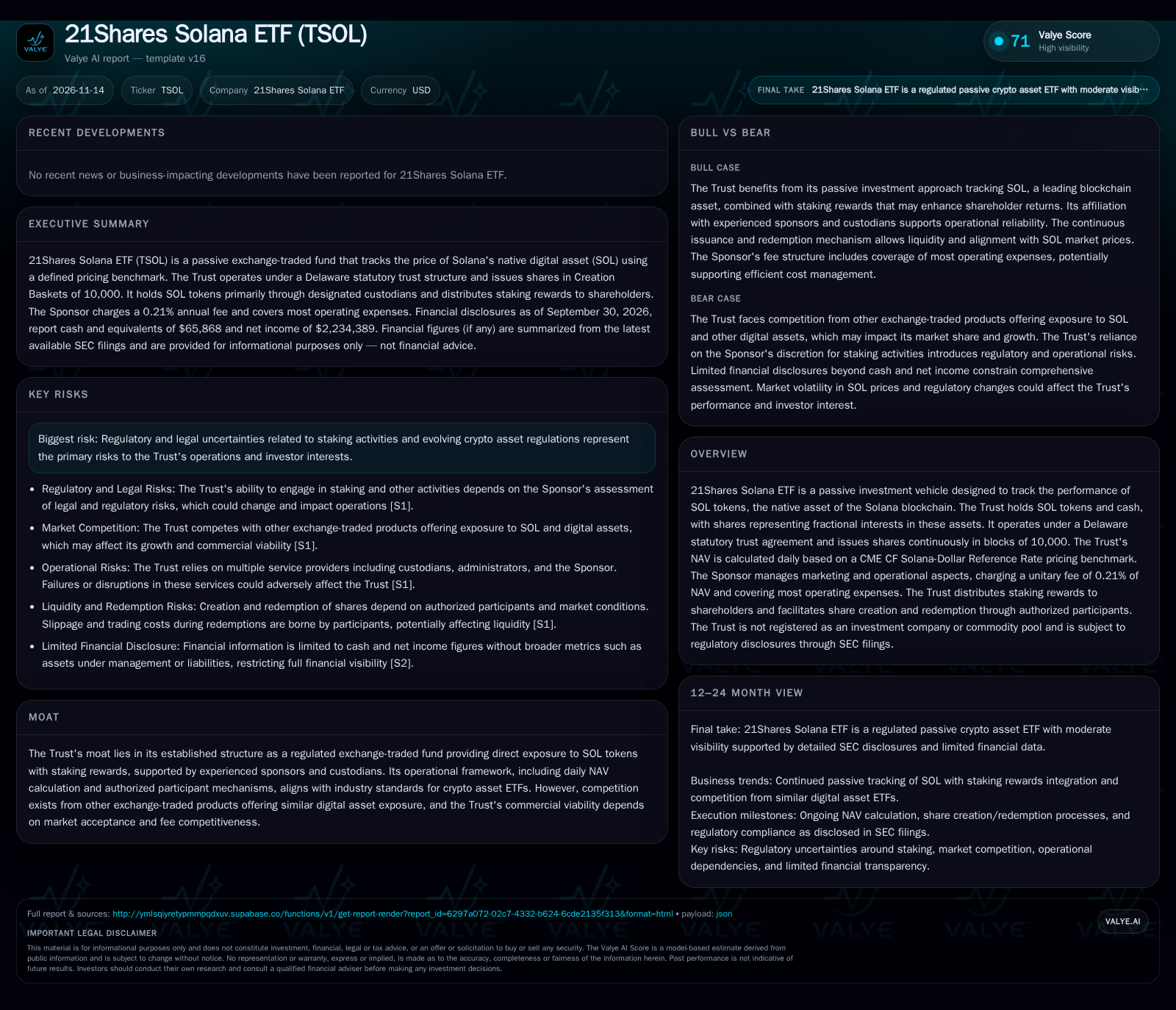
21Shares Solana ETF (TSOL) is a passive ETF holding SOL tokens and distributing staking rewards, with a 0.21% unitary fee and a structure designed for daily liquidity and transparency. As of September 30, 2026, the Trust reported $65,868 in cash and $2.23 million in quarterly net income. Its commercial viability will hinge on Solana’s adoption, regulatory clarity around staking, and its ability to compete with similar digital asset ETFs on cost and execution [S1] [S2].
21Shares Solana ETF (TSOL) provides investors with regulated, exchange-traded exposure to Solana’s native asset, SOL, combining the familiar mechanics of an ETF with the unique attributes of digital assets—including the potential for staking rewards. With a low-fee, passively managed structure and transparent daily NAV, TSOL is designed to appeal to both crypto-native and traditional investors seeking access to Solana via established financial infrastructure. However, the ETF’s long-term prospects will be shaped by its ability to navigate regulatory ambiguity around staking, differentiate itself in a crowded field of crypto ETPs, and maintain operational efficiency amid market volatility and evolving investor expectations [S1] [S2].
Recent Financials and Fund Structure Set the Stage for TSOL’s Next Phase
21Shares Solana ETF currently operates as a passive trust, holding SOL tokens and cash, with shares trading on the Cboe BZX Exchange under the symbol TSOL. The Trust calculates its NAV daily using a CME CF Solana-Dollar Reference Rate and issues shares in Creation Baskets of 10,000. As of September 30, 2026, it reported $65,868 in cash and equivalents and net income of $2,234,389 for the quarter [S2]. Staking rewards are distributed to shareholders at least quarterly, with the Sponsor retaining 10% of rewards (after certain deductions) as compensation [S1]. The 0.21% annual unitary fee covers most operating expenses. Notably, the Trust’s ability to engage in staking is contingent on the Sponsor’s risk assessment and regulatory environment, and it is not subject to regulation under the Investment Company Act or as a commodity pool [S1]. While these mechanics establish the basic economic model, the lack of broader disclosure—such as assets under management—limits external visibility into scale and growth momentum.
How Fee Structure and Staking Rewards Shape Economic Value for Investors
TSOL’s business model is anchored in passively tracking SOL’s price performance, with the addition of staking rewards as a potential source of incremental yield. The 0.21% annual unitary fee, paid in SOL and covering most operating expenses, is designed to be competitive with other single-asset crypto ETFs. This low-cost approach should attract fee-sensitive investors, especially as crypto ETPs are increasingly commoditized. Staking introduces a second layer of economics: the Trust distributes at least 90% of net staking rewards to shareholders, retaining 10% for the Sponsor. If Solana’s staking yields remain attractive and regulatory risk is manageable, this could enhance TSOL’s net returns versus non-staking ETFs.
The ETF structure allows for continuous creation and redemption via authorized participants, supporting liquidity and price alignment with underlying SOL. Most costs are fixed or semi-fixed at the Sponsor level, creating modest operating leverage as assets under management grow. However, as with all passive crypto ETPs, the Trust’s revenue is ultimately a function of AUM, itself driven by investor flows, the perceived prospects of Solana, and the broader risk appetite for digital assets. Capital needs are minimal outside of operational float, as the vehicle does not actively manage or leverage assets.
Differentiation Challenges in a Crowded Crypto ETF Landscape
TSOL’s primary advantage lies in offering direct, regulated exposure to SOL with the added benefit of staking rewards. This positions it ahead of non-staking SOL ETPs on potential net yield, assuming regulatory clarity persists. The low 0.21% fee is competitive within the digital asset ETF segment, where fee compression is an ongoing trend.
However, the Trust faces competition from other Solana ETFs, broader crypto index funds, and alternative vehicles like trusts, closed-end funds, and centralized exchange products. Barriers to entry in launching similar products are modest, particularly as custody and benchmark pricing infrastructure mature. Switching costs for institutional and retail investors are low, with decisions often driven by fee levels, tracking error, and liquidity. TSOL’s operational robustness and the brand reputation of 21co Holdings and FalconX Holdings support reliability, but these are counterbalanced by the ease with which investors can shift to rival products offering similar exposure with lower fees or greater liquidity. The question is whether staking rewards and Sponsor credibility can sustain differentiation as markets mature.
If Staking Rewards and Solana Adoption Drive Flows, TSOL Could Capture Category Leadership
A favorable scenario for TSOL involves a combination of rising Solana adoption, strong on-chain activity driving SOL price appreciation, and regulatory clarity allowing consistent staking reward distribution. In this environment, TSOL would likely attract flows from both crypto-native and traditional investors seeking regulated, yield-enhanced exposure. If the ETF achieves scale, fixed costs become less material, boosting Sponsor profitability and potentially enabling further fee reductions or marketing investment.
Confirmation of this scenario would come from sustained increases in AUM (if disclosed), higher net income driven by both asset appreciation and staking rewards, and narrowing discounts/premia to NAV. Evidence could also include broader market acceptance of staking-enabled ETFs, increasing liquidity, and positive net inflows relative to competing SOL products. Regulatory stability around staking, both in the U.S. and globally, would further support this outcome.
Fee Competition, Regulatory Ambiguity, and Market Volatility Define the Most Likely Trajectory
The most plausible outcome is that TSOL maintains a stable presence among leading SOL-focused ETPs, but faces fee compression, ongoing regulatory scrutiny around staking, and fluctuating investor sentiment tied to the volatility of both SOL and the broader crypto market. The Trust’s ability to distribute staking rewards may be periodically constrained by evolving guidance or risk assessments, potentially narrowing its yield advantage. Operationally, TSOL continues to function reliably, with daily NAV calculation and efficient creation/redemption processes, but does not achieve a dominant share without further differentiation.
Evidence for this scenario would include stable but not rapidly rising AUM (if disclosed), net income that tracks underlying SOL price and staking returns, and periodic disclosures or changes in staking policy. Competitive fee reductions among peer products and shifting flows between ETPs would also support this middle path, as would regulatory updates that neither fully endorse nor prohibit staking in ETF structures.
Regulatory Shocks or SOL Underperformance Could Undermine the ETF’s Appeal
A negative scenario would be triggered by adverse regulatory developments, such as prohibitions or severe restrictions on staking within ETF vehicles, forcing TSOL to suspend staking rewards and eroding its yield advantage. Alternatively, a sharp decline in SOL’s price or a loss of confidence in the Solana ecosystem—due to technical, security, or governance failures—would drive investor redemptions and limit net income. Fee wars could further compress Sponsor margins, especially if rivals move to zero or subsidized fees to gain share.
This scenario would be confirmed by public announcements suspending staking, declining or negative net income, persistent outflows or significant discounts to NAV, and regulatory communications increasing compliance costs or operational uncertainty. A collapse in broader crypto ETP volumes or a major custody or operational failure would also provide strong evidence of downside risk manifesting.
What Will Determine 21Shares Solana ETF’s Staying Power in the Crypto ETP Arena?
Disclosure of assets under management (AUM)—if provided—would offer crucial insight into investor adoption and fee revenue potential.
Frequency, magnitude, and stability of staking reward distributions, including any changes in Sponsor policy or regulatory-driven suspensions.
Net flows (creations vs. redemptions) and secondary market liquidity, as reflected in share turnover and bid-ask spreads.
Tracking error and NAV alignment with the CME CF Solana-Dollar Reference Rate, particularly during periods of market volatility.
Updates to the fee structure—especially competitive responses or Sponsor-initiated reductions.
Regulatory developments affecting staking, ETF classification, or digital asset custody, particularly from U.S. and major international jurisdictions.
Operational disclosures regarding service provider continuity, custody arrangements, and any reported incidents or disruptions.
Quarterly or annual net income and expense trends, especially if driven by factors other than SOL price movements.
Disclaimer: This is research-only, informational analysis and not investment advice. It may include AI-generated interpretation and general industry context. Always verify important details using primary sources.

Comments