
eGain’s AI Platform Transition: Offsetting Legacy Declines and Navigating Enterprise SaaS Headwinds
As eGain’s legacy revenue erodes, the company’s ability to drive and retain AI-enabled SaaS growth is the pivotal factor for future stability. With high customer concentration and long sales cycles, execution risk is elevated even as Gartner recognition and recent financials show progress.
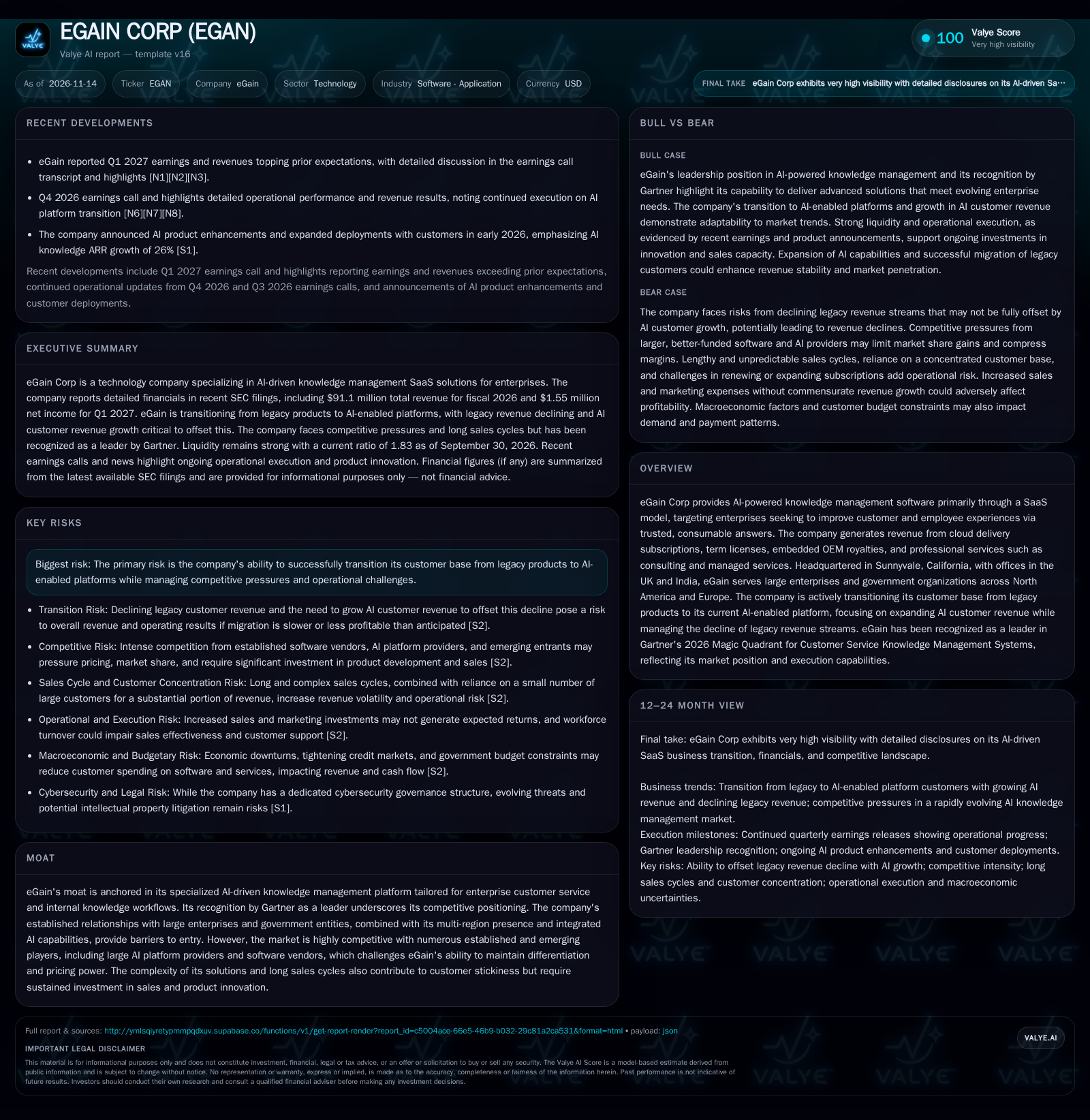
eGain’s financials reflect a business in transition: AI-powered SaaS revenue is growing, but legacy revenue is falling sharply. The company’s future hinges on successfully migrating existing customers to its AI platform, expanding new AI logos, and maintaining competitive differentiation amid intense pricing and technology pressure. Gartner leadership status evidences execution, but long-term success will depend on accelerating AI adoption and reducing reliance on legacy and concentrated accounts. [S1] [S2] [N1] [N2] [N3]
eGain’s journey from legacy knowledge management software to an AI-driven SaaS platform is at an inflection point. While the company’s recent financials show positive operating income and continued AI revenue growth, the rapid decline in legacy revenue, high reliance on a handful of large customers, and the protracted nature of enterprise sales cycles create a precarious balance.
Recent Financials Highlight Progress and Pressure Points
eGain reported total revenue of $91.1 million for fiscal 2026, with SaaS revenue representing $85.3 million and professional services contributing $5.85 million [S1]. For the quarter ended September 30, 2026, the company posted net income of $1.55 million and non-GAAP operating income for the prior fiscal year rose to $12.1 million from $6.9 million [S1] [S2]. However, legacy revenue declined by 25% in the latest quarter, reinforcing the urgency of migrating customers to the AI platform [S2]. Customer concentration remains high: the top 10 customers comprised 57% of revenue, with the largest at 13% [S2]. eGain’s remaining performance obligations totaled $87.0 million as of June 30, 2026, suggesting some contracted revenue visibility, and the company’s cash and equivalents stood at $71.3 million as of September 30, 2026 [S1] [S2]. These figures paint a picture of a company executing on its transition but facing material risks if AI adoption does not accelerate.
AI SaaS Economics and the Legacy Drag
eGain’s revenue is now overwhelmingly driven by SaaS cloud delivery, with subscription fees typically recognized ratably over contract durations. This model provides the potential for recurring revenue, margin expansion through operating leverage, and high gross margins typical of enterprise SaaS businesses—provided customer retention is strong and new bookings outpace churn. However, the company also generates professional services revenue tied to implementation and support, which tends to be lower margin and more variable.
The company capitalizes incremental costs to obtain contracts, amortizing them over five years, indicating a focus on long-term customer value rather than short-term wins [S1]. Operating leverage is emerging: non-GAAP operating income improvement suggests that as SaaS revenue grows, fixed costs are being spread over a larger base. Still, eGain’s economics are exposed to the legacy-to-AI transition. The sharp fall in legacy revenue creates a headwind that must be more than offset by new AI customer wins and successful migrations. If AI ARR growth outpaces legacy declines, the company could ultimately achieve higher recurring-margin stability; if not, negative operating leverage could return.
Enterprise Knowledge Management: Differentiation Versus Market Giants
eGain’s competitive moat lies in its specialized, AI-driven knowledge management platform designed for complex enterprise workflows. Gartner’s recognition as a category leader in 2026 supports its credibility for large customers with advanced requirements [S1]. Still, the company faces formidable competition from both established software vendors (such as CRM suite providers) and AI platform entrants with deeper pockets and broader ecosystems. Pricing pressure is likely as larger players bundle knowledge management into broader offerings or use aggressive discounting to win deals.
Switching costs can be high for large enterprises due to the complexity of integrating knowledge management into existing support workflows, but lengthy sales cycles and complex implementation projects can slow adoption and increase customer acquisition costs. The ongoing evolution of generative AI and knowledge orchestration platforms means new entrants or better-funded incumbents could erode eGain’s differentiation, especially if they match or surpass eGain’s AI features or integrate more seamlessly with adjacent enterprise systems.
Accelerating AI Migrations and Expanding Enterprise Logos
The most favorable outcome for eGain involves a rapid and successful migration of legacy customers to its AI-enabled platform, coupled with the acquisition of new large enterprise customers seeking advanced knowledge management and automation. In this scenario, AI ARR growth not only offsets but surpasses legacy declines, leading to sustained double-digit revenue growth, margin expansion, and improved customer diversification.
Evidence that would confirm this scenario includes: a sustained or accelerating AI ARR growth rate (e.g., above 25% year-over-year), reduction in customer concentration (largest customer below 10% of revenue), and continued recognition from Gartner or similar analysts. Additional confirmation would come from increasing remaining performance obligations, shorter sales cycles due to AI platform differentiation, and a rising mix of multi-year contracts. If eGain can capitalize on its leadership status and deliver superior time-to-value for AI deployments, it could carve out a defensible niche even as the broader market consolidates.
Managing the Crosscurrents of AI Growth and Legacy Attrition
The most plausible trajectory is one where eGain continues to grow AI platform revenue at a healthy rate, but legacy revenue declines remain a drag, resulting in modest top-line growth or near-term revenue flatness. Sales cycles stay lengthy and competitive intensity persists, limiting the pace of new logo acquisition and making customer migrations more challenging than anticipated.
The company reported profitability for the period. Confirmation would come from AI ARR growth rates in the high teens to low twenties, a relatively stable customer concentration profile, and performance obligations that grow slowly or plateau. Falsification would be a sharp drop in AI ARR or a failure to reduce legacy revenue’s share over several quarters.
Legacy Revenue Outpaces AI Gains and Concentration Risks Materialize
The adverse scenario unfolds if AI platform revenue growth stalls or slows materially, failing to compensate for accelerating legacy declines. This could be driven by competitive displacement, loss of major customers, or technological obsolescence as larger vendors integrate similar or superior AI capabilities into their suites. High customer concentration becomes a liability if one or more top accounts churn or reduce spend.
Evidence supporting this scenario would include declining AI ARR, negative total revenue growth, rising sales and marketing expenses as a percentage of revenue, and loss of analyst or industry recognition. If customer concentration rises or sales cycles lengthen further, the risk of volatility and sharp revenue declines increases.
Milestones and Metrics That Will Shape eGain’s Transition
Quarterly AI Annual Recurring Revenue (ARR) growth rate—sustained acceleration above 25% would support the bull case, while deceleration would challenge the thesis; a useful metric would be disclosed AI ARR by cohort.
Legacy revenue as a percentage of total revenue—continued declines must be offset by visible AI gains; if disclosed, the pace of legacy-to-AI migration by customer count would sharpen visibility.
Customer concentration metrics—top customer and top 10 customer revenue shares; diversification would reduce downside risk.
Remaining performance obligations (RPO) and the mix due within one year—rising RPO would suggest growing contracted revenue visibility.
Sales cycle duration and win rates—shortening cycles or improved conversion rates would indicate growing AI platform traction.
Gross and operating margin trends—expansion would confirm SaaS leverage, while compression may signal pricing or investment pressure.
Updates on Gartner or third-party analyst ratings—continued leadership status would support the company’s differentiation claims.
Material customer wins, renewals, or competitive displacements—publicized large deals or migrations would provide real-world validation of platform momentum.
Disclaimer: This is research-only, informational analysis and not investment advice. It may include AI-generated interpretation and general industry context. Always verify important details using primary sources.

Comments