
Helix Acquisition Corp. III: Capital Foundations, SPAC Dynamics, and Value Creation in Healthcare Deals
Helix Acquisition Corp. III enters the SPAC arena with $172.5 million in trust, a healthcare-focused mandate, and a management team versed in public market transactions. The ultimate value for shareholders now hinges on sourcing and executing a compelling business combination amid a crowded and evolving SPAC landscape.
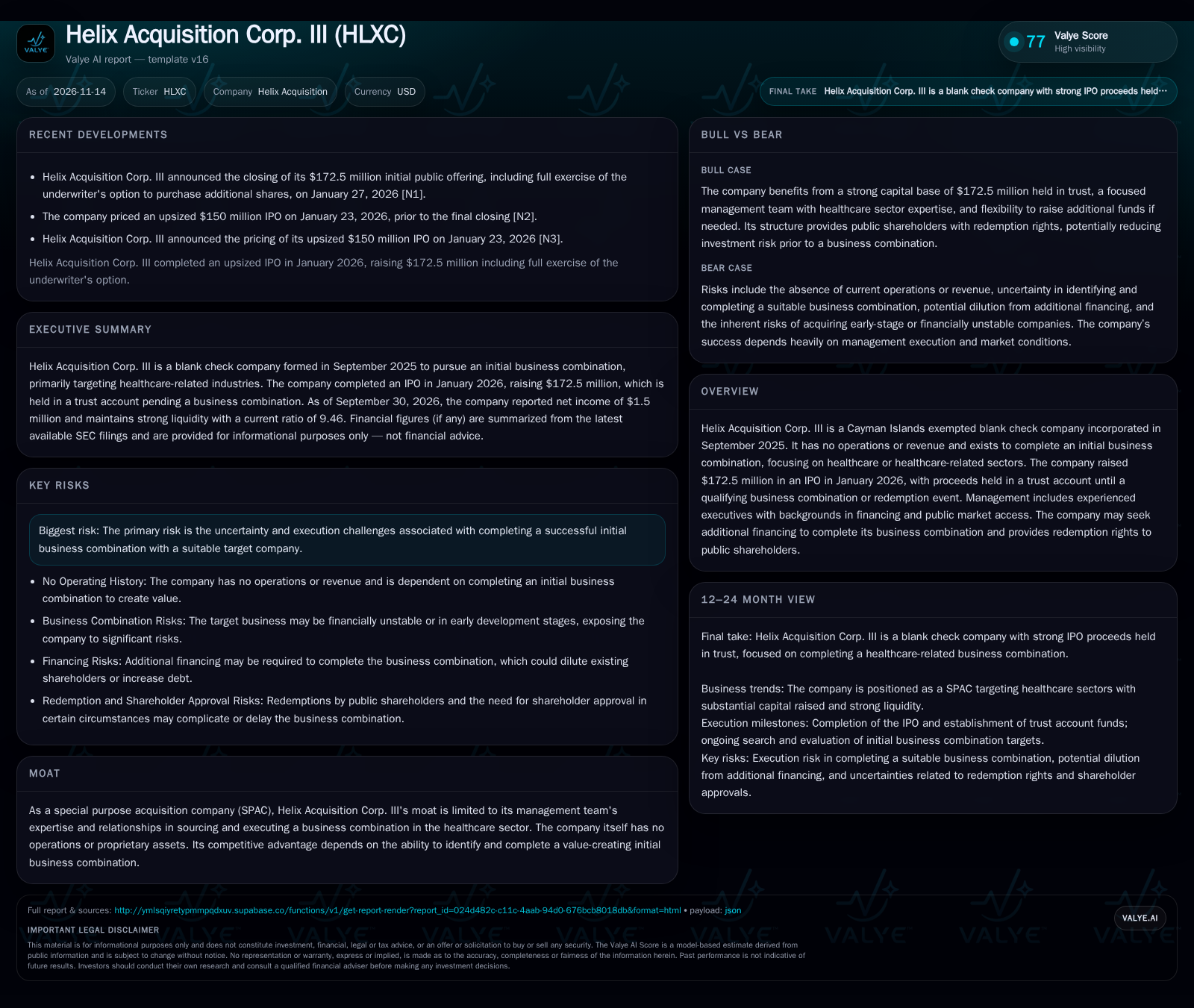
Helix Acquisition Corp. III raised $172.5 million in its January 2026 IPO, placing funds in a trust until a healthcare-focused business combination is completed. With no operations or revenue, the company’s prospects rest on management’s ability to source and execute a value-accretive deal within its 24-month window. Investors face both the potential for upside through a well-structured acquisition and the risks of dilution, redemptions, and execution failures typical of the SPAC model. [S1] [S2] [N1]
Helix Acquisition Corp. III exemplifies the modern healthcare-focused SPAC: flush with $172.5 million in trust and led by a management team experienced in capital markets, yet entirely dependent on the successful identification and consummation of a business combination. With no operations or revenue, the company’s fate is tied to its ability to secure a suitable target—balancing the promise of rapid public market access for a healthcare asset against the risks of shareholder redemptions, dilution, and the competitive SPAC landscape. The next 12-18 months will test whether management can deliver a value-creating transaction or if structural SPAC risks will dominate the narrative. [S1] [S2] [N1]
Current Capital Position, Trust Setup, and Healthcare Investment Focus
Helix Acquisition Corp. III completed its IPO in January 2026, issuing 17.25 million Class A shares at $10.00 each, with total gross proceeds (including a private placement) of $172.5 million now held in a U.S.-based trust account. These funds are restricted from use until the company completes a qualifying business combination or faces redemption events. As of September 30, 2026, reported net income of $1.5 million was generated entirely from interest on the trust account, not from operational activity. The company remains a shell entity with no revenue, and its current assets ($2.3 million) vastly exceed its current liabilities ($243,000), resulting in a reported current ratio of 9.46. Management has signaled a focus on healthcare or healthcare-related sectors for its acquisition target, but retains the flexibility to pursue opportunities in any industry. [S1] [S2] [N1]
Incentive Structures, Dilution Effects, and Return Potential in SPAC Mechanics
Helix Acquisition Corp. III’s economics are defined by the typical SPAC structure: the company earns interest on funds held in trust while incurring administrative and diligence costs, but generates no operating revenue until (and unless) a business combination closes. The proceeds from the IPO are intended to serve as both acquisition currency and a source of capital for the target, but are subject to possible reduction from public shareholder redemptions at the time of the deal. If the chosen target requires more capital than the trust can provide, Helix may seek additional equity or debt financing—potentially diluting existing shareholders or increasing the risk profile if leverage is used. The fixed costs of being a public entity (legal, compliance, audit fees) create a mild cash burn, but the real leverage and value creation (or destruction) will be determined by the quality, pricing, and post-merger performance of the chosen acquisition. If the deal is attractive and redemptions are low, Helix can deliver substantial upside to both sponsors and public holders; if redemptions are high or the deal is poorly received, dilution and value destruction are likely.
Navigating Healthcare M&A Competition to Identify the Optimal Target
Helix Acquisition Corp. III faces a highly competitive SPAC market, particularly in the healthcare sector, where a glut of blank check companies are all seeking to acquire promising private firms. The company’s only durable advantage lies in its management team’s network, sector knowledge, and execution skill—factors that may help in sourcing proprietary deals or negotiating favorable terms. However, competition from both other SPACs and traditional acquirers (private equity, strategics) is intense, often driving up valuations and making it harder to secure high-quality targets on attractive terms. Further, as the SPAC market matures, targets are increasingly savvy about deal structures, sponsor incentives, and the risks of post-merger public performance. Helix must not only find a willing and suitable target, but also convince public shareholders of the value proposition to minimize redemptions and maximize retained capital.
Creating Value Through a Strategic Healthcare Business Combination
The optimal outcome for Helix would involve identifying a healthcare business with strong growth prospects, attractive unit economics, and a credible path to public-market scale. If management leverages its sector expertise to secure a proprietary or off-market deal—ideally at a valuation that leaves room for post-merger appreciation—public shareholders could benefit from both the optionality of redemption and the upside of a successful combination. Confirmation of this scenario would come from a well-received deal announcement (as measured by low redemption rates and positive trading post-merger), clear disclosure of the target’s financials and growth plan, and the ability to close the transaction without excessive dilution or additional fundraising. Falsification would occur if Helix fails to announce a deal, or if a proposed transaction is met with high redemptions, negative investor sentiment, or regulatory complications.
Expected Developments: Lengthy Search, Moderate Redemptions, and Typical De-SPAC Execution
Given current market dynamics, the most plausible trajectory is that Helix will spend much of its 24-month window evaluating potential targets, ultimately announcing a business combination in the latter half of the period. The deal is likely to be with a mid-stage healthcare firm seeking public capital, but not necessarily a uniquely proprietary asset. Redemptions could be moderate, with some public shareholders opting for cash rather than equity in the new entity, reducing the capital available for the post-merger company. Confirmation would come from a deal announcement with moderate redemptions and completion of the merger on schedule. Falsifying evidence would include a failure to announce a deal within the required window or a need to extend the SPAC’s life beyond the original timeline.
Risks of Redemptions, Dilution, and Possible Liquidation Outcomes
The adverse path would involve Helix failing to secure a compelling target, or proposing a transaction that is poorly received by public holders. High redemption rates would drain the trust, reducing the capital available and possibly forcing management to seek expensive or dilutive financing to close the deal. In the worst case, Helix could be unable to complete a business combination within its 24-month window, resulting in a return of trust assets to public shareholders and the effective liquidation of the SPAC. Confirmation of this scenario would include repeated delays, extension votes, or withdrawal of a proposed business combination due to lack of support or regulatory hurdles.
Progress Benchmarks Reflecting Helix’s Trajectory Toward a Successful Deal
Announcement of a definitive business combination agreement, particularly with a healthcare company that demonstrates robust historical and projected growth (if disclosed).
Actual redemption rates at the time of deal approval—high redemptions would signal low investor confidence and reduce capital for the post-merger entity.
Disclosure of additional financing arrangements (PIPEs, debt, or equity raises) that could dilute existing holders or alter the capital structure.
Timeline adherence—whether Helix can announce and close a deal within its 24-month window without seeking extensions.
Quality and transparency of target company disclosures (financials, management team, business model), which will be critical in driving shareholder approval.
Trading performance of Helix shares post-deal announcement and after the de-SPAC, as a proxy for market confidence in the transaction.
Regulatory or legal developments affecting the SPAC structure or healthcare M&A environment, which could impact deal feasibility or timing.
Sponsor actions regarding founder shares or private placement shares—any changes or forfeitures could indicate shifting sponsor confidence or deal economics.
Disclaimer: This is research-only, informational analysis and not investment advice. It may include AI-generated interpretation and general industry context. Always verify important details using primary sources.

Comments