
MOZAYYX Acquisition Corp.: Blank-Check Economics, Capital Structure, and the Search for a Business Combination
MOZAYYX Acquisition Corp. reported substantial net income and reported liquidity position as of Q3 2026, but with no operating revenue and limited disclosure, its future hinges on executing a successful business combination. The trust account structure, incentive alignment, and timeline pressure shape both upside and downside scenarios for stakeholders.
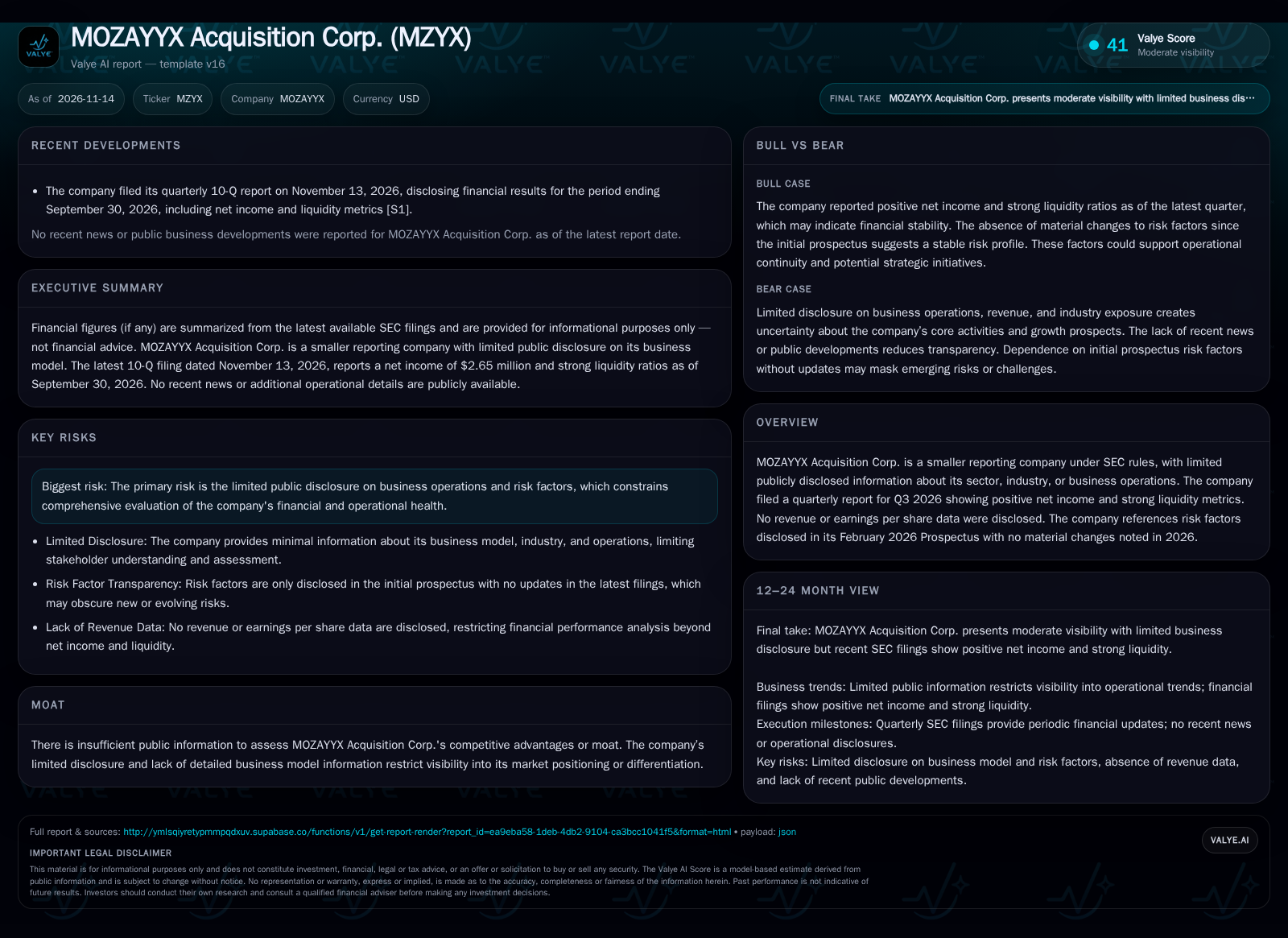
MOZAYYX Acquisition Corp. is a newly formed blank-check company (SPAC) that reported $2.65 million in Q3 2026 net income, driven by trust account investment income rather than operating results. With $1.06 million in cash and a current ratio of 8.45, it holds reported liquidity position, but has not yet completed a business combination or disclosed a target. The company’s future value and risk profile depend on its ability to identify and execute a compelling acquisition before its time/policy window closes. [S1]
MOZAYYX Acquisition Corp. (MZYX) exemplifies the modern blank-check company: flush with IPO capital, reporting positive net income from trust account investments, but with no operating revenues or disclosed business activity. As of Q3 2026, MOZAYYX’s financials reflect the classic SPAC holding pattern—substantial cash, minimal liabilities, and a complete absence of commercial operations beyond managing its trust. The core thesis now pivots on the ability of management to source and consummate a high-quality business combination before regulatory or contractual deadlines. The alignment of incentives, structure of the trust, and competitive dynamics in the SPAC market will be critical to understanding both risk and potential reward.
MOZAYYX’s Q3 2026 Financials: Trust Income, Reported Liquidity Position, No Operating Business
As of September 30, 2026, MOZAYYX Acquisition Corp. reported $2.65 million in net income for the quarter, which was almost entirely attributable to interest income generated from its trust account investments. The company’s current assets were $1.31 million versus $0.15 million in current liabilities, resulting in a current ratio of 8.45 and a cash ratio of 6.88. These metrics reflect a reported liquidity position, but crucially, no operating revenues have been generated—consistent with its status as a pre-combination SPAC. The company’s risk disclosures remain unchanged from its February 2026 prospectus, and no business combination had been announced by the report date. [S1]
SPAC Business Model: Trust Account Yield, Cost Structure, and the Acquisition Imperative
MOZAYYX’s economics are typical of a blank-check company: proceeds from its $300 million IPO are held in a trust account, invested in low-risk marketable securities. The company earns interest income on these assets, which is reported as net income, while incurring minimal operating expenses related to compliance, due diligence, and public company costs. There is no recurring revenue from business operations until a merger is completed.
The fixed costs are relatively low, but the company’s future value is binary—either it closes a business combination (de-SPAC) and transitions into an operating entity, or it liquidates and returns trust proceeds to shareholders. The trust account structure effectively locks up IPO capital, aligning incentives for management to source a deal, but also imposes a finite timeline, often 18-24 months from IPO, after which the SPAC must liquidate if no merger is completed. Operating leverage only materializes post-merger, and the capital needs, margin structure, and cash flow profile will depend entirely on the target acquired.
The trust account's yield, while providing a steady source of reported income, is inherently limited by prevailing interest rates and the low-risk investment mandate typical for SPACs. This constraint caps the potential growth of the trust balance prior to a business combination, making the timing and quality of the acquisition critical for value creation. Furthermore, the cost structure, though modest, includes ongoing expenses such as legal, accounting, and regulatory compliance that steadily erode trust account returns over time. Therefore, the SPAC’s economic viability is highly sensitive to the duration of the search process and the efficiency with which management can deploy capital into a target with meaningful operating cash flow or growth prospects.
Sourcing a Target: SPAC Competition, Market Dynamics, and Sponsor Incentives
MOZAYYX operates in a highly competitive environment for SPACs, with numerous blank-check companies seeking attractive targets, often in overlapping sectors such as technology, healthcare, or consumer. The competitive landscape is shaped by the abundance of SPAC capital, the limited pool of high-quality private companies seeking public status, and increasing regulatory scrutiny.
Sponsor incentives are structured to reward deal completion—typically through founder shares and warrants—while public shareholders face dilution risk if a suboptimal target is chosen. The ability to identify, negotiate, and execute a compelling merger is the critical differentiator among SPACs. In this context, MOZAYYX’s competitive position will depend on its management team’s sourcing network, due diligence rigor, and reputation among target companies. The absence of a disclosed industry focus or target adds to the uncertainty.
In addition to competition among SPACs, MOZAYYX faces challenges from traditional IPOs and direct listings as alternative routes for private companies seeking public markets. The attractiveness of a SPAC merger often hinges on the perceived speed and certainty of execution, but as the market matures, private companies may demand more favorable terms or greater transparency, potentially reducing the pool of willing targets. Sponsor incentives, while aligned towards deal completion, can sometimes create tension if the economics encourage closing any deal rather than the optimal one. Thus, MOZAYYX’s ability to differentiate itself through sector expertise, deal structuring creativity, and reputation management will be essential to securing high-quality targets before competitors or alternative capital-raising methods prevail.
Value Creation if a High-Quality Merger Is Secured
The favorable scenario for MOZAYYX is the successful identification and acquisition of a private company with strong growth prospects, solid unit economics, and a credible path to public-market value creation. If management can leverage its capital and networks to secure a differentiated target—particularly in a sector with public-market scarcity value—the SPAC could deliver significant returns to shareholders and sponsors.
Evidence that would confirm this scenario includes the announcement of a letter of intent (LOI) or definitive merger agreement with a credible, well-regarded private company, positive market reaction to the deal terms, and transparent disclosure of the target’s financials, growth trajectory, and management quality. Early redemption rates below peer averages and anchor investor participation would further validate confidence in the transaction.
If MOZAYYX successfully executes a merger with a high-quality target, the post-merger entity’s valuation will depend on several factors beyond initial deal terms. These include the target’s ability to demonstrate scalable revenue growth, maintain or improve margins, and generate positive free cash flow. Additionally, management continuity and strategic clarity post-merger will influence investor confidence and market reception. The SPAC structure can also facilitate access to additional capital through PIPE investments, which, if secured, can provide a runway for growth initiatives. However, the ultimate value creation will be contingent on the target’s competitive positioning and resilience to market cycles, underscoring the importance of rigorous due diligence and realistic financial projections during the acquisition process.
Likely Trajectory: Standard De-SPAC Process or Eventual Liquidation
The most plausible path for MOZAYYX is a conventional SPAC timeline: continued search for a target, eventual announcement of a merger (likely within 18-24 months post-IPO), and subsequent shareholder vote. If a suitable target is found, the company transitions to an operating entity with the economics and risks of the acquired business. If no compelling target emerges, the SPAC will be forced to liquidate, returning trust proceeds to shareholders minus expenses.
Confirmation of this scenario would require further SEC filings indicating either a pending merger or, conversely, extension votes or liquidation notices as the deadline approaches. High redemption rates or difficulties in securing PIPE (private investment in public equity) financing would be warning signs that the transaction is not perceived as value-accretive.
Deal Risk: Poor-Quality Target or Failure to Close
The adverse scenario involves MOZAYYX either failing to identify a merger target in time, resulting in liquidation of the trust account, or closing a deal with a poor-quality or overvalued target. In the first case, shareholders receive their pro rata trust proceeds, but sponsors lose their at-risk capital and warrants. In the second, the public float may be saddled with a weak business, potentially leading to post-merger value destruction, high redemptions, and share price declines.
Evidence supporting this scenario would include repeated deadline extensions, high redemption rates at the merger vote, lack of PIPE investor support, or negative market perception of the announced target’s business fundamentals. Regulatory or litigation challenges could further complicate deal execution.
Milestones That Will Define MOZAYYX’s Ultimate Outcome
Announcement of a letter of intent (LOI) or definitive merger agreement with a specific target company.
Disclosure of the target’s financials, sector, and growth strategy if a business combination is announced.
Shareholder redemption rates at the time of the merger vote—if disclosed—as an indicator of deal quality and investor confidence.
Any SEC filings or press releases indicating deadline extensions, liquidation notices, or changes to the SPAC’s timeline.
PIPE financing commitments or anchor investor participation in conjunction with a merger announcement—if disclosed.
Sponsor capital at risk and any changes to founder-share or warrant structures in response to deal negotiations.
Updates to risk factor disclosures or emergence of litigation/regulatory challenges related to the de-SPAC process.
A useful metric would be post-merger operating guidance and management continuity, if and when a business combination closes.
Disclaimer: This is research-only, informational analysis and not investment advice. It may include AI-generated interpretation and general industry context. Always verify important details using primary sources.

Comments