
CH4 Natural Solutions Corp: Positive Net Income Amid Acute Liquidity Constraints and Sparse Disclosure
CH4 Natural Solutions Corp shows positive net income for the latest period but faces acute short-term liquidity pressures, with zero cash on hand and a current ratio well below 1. The lack of public detail on business operations, sector, or commercial mechanics complicates any assessment of resilience or future prospects.
CH4 Natural Solutions Corp reported positive net income for the period ending September 30, 2026, yet ends the quarter with zero cash and a current ratio of just 0.47. Investors face a binary situation hinging on the company’s access to funding or rapid operational cash generation.
The absence of any detailed public disclosure on its business operations, sector focus, or revenue model leaves investors with little visibility into the sustainability of recent profitability or mechanisms for resolving its liquidity crunch. The situation sets up a binary near-term outlook—either the company secures funding or generates immediate cash flow, or it faces escalating operational risk.
A Paradox of Profitability and Liquidity Crunch Defines the Present
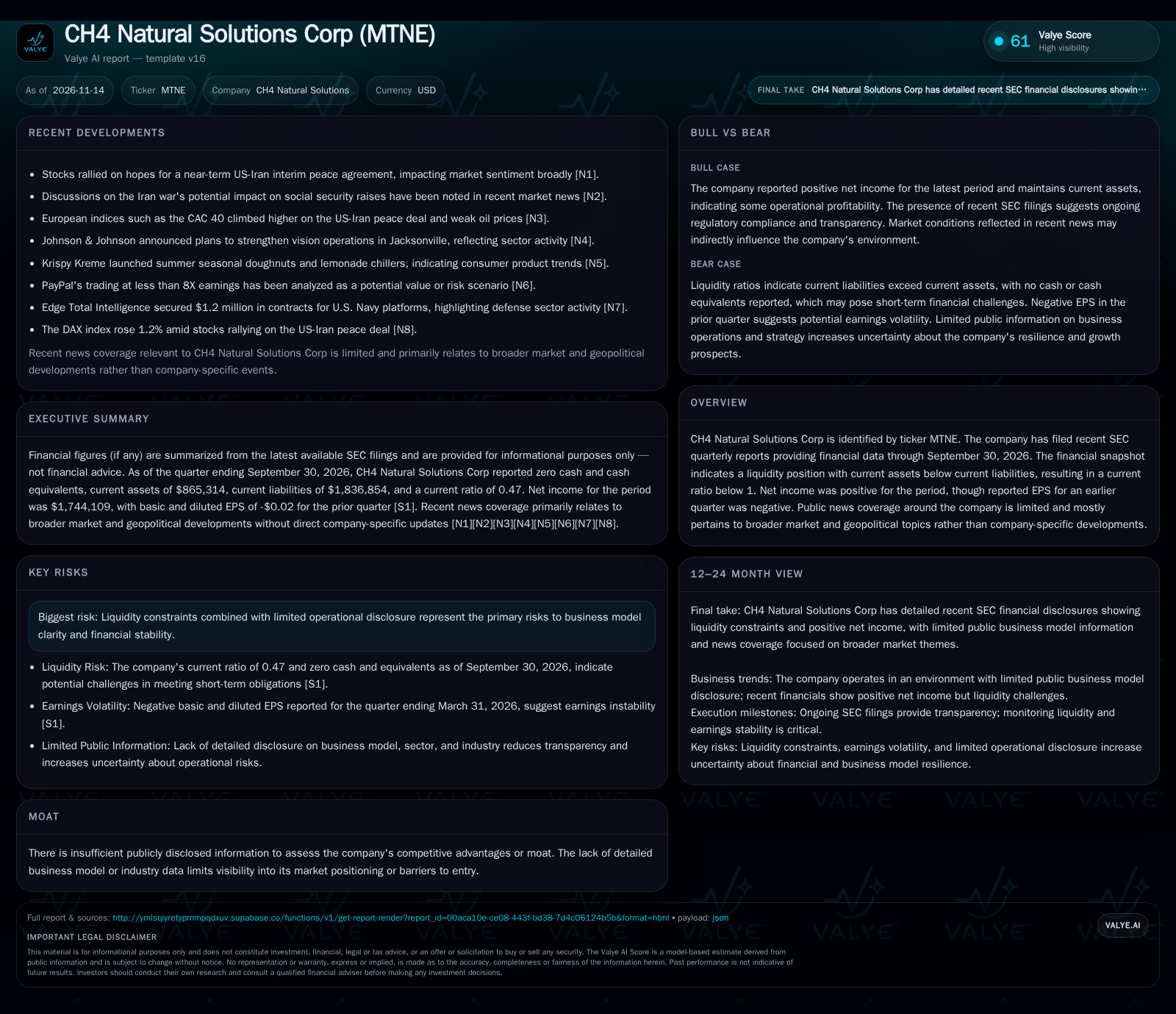
The most striking current facts about CH4 Natural Solutions Corp are its positive net income of $1,744,109 for the period ending September 30, 2026, juxtaposed with a reported cash and cash equivalents balance of $0 and a current ratio of just 0.47 as of the same date [S1]. Current assets total $865,314, while current liabilities stand at $1,836,854, meaning the company lacks the liquid resources to cover its immediate obligations [S1]. Basic and diluted EPS for the prior quarter were both negative at -$0.02, suggesting recent profitability may be volatile or nonrecurring [S1]. No substantive public news or disclosures clarify the operational or strategic context. These facts matter because they indicate a business that, while capable of generating profit in the near term, is at acute risk of liquidity-driven disruption unless it can rapidly secure additional funding or convert assets to cash.
The paradox of profitability alongside severe liquidity constraints often signals a timing mismatch between revenue recognition and cash inflows. In many industries, especially those involving long sales cycles or milestone-based payments, accrual accounting can show profit while cash remains tied up in receivables or inventory. This scenario can be exacerbated if the company extends generous payment terms to customers or faces delayed collections. Furthermore, the absence of cash reserves limits the firm's ability to respond to unforeseen expenses or capitalize on emergent opportunities, increasing operational risk despite reported profitability. Understanding the underlying drivers of this discrepancy is critical to assessing near-term viability.
Uncertain Revenue Model and the Economics of Survival
With no public disclosure of sector, product lines, or commercial mechanics, the economics of CH4 Natural Solutions Corp remain opaque. The positive net income suggests that operating revenues—however generated—recently exceeded costs, but the absence of cash on hand points to either non-cash income (such as accruals, asset sales, or one-off events) or a significant lag between revenue recognition and cash collection [S1]. If the business relies on project-based or milestone payments, lumpy cash flows could explain this paradox.
Fixed versus variable cost structure is unknown, but in a typical scenario where working capital is negative and cash is absent, companies often face urgent pressure to either accelerate receivables or defer payables. The reported current ratio signals a need for near-term funding, whether through asset liquidation, external financing, or operational cash generation. Without visibility into capital needs or funding sources, it is impossible to judge whether recent profitability is sustainable or a one-off event. Operating leverage could work both ways: if costs are largely fixed, declining revenues could quickly swing the business back to loss-making territory; if variable, cost control may buy some runway, but only if cash can be generated rapidly.
If disclosed, the composition of working capital components would help clarify the liquidity dynamics. A high proportion of accounts receivable relative to cash might indicate potential cash flow once collections improve, but also exposes the company to credit risk if customers delay payments or default. Conversely, significant inventory levels could imply tied-up capital subject to obsolescence or markdown risks. The cost structure’s fixed-to-variable ratio further influences resilience: a predominantly fixed cost base limits flexibility to reduce expenses in downturns, while a variable cost structure allows more agile adjustment to revenue fluctuations. The interplay of these factors determines whether operational cash generation can realistically bridge the liquidity gap without external financing.
Competitive Standing Obscured by Lack of Disclosure
There is no public information about CH4 Natural Solutions Corp’s industry, customer base, or product offering, making it impossible to assess its competitive position directly. Without such context, potential advantages—such as proprietary technology, regulatory barriers, or customer relationships—cannot be confirmed. The lack of sector disclosure also means that the relevant peer set is unknown: the company’s risks and opportunities could differ radically depending on whether it operates in a commodity, technology, or service-based industry.
In general, businesses facing acute liquidity constraints while maintaining profitability may be in a competitive market with thin margins, or they may be experiencing a temporary working capital mismatch. If the firm is in a sector with high switching costs, strong customer lock-in, or IP-based barriers, it might have more time to resolve liquidity issues. Conversely, in rapidly evolving or commoditized sectors, the lack of cash could quickly erode any competitive standing.
The competitive landscape's nature, if known, would critically influence the company's strategic options amid liquidity stress. In sectors characterized by rapid innovation or commoditization, the ability to quickly pivot product offerings or reduce costs is paramount. Conversely, industries with high regulatory barriers or specialized technology may afford longer runway to resolve liquidity issues due to higher entry barriers protecting market share. Customer concentration also matters: a diversified customer base reduces dependency risk, while reliance on a few major clients can amplify vulnerability if payment delays or contract losses occur. Without this context, the company's competitive positioning and strategic flexibility remain speculative.
Rapid Cash Conversion or External Funding Could Unlock a Turnaround
The most favorable outcome for CH4 Natural Solutions Corp is a scenario in which the company quickly converts accrued income to cash—perhaps by collecting receivables, accelerating project milestones, or liquidating non-core assets. Alternatively, if the company can secure short-term financing or investment, it could bridge the liquidity gap and reinvest in operations, leveraging its recent profitability to drive further growth.
Confirmation of this scenario would come from new disclosures of debt or equity financing, evidence of improved cash balances in subsequent filings, or a marked increase in operating cash flow. Announcements regarding new contracts, customer wins, or asset sales would also support the case. Falsification would be indicated by continued zero or negative cash balances, missed payments, or a sharp reversal to net losses.
Sustained Uncertainty as Operational and Liquidity Risks Interact
The most plausible middle path is persistent uncertainty: the company continues to operate while seeking ways to resolve its liquidity crunch, but faces ongoing risks of disruption if funding is not secured quickly. Operational momentum may be hampered by the need to stretch payables, delay investments, or negotiate with creditors. Profitability may prove to be nonrecurring if it was driven by one-off events or non-cash gains.
Evidence supporting this scenario would include continued reported liquidity position, stagnant or declining current assets, and the absence of new financing or operational disclosures. If future filings show modest improvements in cash or working capital without a major strategic shift, it would suggest the company is muddling through but remains vulnerable. A sudden return to net losses or evidence of creditor actions would push the scenario toward the downside.
Liquidity Failure Forces Disruption or Restructuring
The adverse scenario is a liquidity-driven crisis: with no cash on hand and current liabilities far outweighing current assets, the company could be forced to default on obligations, enter restructuring, or even cease operations if new funding is not secured imminently. Suppliers or creditors could take action to recover debts, and operational continuity could be threatened.
This scenario would be confirmed by subsequent filings or disclosures showing missed payments, default notices, or the initiation of bankruptcy or liquidation proceedings. Sharp declines in reported assets, a surge in liabilities, or the absence of ongoing operations would also corroborate this outcome.
Testing the CH4 Natural Solutions Thesis: What Could Change the Outlook?
Cash and cash equivalents in future filings—any material increase would suggest successful funding or operational cash conversion.
Operating cash flow (if disclosed)—positive and growing operating cash flow would demonstrate the sustainability of reported profit.
New debt or equity financing announcements, including terms and timing, which would alleviate immediate liquidity pressures.
Disclosures of sector, primary business lines, or customer concentration, providing clarity on the sustainability of revenue and profit sources.
Evidence of asset sales, receivable collections, or working capital optimization.
Any regulatory, legal, or contractual developments indicating creditor action or disruption to operations.
Subsequent net income or EPS trends—whether profitability is sustained or proves to be a one-off event.
Disclaimer: This is research-only, informational analysis and not investment advice. It may include AI-generated interpretation and general industry context. Always verify important details using primary sources.

Comments