
Hashdex Nasdaq CME Crypto Index ETF: Navigating Crypto Index Exposure Amid Sparse Disclosure
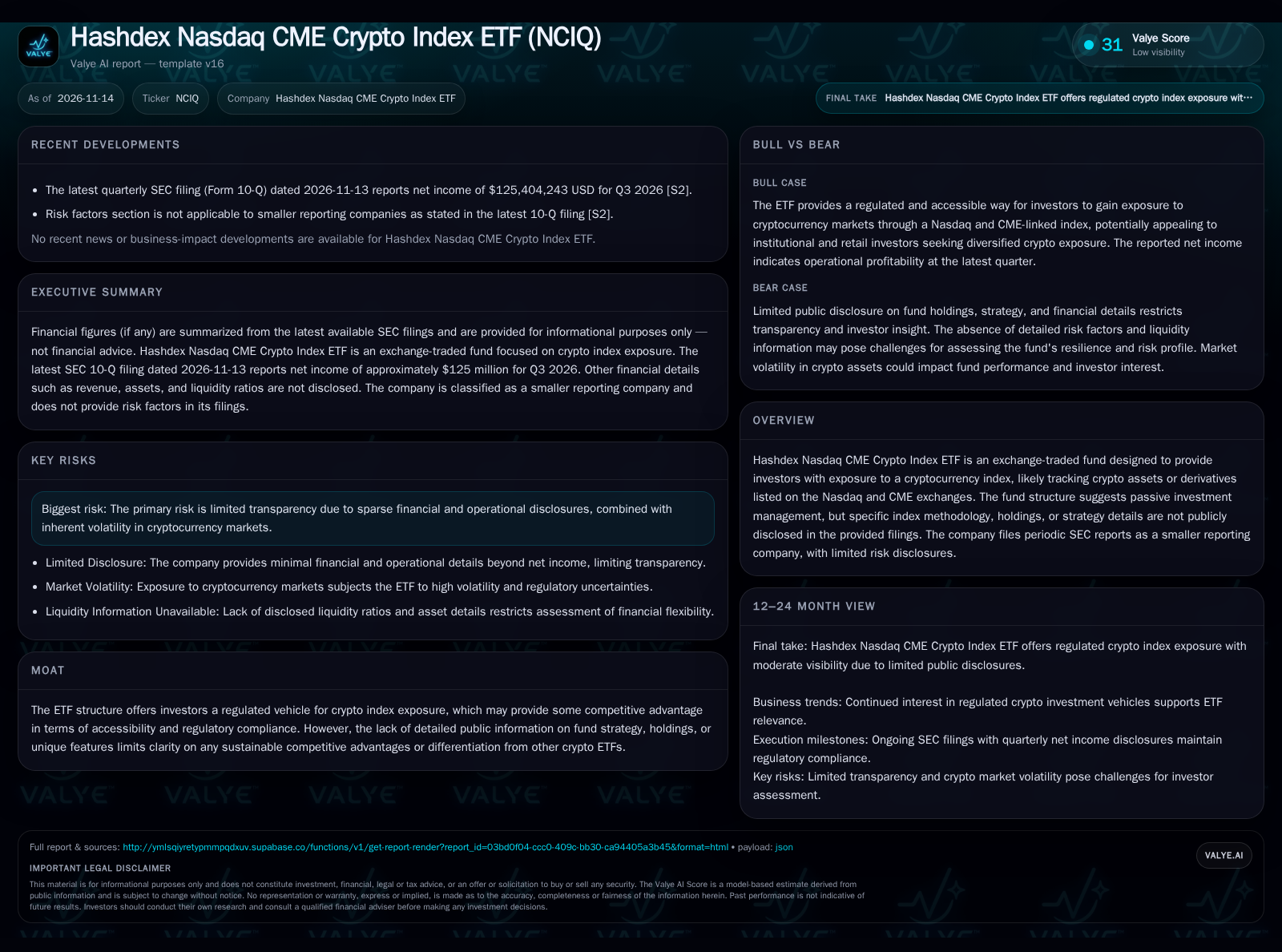
Hashdex Nasdaq CME Crypto Index ETF delivers regulated access to the cryptocurrency market via a Nasdaq and CME-linked index, reporting notable Q3 2026 net income but offering limited transparency on holdings, strategy, and liquidity. The fund’s future hinges on the evolving appetite for crypto ETFs, regulatory clarity, and its ability to differentiate in an increasingly competitive landscape.
Hashdex Nasdaq CME Crypto Index ETF reported $125.4 million in net income for Q3 2026, affirming operational profitability in a volatile asset class. Success will depend on sustained investor demand for regulated crypto exposure and the ability to stand out among similar offerings, while market volatility and limited transparency remain key challenges. [S2]
Hashdex Nasdaq CME Crypto Index ETF presents a compelling but opaque proposition: it offers regulated, exchange-traded access to digital asset markets via a Nasdaq and CME-linked index, at a time when demand for crypto exposure remains strong among both institutional and retail investors. The fund’s reported net income of $125.4 million for Q3 2026 underlines its ability to generate profits in a volatile sector, but the absence of granular disclosures on holdings, strategy, and liquidity leaves investors with significant blind spots. In a rapidly evolving ETF landscape where transparency and differentiation are increasingly critical, Hashdex’s future trajectory will depend on its ability to balance regulatory compliance, market appetite, and the need for greater operational clarity. [S2]
What the Latest Filing Reveals—and What It Omits
Hashdex Nasdaq CME Crypto Index ETF’s most recent SEC 10-Q filing, as of September 30, 2026, disclosed net income of $125,404,243 for Q3 2026, confirming not only operational activity but also profitability during this period [S2]. The company reported cash and liquidity metrics for the period; these figures do not by themselves establish operating runway, investment capacity, financial flexibility, or financing capacity. [S2] This combination of profitability and sparse disclosure is unusual for publicly traded funds, complicating efforts to evaluate the ETF’s risk profile and operational resilience. The ETF structure and Nasdaq/CME linkage suggest exposure to a diversified basket of crypto assets or derivatives, but without portfolio transparency, it is difficult to ascertain the precise sources of income, risk concentrations, or how the fund navigates crypto market volatility.
Underlying Economics: Passive Exposure, Fee Potential, and Cost Structure
The ETF’s business model likely centers on providing passive, rules-based exposure to a diversified crypto index, with income primarily derived from management fees charged as a percentage of assets under management (AUM). In typical crypto index ETFs, net income is driven by the scale of AUM, fee rates (often ranging from 0.5% to 1% annually), and efficient cost control. Because the fund does not disclose its AUM, fee structure, or expense ratios, the sustainability and drivers of reported profitability remain opaque.
If the ETF tracks indices referencing digital assets traded on Nasdaq and CME, its returns could be influenced by both spot crypto price movements and derivatives performance. Operating leverage can be significant for ETFs, as fixed costs are relatively low and incremental AUM growth largely translates into higher net income. However, crypto ETFs may face higher operational costs due to custody, compliance, and security requirements unique to digital assets. Without specific disclosures, it is unclear whether Hashdex’s reported net income reflects temporary market gains, effective cost management, or a scalable, repeatable model.
Capital requirements for ETFs are typically limited, as they do not require proprietary trading or heavy infrastructure investment. However, crypto-specific ETFs may need to invest in robust custody and cybersecurity solutions, which can increase baseline expenses. The absence of disclosed asset or liquidity data makes it impossible to assess the fund’s ability to absorb redemptions or weather prolonged market downturns.
Assessing Differentiation in a Crowded Crypto ETF Market
The ETF sector for crypto exposure has become increasingly competitive, with numerous products offering access to spot, futures, or blended crypto indices. Hashdex Nasdaq CME Crypto Index ETF’s potential advantages include its regulated structure, association with established exchanges, and possible appeal to investors seeking diversified, institutionally managed crypto exposure. However, the lack of disclosed index methodology, holdings, or unique product features limits any observable competitive differentiation.
Peer funds typically compete on transparency, fee levels, tracking accuracy, and liquidity. Some offer daily portfolio disclosure, detailed risk metrics, or innovative staking/yield features—none of which are confirmed for Hashdex in the current filings. Without clarity on rebalancing rules, underlying asset mix, or risk management practices, it is difficult for investors to gauge the ETF’s resilience or its appeal relative to other crypto index products.
Switching costs in the ETF space are generally low, as investors can typically move between funds with minimal friction. Therefore, sustainable advantage depends heavily on brand, transparency, fee competitiveness, and investor trust. The current opacity around Hashdex’s mechanics and risk profile may constrain its ability to capture share from more transparent or established rivals.
How Regulatory Clarity and Crypto Market Growth Could Drive Outsized Success
In a favorable scenario, continued regulatory acceptance of crypto ETFs and rising institutional adoption drive robust inflows into regulated index products. Hashdex could benefit from a surge in AUM, fueling higher management-fee income and enhancing operating leverage. If the ETF offers a unique or well-constructed index—perhaps one with superior risk-adjusted returns or innovative exposure to both spot and derivative assets—it could attract investors seeking diversification beyond single-asset crypto funds.
Confirmation of this scenario would include: sustained net income growth across multiple quarters, public disclosure of rising AUM, competitive fee levels, and evidence of product differentiation (such as portfolio transparency, unique index methodology, or value-added features). Additional signals would be growing liquidity and trading volumes, as well as positive mentions in institutional research or media coverage.
Falsification would occur if net income remains volatile or flat despite favorable market conditions, or if the ETF’s share of industry flows lags behind peers amid transparency concerns.
Steady Demand Meets Persistent Transparency Gaps
The most plausible middle path is one where Hashdex Nasdaq CME Crypto Index ETF continues to attract moderate inflows from investors seeking regulated crypto exposure, but growth is capped by ongoing transparency limitations. The fund remains profitable in most quarters, supported by baseline management fees and periodic market rallies, but may underperform more transparent or lower-fee competitors in capturing institutional mandates.
Evidence supporting this scenario would be the maintenance of positive net income, stable or slowly rising AUM (if disclosed), and periodic SEC compliance filings. Lack of media attention, limited analyst coverage, or muted trading volumes would also align with a fund that is operationally sound but not a market leader.
This scenario would be challenged if the ETF either discloses significant negative swings in net income (suggesting higher than expected volatility or cost structure issues) or if it moves toward greater transparency and product innovation, potentially unlocking new demand.
Transparency Deficit Amplifies Volatility and Investor Outflows
A bearish scenario would see Hashdex’s limited disclosure undermining investor confidence, particularly during periods of heightened crypto market volatility or regulatory scrutiny. Without clarity on holdings or liquidity, investors may fear hidden risks, leading to outflows and shrinking AUM. If the fund’s net income proves unsustainable—perhaps due to market drawdowns, unexpected operational losses, or fee compression—profitability could evaporate, making the ETF less attractive to both retail and institutional investors.
Evidence of this outcome would include a sharp drop in net income, negative media coverage regarding lack of transparency or risk management, and an acceleration of redemptions (if disclosed). Regulatory changes imposing stricter reporting or risk controls on crypto ETFs could also force operational adjustments or reveal previously undisclosed vulnerabilities.
This scenario would be less likely if the ETF proactively improves disclosure, demonstrates resilience during market corrections, or secures endorsements from large institutional investors.
Concrete Data Points to Validate or Challenge the Hashdex Thesis
Quarterly net income trends: Continued profitability or emerging losses will help indicate the sustainability of the fund’s business model [S2].
Assets under management (AUM): If disclosed, rising or falling AUM would directly reflect investor sentiment and the ETF’s market traction.
Fee structure and expense ratio: Disclosure of management fees and cost breakdowns would clarify competitive positioning and operating leverage.
Portfolio transparency: Any move to publish detailed holdings or index methodology would help investors assess risk and potential differentiation.
Regulatory developments: Changes in U.S. or global crypto ETF regulations could materially impact demand, reporting requirements, or risk management practices.
Comparative trading volume and bid-ask spreads: These metrics, if disclosed, would benchmark the ETF’s secondary-market liquidity against peers.
Media and institutional research coverage: Increased external attention or scrutiny may signal shifts in perceived risk or opportunity.
Disclaimer: This is research-only, informational analysis and not investment advice. It may include AI-generated interpretation and general industry context. Always verify important details using primary sources.

Comments