
Perimeter Acquisition Corp. I: Defense-Focused SPAC Faces Execution Risk and Funding Constraints
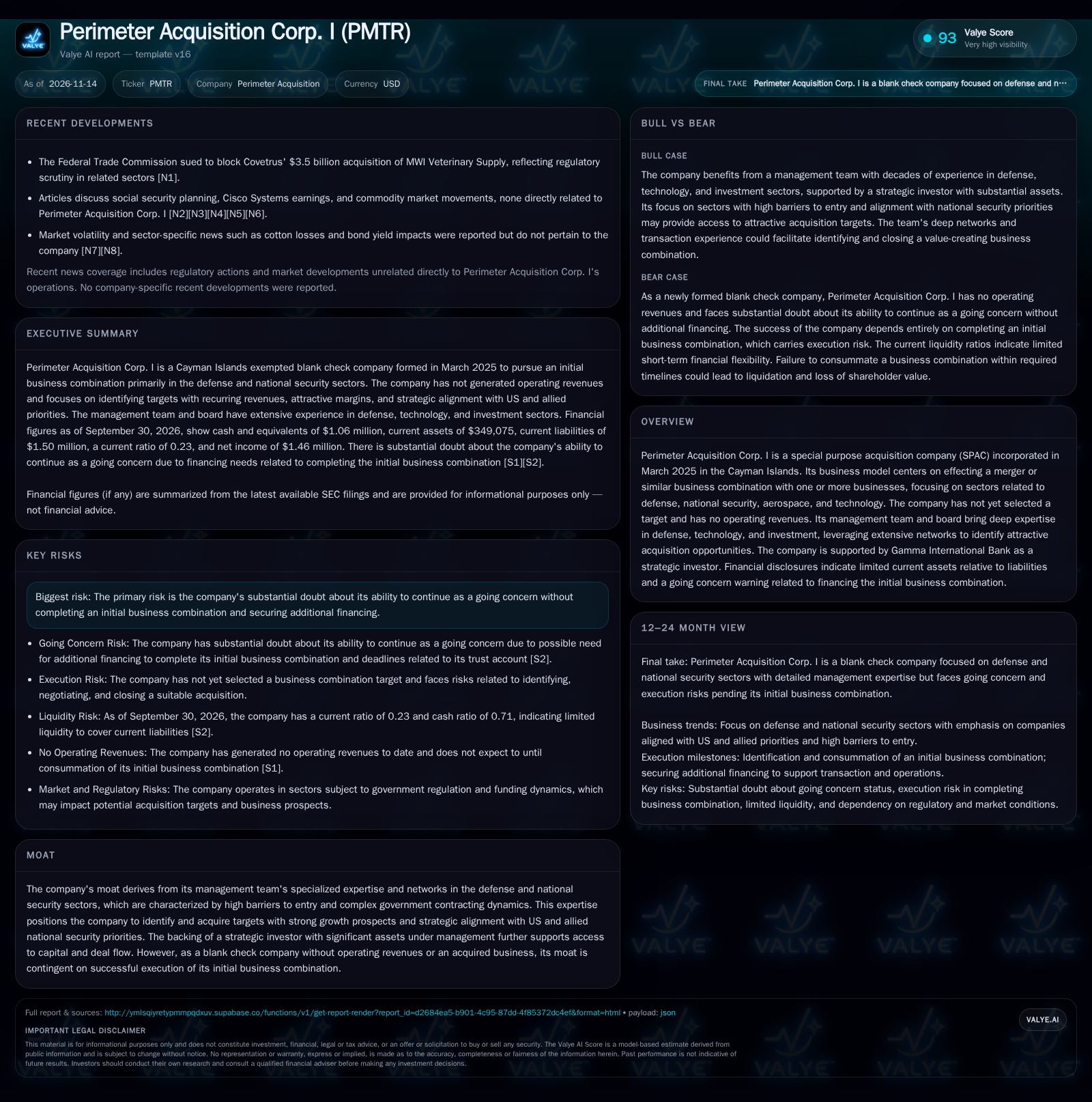
With a management team steeped in defense and security expertise and a significant trust account from its IPO, Perimeter Acquisition Corp. I aims to capitalize on high-barrier sectors. Yet, the absence of a target, reported liquidity position outside the trust, and a going concern warning heighten the urgency to secure and close a value-creating business combination.
Perimeter Acquisition Corp. I is a newly formed SPAC targeting U.S. defense and national security sectors. Backed by a $254 million trust account and a team with deep industry networks, it has yet to announce a business combination. The company’s reported liquidity position outside the trust and a substantial doubt about going concern status underscore the critical importance of executing a deal before deadlines trigger forced liquidation or value erosion [S2].
Perimeter Acquisition Corp. I is a SPAC launched in 2025 with a mission to acquire or merge with a business in the U.S. defense, national security, or related technology sectors. The company has raised $241.5 million through its IPO and an additional $6.4 million in a private placement, with all proceeds—less a small working capital reserve—locked in a trust account pending a business combination. A going concern warning signals that, without swift execution or additional financing, the SPAC could face forced liquidation, underscoring the importance of target selection, deal negotiation, and closing within regulatory deadlines [S2].
SPAC Structure and Financial Realities Shape Immediate Outlook
Perimeter Acquisition Corp. I stands at a pivotal juncture as a newly organized SPAC with a $254.3 million trust account—substantially all of which must be used to consummate a business combination. As of September 30, 2026, only $259,758 is available outside the trust for ongoing expenses, and the company reports a current ratio of 0.23. The absence of operating revenue and the presence of a going concern warning point to acute execution risk: unless a qualifying transaction is identified and closed, the company may be forced to liquidate and return trust proceeds to shareholders. The company reported cash and liquidity metrics for the period; these figures do not by themselves establish operating runway, investment capacity, financial flexibility, or financing capacity. [S2]
How Perimeter’s Economics Hinge Entirely on Completing a Business Combination
The business model of Perimeter Acquisition Corp. I is archetypal for a SPAC: raise capital through an IPO, invest the bulk of proceeds in a trust account, and use those funds exclusively to acquire a target company. The economics are binary—until a deal closes, the SPAC earns only interest income on its trust (which is not operating revenue). Upon a successful merger, the choice of target, deal structure, and post-combination capital needs will determine future revenue streams, cost structure, and value creation.
SPACs typically seek targets with recurring revenue, attractive margins, and high barriers to entry—criteria that, if achieved, can support premium valuations and public market appetite. However, the structure imposes significant fixed costs (legal, due diligence, regulatory filings) that must be covered from a small working capital reserve. If a transaction fails, these sunk costs are not recoverable. [S2]
Sector Focus, Management Networks, and SPAC Competition
Perimeter’s competitive positioning is rooted in its specialized focus on defense, aerospace, and national security, sectors characterized by high regulatory barriers, complex procurement cycles, and a limited pool of investable private companies. The management team’s deep networks in government, technology, and defense investing could provide differentiated access to proprietary deal flow—an important edge in a crowded SPAC landscape.
However, the SPAC market remains highly competitive, with many vehicles seeking similar high-quality targets, especially in resilient, government-aligned sectors. Perimeter’s strategic backer, Gamma International Bank, may help with capital flexibility or post-merger support. Still, competition comes not only from other SPACs but also from private equity, strategic acquirers, and even direct public offerings, potentially driving up valuations or making negotiations more complex. The company’s stated focus on dual-use and infrastructure security businesses may help differentiate its sourcing, but also narrows the addressable universe of targets.
Capturing Value Through a Strategically Aligned, High-Barrier Acquisition
The upside scenario for Perimeter is predicated on identifying and closing a business combination with a target that exhibits strong recurring revenue, attractive margins, and proven alignment with U.S. and allied national security priorities. If the management team leverages its networks to secure a proprietary or less-contested deal in a sector with robust government funding and high switching costs, the post-combination entity could command a premium valuation and enjoy investor support.
Evidence that would confirm this scenario includes a timely announcement of a definitive merger agreement with a differentiated, high-quality target, clear disclosure of strong historical and projected financials, and indications of government contract durability or deep customer relationships. Additional confirmation would come from the ability to structure the deal without excessive dilution or onerous earnouts, and from favorable market reception upon deal announcement and closing. Falsification would be indicated by repeated delays, inability to secure a target, or announcement of a deal in a less attractive sector or with weak margins.
Most Likely Outcome: Deal Pressure, Narrow Timeline, and Execution Risk
The most plausible scenario for Perimeter is a race against the clock to announce and close a business combination before regulatory deadlines or working capital exhaustion force liquidation. In this path, the company may face difficult trade-offs: the need to secure a deal could drive acceptance of less-than-ideal terms or a target with only moderate growth prospects. The economics of the transaction may be constrained by valuation pressure, competitive bidding, or the need to provide significant incentives to the target’s owners.
This outcome would be confirmed by a deal announcement close to the deadline, with terms that include substantial sponsor concessions, higher dilution, or complex earnout structures. Evidence against this scenario would be an early, high-quality deal announcement with minimal concessions, or the ability to raise additional capital on favorable terms to extend the timeline or improve negotiation leverage.
No Deal, Forced Liquidation, and Value Erosion for Stakeholders
The adverse scenario is that Perimeter is unable to identify or close a qualifying business combination within the allotted timeframe. In this event, the company would be required to liquidate, returning trust proceeds to public shareholders and leaving sponsors and warrant holders with little or no value. The limited working capital outside the trust account and the going concern warning suggest that, absent additional financing or a breakthrough in negotiations, the risk of this outcome increases as deadlines approach.
Confirmation of this scenario would be repeated extensions, failed negotiations, or regulatory filings indicating imminent liquidation. Additional warning signs would include sponsor loans increasing sharply, or adverse changes in the regulatory or SPAC market environment that further reduce the pool of viable targets or investor appetite.
Milestones and Metrics Shaping the Perimeter Acquisition Thesis
Announcement of a definitive agreement for an initial business combination, including target sector, financials, and deal structure.
Evidence of additional working capital raised or extensions secured to prolong the SPAC’s operating runway, including sponsor loans or PIPE financings.
Clarity on the quality and durability of the target’s revenue streams, especially government contract visibility, if disclosed.
Magnitude and terms of any dilution to public shareholders or sponsor concessions required to close a deal.
Changes in SPAC regulatory deadlines, SEC intervention, or shifts in market appetite for defense/national security deals.
Sponsor or strategic investor actions, such as conversion of working capital loans to equity or further financial commitments.
Disclosure of target company’s backlog, customer concentration, or switching cost metrics—would help test the defensibility of the acquired business.
Disclaimer: This is research-only, informational analysis and not investment advice. It may include AI-generated interpretation and general industry context. Always verify important details using primary sources.

Comments