
TRex Bio: Clinical Ambition and Capital Imperatives at the Edge of Analyst Interest
TRex Bio’s recent wave of positive analyst initiations spotlights its clinical-stage pipeline and liquidity, but the company’s future will be determined by clinical progress, capital raises, and its navigation of typical early-stage biotech uncertainties.
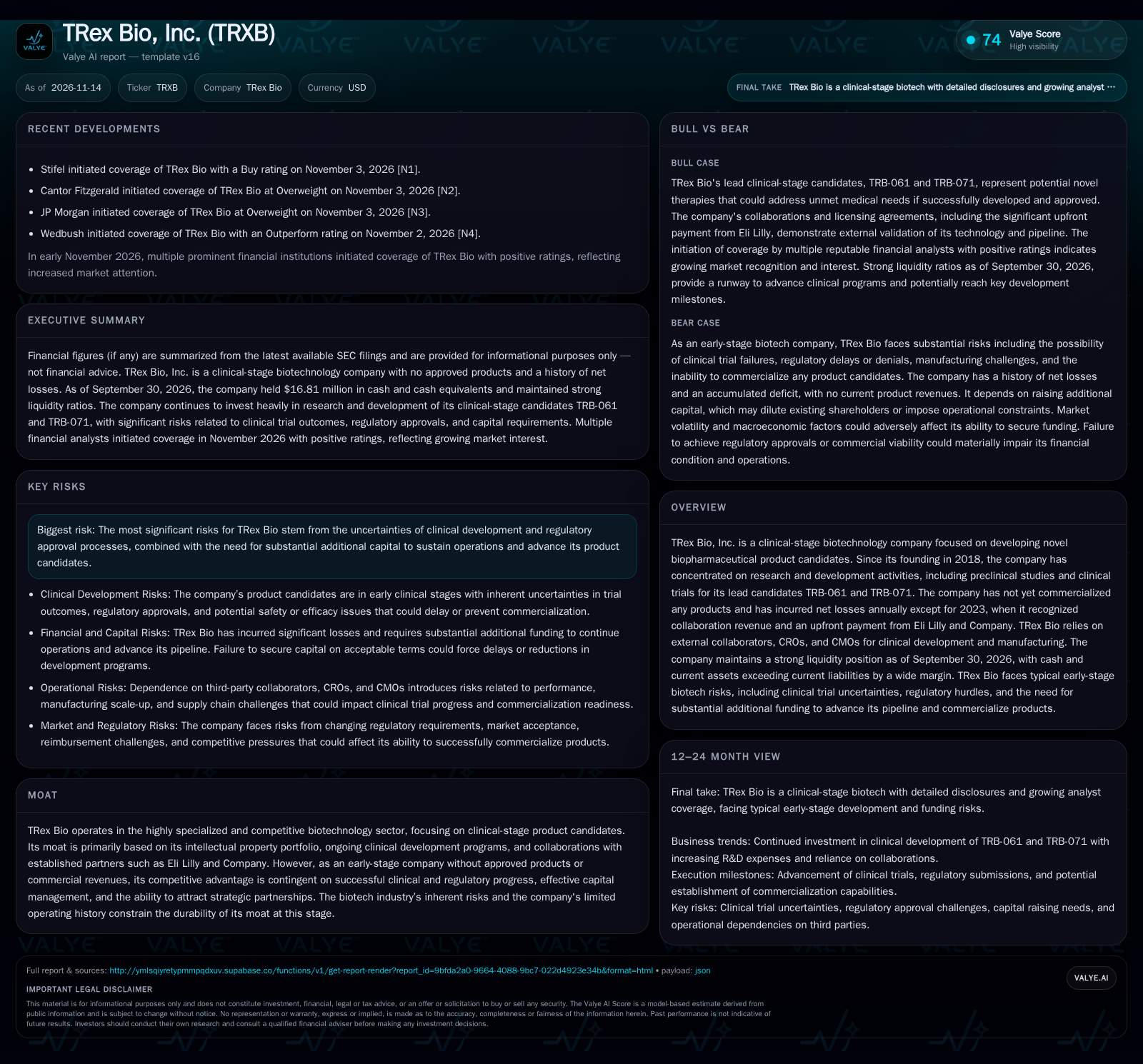
TRex Bio, Inc. is a clinical-stage biotech with lead candidates TRB-061 and TRB-071, no approved products, and a history of net losses except for a one-time revenue event in 2023. As of September 30, 2026, it reported $16.81 million in cash, a current ratio of 7.58, and an accumulated deficit of $136.8 million. Multiple major analysts initiated coverage in November 2026 with positive ratings, highlighting increased market attention but not mitigating the need for substantial additional funding and successful clinical progress to realize commercial potential. [S1] [N1] [N2] [N3] [N4]
TRex Bio’s emergence onto analysts’ radar with a string of positive ratings in November 2026 signals a moment of heightened attention for the clinical-stage biotech. Yet, beneath the surface, the company’s reality is defined by the classic high-wire act faced by early-stage biopharma: a compelling pipeline, a single year of break-even performance driven by a one-off collaboration payment, and a balance sheet that—while currently robust in terms of liquidity ratios—will be tested by rising R&D and operational costs. The company’s future will depend on the interplay between clinical trial progress, regulatory navigation, and its ability to attract further capital on acceptable terms.
Recent Analyst Coverage and Financial Position: What’s Changed for TRex Bio?
The most material recent development for TRex Bio is the wave of positive analyst initiations in early November 2026, with Stifel, Cantor Fitzgerald, JP Morgan, and Wedbush all starting coverage with Buy, Overweight, or Outperform ratings. This reflects a significant uptick in market attention and suggests that the company’s pipeline and story are gaining traction with institutional investors and the sell-side. [N1] [N2] [N3] [N4]
On the financial side, as of September 30, 2026, TRex Bio reported a net loss of $42.5 million for the first nine months of the year and an accumulated deficit of $136.8 million. The company’s cash and cash equivalents totaled $16.81 million, with a current ratio of 7.58, indicating reported liquidity position but not long-term funding sufficiency. [S1]
The company’s financial history is marked by recurring losses, with 2023 as a one-off exception due to a significant collaboration payment from Eli Lilly, rather than sustainable product or royalty revenue. [S1]
These facts matter because they frame both the urgency and the opportunity: TRex Bio now has a platform for broader investor engagement, but its capital needs and clinical execution risks remain acute and unresolved.
Pipeline Economics: R&D Spend, Funding Pressure, and the Commercialization Challenge
TRex Bio’s business model is emblematic of clinical-stage biotech: the company invests heavily in R&D, especially for its lead assets TRB-061 and TRB-071, with the goal of ultimately achieving high-margin product sales or lucrative licensing deals if development is successful. Until regulatory approval, however, the company’s economics are defined by negative operating leverage—fixed R&D and G&A outlays with no offsetting product revenue.
The company’s cost structure is dominated by research, clinical trial expenses, and payments to contract research and manufacturing organizations. These costs are mostly variable in the sense that they scale with the number and stage of programs, but there are also significant fixed overheads as the company builds out its platform and public-company infrastructure.
Capital requirements are substantial and ongoing. The company reported cash and liquidity metrics for the period; these figures do not by themselves establish operating runway, investment capacity, financial flexibility, or financing capacity. [S1]
Revenue from collaborations—such as the one-time upfront from Eli Lilly in 2023—can provide episodic relief but is not a reliable or recurring stream. The company’s path to sustainable economics depends on either successful out-licensing, additional collaborations, or—most valuably—bringing a product to market and capturing commercial margins.
Assessing TRex Bio’s Position: Intellectual Property, Collaboration, and the Race for Validation
In the highly competitive biotechnology sector, clinical-stage companies like TRex Bio typically compete on the strength of their intellectual property, the novelty and differentiability of their clinical pipeline, and their ability to secure validating partnerships or collaborations.
TRex Bio’s collaboration with Eli Lilly—evidenced by the prior upfront payment—suggests some external validation of its underlying technology platform, which may help differentiate it from less-partnered peers. However, with no approved products, the company’s moat is inherently fragile and contingent on successful clinical and regulatory progress.
The competitive landscape includes other clinical-stage and established biotech firms targeting similar indications or mechanisms. Substitution risk is high: if a competitor advances a similar therapy to market faster or demonstrates superior efficacy or safety, TRex Bio’s commercial prospects could narrow considerably.
Access to capital and the ability to attract further collaborations are also indirect but powerful competitive levers; companies that can secure non-dilutive funding or high-profile partnerships are better positioned to survive the long path to commercialization.
Breakthroughs in the Clinic: What a Positive Readout Could Unlock
A favorable scenario for TRex Bio centers on successful clinical progress for TRB-061 and/or TRB-071. Positive interim or final data—especially on safety and efficacy—could drive several reinforcing outcomes: increased investor confidence, higher share price, improved access to capital on favorable terms, and the potential for new or expanded collaboration deals with larger pharmaceutical companies.
Such clinical success could also accelerate regulatory interactions, positioning the company for pivotal trials or even expedited review pathways if the target indication is an area of high unmet need.
Confirmation of this scenario would include public disclosure of positive clinical trial data, new strategic partnerships or collaborations, and successful capital raises at terms that minimize dilution. Conversely, the absence of clinical milestones or difficulty raising capital despite positive data would challenge the upside narrative.
Incremental Progress and Persistent Capital Constraints: The Most Likely Trajectory
The most plausible near-term outcome is steady but incremental advancement of TRex Bio’s pipeline, punctuated by regular capital raises to fund ongoing operations.
Clinical development will proceed in stages, with periodic data releases and regulatory interactions. The company may secure additional collaboration revenue, but episodic payments are unlikely to fully offset recurring R&D and G&A costs.
This scenario would be confirmed by continued net losses, sequential R&D expense growth, periodic capital market transactions, and a cadence of clinical trial updates without transformative breakthroughs. Falsification would come from either a major clinical setback or, on the positive side, a surprise inflection in partnership or licensing activity that substantially improves funding visibility.
Clinical Setbacks or Funding Gaps: How Downside Risks Could Materialize
The most acute threats facing TRex Bio are negative clinical trial outcomes, regulatory delays, or inability to secure new funding. A failed or inconclusive trial for either TRB-061 or TRB-071 could erode investor confidence, limit access to capital, and force the company to curtail or suspend programs.
Given the absence of committed external funding, a deterioration in capital markets or waning investor interest could result in unfavorable dilution, punitive debt terms, or an outright cash crunch. Operational dependencies on CROs and CMOs add further risk: supply chain disruptions or partner underperformance could delay key milestones.
Evidence confirming downside risk would include adverse clinical data disclosures, missed or delayed trial timelines, failed capital raises, or explicit warnings about going-concern status. Falsification would require clear positive signals on both the clinical and capital fronts.
Milestones and Metrics That Will Shape TRex Bio’s Next Chapter
Progress of clinical trials for TRB-061 and TRB-071, including enrollment rates, interim data readouts, and safety/efficacy signals, if disclosed.
Updates on partnership or collaboration activity—especially any new deals, expanded relationships, or milestone payments secured.
Cash runway disclosures: management statements on operating runway, targeted burn rates, and planned timing of capital raises would help test funding sufficiency.
Regulatory interactions and feedback, such as IND clearances, Fast Track/Breakthrough Therapy designations, or regulatory warning letters.
R&D and G&A expense growth rates, as sustained increases would indicate pipeline activity but also intensifying funding needs.
Changes in analyst coverage or target price revisions, which may signal shifting market sentiment or new information.
Operational updates on CRO/CMO performance or supply chain disruptions, if disclosed, as these could materially impact development timelines.
Disclaimer: This is research-only, informational analysis and not investment advice. It may include AI-generated interpretation and general industry context. Always verify important details using primary sources.

Comments