
Aperture AC: Merger Mechanics, Liquidity Strain, and the Binary Stakes of the Atlantic HPC Combination
Aperture AC’s proposed merger with Atlantic HPC Group highlights both the potential of public market access for a high-performance computing player and the acute financial and operational constraints facing the SPAC itself.
Leadership changes and the pending merger increase execution risk, making the outcome highly contingent on transaction completion and financing success. The situation is a classic SPAC binary: merger and recapitalization, or liquidation.
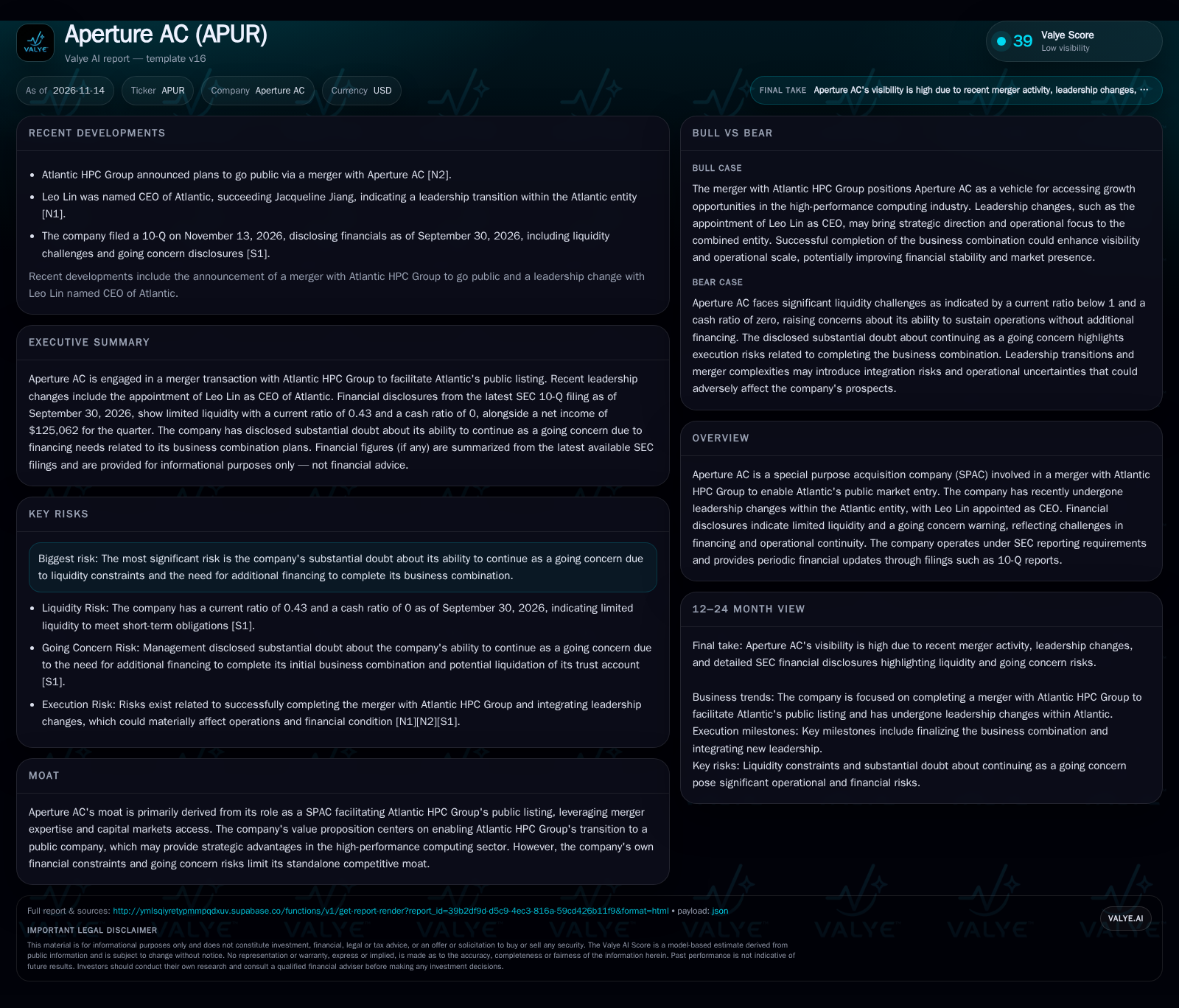
Aperture AC, a SPAC currently facilitating the public debut of Atlantic HPC Group, finds itself at a critical inflection point. The company’s acute liquidity shortfall—evidenced by a current ratio of 0.43 and a cash ratio of zero—paired with a going concern warning, underscores the urgency of completing its business combination. The appointment of Leo Lin as CEO of Atlantic adds a strategic twist, but also introduces integration risk at a sensitive juncture. In the classic SPAC binary, Aperture AC must close and fund the merger to avoid liquidation, while the economics and future of the combined entity will hinge on its ability to execute, attract capital, and deliver on the promise of high-performance computing growth.
Liquidity Crunch and the High-Stakes Atlantic Merger
Aperture AC’s most pressing facts revolve around its precarious financial position and the high-stakes merger with Atlantic HPC Group. As of September 30, 2026, the company reported just $261,304 in current assets against $606,630 in current liabilities, yielding a current ratio of 0.43 and a cash ratio of zero. The company reported cash and liquidity metrics for the period; these figures do not by themselves establish operating runway, investment capacity, financial flexibility, or financing capacity. Management has explicitly disclosed substantial doubt about the company’s ability to continue as a going concern, directly tying survival to the need for additional financing and successful completion of its initial business combination [S1]. This is not a slow-burn cash challenge but an existential cliff, with the trust account at risk of liquidation absent a deal. Meanwhile, the appointment of Leo Lin as CEO of Atlantic, the merger target, signals a leadership reset that could reshape strategy but also adds execution complexity at a critical juncture [N1] [N2].
SPAC Economics: Fee Structure, Funding Cliff, and the Imperative of a Successful Combination
Aperture AC operates under the typical SPAC model: it raised capital through an IPO ($102 million from public units and an additional $3.1 million from a private placement) and parked the proceeds in a trust account, which can only be deployed if a qualifying business combination is completed. Until that point, operational expenses must be met from limited working capital outside the trust, resulting in the current liquidity strain [S1]. The SPAC’s economics hinge entirely on closing the merger—if successful, sponsor shares convert and warrants may become valuable; if not, the trust is returned to shareholders and the SPAC is dissolved.
The economics of the post-combination entity (Atlantic HPC Group) will depend on its ability to leverage public market access for capital raises and growth investment, likely in a capital-intensive sector such as high-performance computing. These businesses typically require substantial upfront investment in hardware, datacenters, and R&D, making access to capital markets a key rationale for the merger. However, the SPAC structure also imposes meaningful friction: dilution from sponsor shares, fees, and potential redemptions can erode the capital available to the target.
Aperture’s Role in the SPAC Ecosystem and Atlantic’s Prospective HPC Market Position
Aperture AC’s competitive position is defined less by operational moat and more by its role as a capital markets facilitator. Its core function is to deliver Atlantic HPC Group to public markets, leveraging the SPAC structure’s speed and flexibility. In the SPAC landscape, competition is fierce: multiple blank-check companies vie for high-quality targets, and regulatory scrutiny has intensified since 2021, raising the bar for successful de-SPAC transactions.
For Atlantic HPC Group, the prospective business post-merger will face a different set of competitive dynamics. High-performance computing is a capital- and technology-intensive sector where barriers to entry are meaningful but not insurmountable. Success depends on scale, access to low-cost capital, customer relationships, and technology differentiation. The merger may offer Atlantic a visibility and funding boost, but it will also need to contend with established players in cloud computing, datacenter services, and specialized hardware. The combined entity’s edge will depend on its execution in capital deployment, customer acquisition, and innovation—none of which are guaranteed by the SPAC process itself.
Merger Completion Unlocks Growth Capital and Strategic Reset
In the best-case scenario, Aperture AC successfully completes the merger with Atlantic HPC Group, recapitalizing the combined entity and providing the public listing needed to access additional capital. This would allow Atlantic to accelerate investment in high-performance computing infrastructure, pursue customer acquisition, and potentially attract strategic partnerships. The leadership transition to Leo Lin could bring fresh operational focus and credibility, particularly if Lin brings relevant industry experience or relationships [N1].
Confirmation of this scenario would come from regulatory approval of the business combination, closing of the transaction, and announcements of new capital raises or customer wins by the combined company. Evidence of robust demand for Atlantic’s HPC services, successful integration of new leadership, and clear plans for post-merger investment would further support the upside case.
Execution Hurdles and Dilution Risks Shape the Most Likely Outcome
The most plausible outcome is a challenging, protracted path to deal closure. The merger with Atlantic HPC Group could still succeed, but likely with substantial dilution from redemptions or concessions to secure shareholder approval. The acute liquidity shortage means any delay or complication could force Aperture AC into seeking costly bridge financing or extensions, further eroding the economics for both SPAC sponsors and the target.
The base scenario assumes the business combination is completed, but with a smaller-than-hoped capital infusion due to redemptions and transaction friction. Atlantic emerges as a public company, but with limited immediate potential financial flexibility. The leadership team faces a steep integration curve, and the market will demand evidence of growth execution. Confirmation would come from the deal closing but with high redemption rates, modest capital raised, and initial operational updates focused on cost management and incremental wins rather than headline growth.
Merger Failure Triggers Liquidation and Sponsor Losses
The adverse scenario is straightforward: the merger with Atlantic HPC Group fails—whether due to regulatory hurdles, shareholder rejection, inability to secure necessary financing, or breakdowns in negotiation. In this case, Aperture AC would be forced to liquidate the trust account and return funds to public shareholders, with sponsors and private placement investors likely losing their at-risk capital.
This outcome would be confirmed by merger termination announcements, missed regulatory or shareholder approval milestones, or explicit liquidation filings. Signs would include persistent delays, withdrawal of Atlantic from the transaction, or public statements citing insurmountable financing or integration obstacles. In such a scenario, the SPAC ceases to be a going concern, and the business combination thesis collapses.
Concrete Developments That Will Determine Aperture AC’s Outcome
Progress toward regulatory approval and shareholder vote on the Atlantic HPC Group merger—timing and success here will directly impact viability.
Disclosure of the actual redemption rate by public shareholders at the time of the combination—high redemptions would shrink the cash available to the combined entity and increase dilution.
Announcement of any bridge financing, PIPE (private investment in public equity) commitments, or other capital-raising measures to shore up liquidity pre- or post-merger.
Integration and onboarding of Leo Lin as Atlantic’s CEO—any updates on leadership team stability, strategic vision, or operational plan would help test the scenario assumptions [N1].
If disclosed, updates on Atlantic HPC Group’s commercial traction, customer pipeline, or backlog, which would indicate real demand for its services post-listing.
Reporting of post-merger pro forma financials, particularly cash runway, capex plans, and expected EBITDA or free cash flow trajectory.
Any SEC or exchange communications regarding compliance with listing requirements, especially in light of the current liquidity and going concern warnings.
Disclaimer: This is research-only, informational analysis and not investment advice. It may include AI-generated interpretation and general industry context. Always verify important details using primary sources.

Comments