
DSS, INC.: Leadership Uncertainty and the Complexities of Sustained Turnaround Efforts
DSS, INC. faces acute liquidity pressure as current liabilities vastly exceed current assets, despite recent capital raises and prior revenue growth. Leadership transition and strategic shifts add execution risk, making near-term financial resilience a central thesis variable.
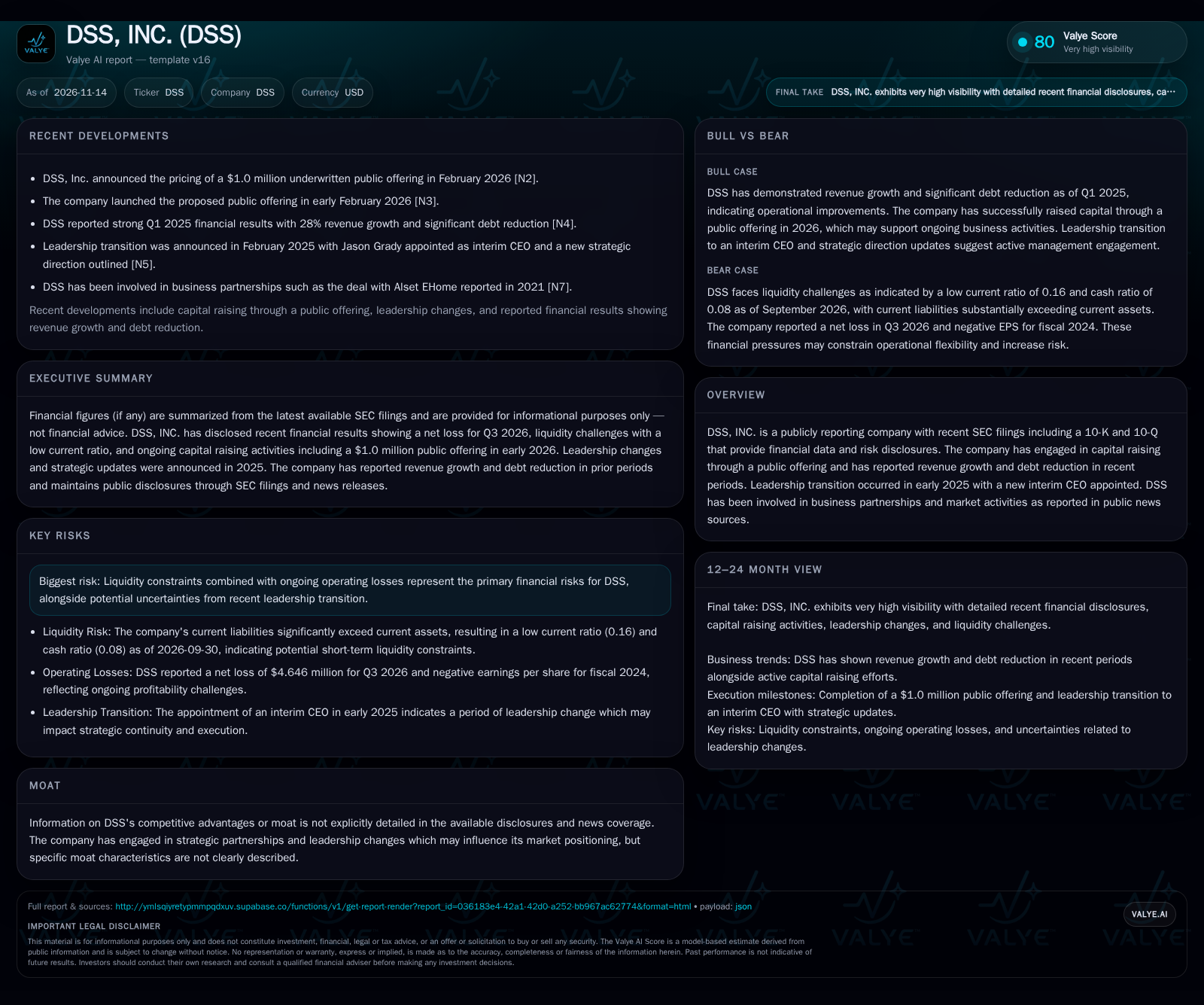
DSS, INC. reported a net loss and continues to operate with a current ratio of just 0.16 as of September 2026, while pursuing new capital via public offerings. Despite prior success in revenue growth and debt reduction, ongoing operating losses and a leadership transition cast uncertainty on the company's ability to stabilize its financial position and execute any turnaround.
DSS, INC. is navigating a period of acute financial stress, with short-term obligations far outstripping liquid resources and recent performance marked by continued net losses. While the company has a history of revenue growth and debt reduction, its current liquidity profile is deeply challenged, prompting a $1.0 million capital raise and a leadership shakeup. The question is whether these measures are sufficient to stabilize operations or merely delay more fundamental restructuring. Investors and stakeholders must weigh the company's ability to generate sustainable positive cash flow against persistent execution risks and an uncertain strategic direction.
Immediate Outlook Influenced by Recent Financial Challenges and Capital Injections
DSS, INC.'s most recent SEC filing shows a net loss of $4.646 million for Q3 2026, against a backdrop of just $3.275 million in cash and $613,000 in short-term investments. Current assets total $7.934 million, while current liabilities stand at $50.753 million, resulting in a current ratio of only 0.16 and a cash ratio of 0.08 [S2]. These figures underscore an acute liquidity challenge, where near-term obligations vastly outstrip available liquid resources. In response, DSS announced a $1.0 million underwritten public offering in early 2026, reflecting urgent capital needs [N2] [N3]. Meanwhile, the company is operating under interim CEO Jason Grady following a leadership transition and strategic update in 2025 [N5]. While the company reported strong revenue growth (28%) and debt reduction in Q1 2025, recent quarters no longer reflect this momentum [N4]. The confluence of liquidity strain, leadership change, and external capital raising defines DSS's current reality.
Interactions Between DSS’s Business Model, Cash Flow, and Financing Requirements
DSS’s economics appear to be characterized by negative operating leverage—fixed overhead, debt service, and possibly high working capital requirements outpace gross profit, resulting in recurring net losses. The company’s ability to generate positive cash flow is undermined by insufficient revenue scale or margin, as indicated by negative EPS and continued net losses [S1] [S2]. Without disclosure of specific business segments or unit economics, it is plausible that DSS operates across multiple ventures or product lines, each with distinct capital and margin profiles. The acute imbalance between current liabilities and assets suggests reliance on trade credit, delayed payments, or short-term borrowing to fund operations. The $1.0 million public offering in early 2026 is modest relative to the liability stack, implying that such capital raises may only provide temporary relief unless accompanied by a step change in profitability or asset monetization [N2] [N3]. In the absence of recurring high-margin revenue streams or asset sales, the company’s path to sustainable economics appears highly uncertain.
Market Positioning Shaped by Strategic Collaborations and Competitive Moves
DSS’s reported business partnerships, such as the deal with Alset EHome in 2021, indicate efforts to expand through alliances, but there is no current evidence that these translate into durable commercial advantage or recurring revenue [N7]. The company’s competitive positioning remains ambiguous given the lack of detail on core offerings, customer concentration, or technology differentiation in recent filings. In industries where capital constraints are severe, competitors with stronger balance sheets or more focused business models may be able to outlast DSS or capture share as liquidity pressures force it to retrench or divest. If DSS is pursuing a diversified holding or operating company approach, the risk is dilution of focus and limited synergies, particularly when capital is scarce. The leadership transition and strategic update in 2025 suggest a recognition of the need for repositioning, but execution risk is heightened without clear evidence of market leadership or defensible moat characteristics.
Operational Leverage, Asset Sales, or External Support: Pathways to a Successful Turnaround
A favorable scenario for DSS would involve a combination of rapid margin improvement, successful asset monetization, and/or access to new sources of capital that are large enough to refinance or restructure the current liability overhang. If the company can convert business partnerships into recurring, high-margin revenue streams, or if there are hidden assets that can be sold or leveraged, DSS could stabilize its liquidity position and regain investor confidence. Confirmation of this scenario would come from positive quarterly cash flow, a substantial reduction in current liabilities, renewed revenue growth, or announcements of major strategic transactions. Evidence against this scenario would be continued negative cash flow, inability to raise meaningful capital, or further increases in short-term obligations.
Incremental Capital Infusions and Cost Management as Pillars of Business Stabilization
The most plausible near-term path is a series of incremental capital raising efforts—small public offerings, asset sales, or bridge facilities—combined with aggressive cost management to buy time for a potential operational turnaround. The leadership team may seek to renegotiate terms with creditors and suppliers, delay some obligations, or restructure aspects of the business to reduce cash burn. This scenario would be confirmed by a stabilization or slow improvement in the current ratio, sequential declines in net losses, and continued but modest capital inflows. However, if cash burn persists and external capital becomes more expensive or unavailable, the risk of default, forced asset sales, or restructuring increases. Failure to demonstrate improved financial metrics quarter-over-quarter would undermine this base case.
Consequences of Liquidity Depletion: Restructuring as a Last Resort
The adverse scenario is one where DSS’s liquidity is exhausted before operational improvements or major capital infusions materialize. In this case, the company may be forced into a formal restructuring, asset liquidation, or a distressed sale. Signs of this scenario would include missed payments to creditors, accelerating current liabilities, inability to close even small capital raises, or resignations of key executives. If DSS cannot stem the cash outflow or access larger-scale financing, stakeholders could face severe dilution, loss of control, or impaired recoveries. This scenario is also more likely if macro conditions tighten, further restricting access to risk capital or depressing asset values.
Evaluating DSS Progress Through Specific Financial and Strategic Developments
Quarterly cash flow from operations: Sequential improvement or deterioration would directly indicate whether cost controls and revenue efforts are gaining traction.
Current ratio and cash ratio trends: Sustained improvement would suggest progress in balancing liquidity, while further deterioration would flag impending distress.
Announcements of additional capital raises or credit facilities: The size, terms, and frequency of new financings will reveal market confidence and the company’s access to capital.
Leadership continuity and strategic execution: Any further changes in executive team or shifts in stated strategy would signal either adaptability or instability.
Evidence of asset monetization (if disclosed): Sale or leveraging of non-core assets would provide near-term liquidity and test management’s ability to execute under pressure.
Recurring revenue growth or major contract wins: New or expanded customer relationships, if disclosed, would validate the potential for operational turnaround.
Changes in accounts payable and short-term debt: Rapid increases could indicate worsening liquidity, while reductions would suggest progress on restructuring.
Disclaimer: This is research-only, informational analysis and not investment advice. It may include AI-generated interpretation and general industry context. Always verify important details using primary sources.

Comments