
Mountain Crest Acquisition 6 Corp.: SPAC Economics, Liquidity Strains, and the High Stakes of the Search Phase
With no announced business combination and extremely reported liquidity position, Mountain Crest Acquisition 6 Corp. faces the classic SPAC clock: finding a viable merger target before financial and regulatory deadlines force a reckoning. The company’s recent net income is a function of trust-account interest, not operations, leaving its future entirely dependent on successful deal execution.
Mountain Crest Acquisition 6 Corp. is an early-stage SPAC that has yet to announce or identify a merger target. The company’s value proposition and risks hinge entirely on its ability to identify and close a compelling business combination within the required timeframe.
Mountain Crest Acquisition 6 Corp. exemplifies the binary, high-stakes nature of the SPAC business model at its earliest stage. With no operational activities, sector focus, or merger target announced, the company’s financials reflect only the mechanics of a newly listed blank check entity: modest current assets, significant liabilities, and net income generated solely from trust account interest.
Liquidity Crunch and Absence of a Target Define the Current State
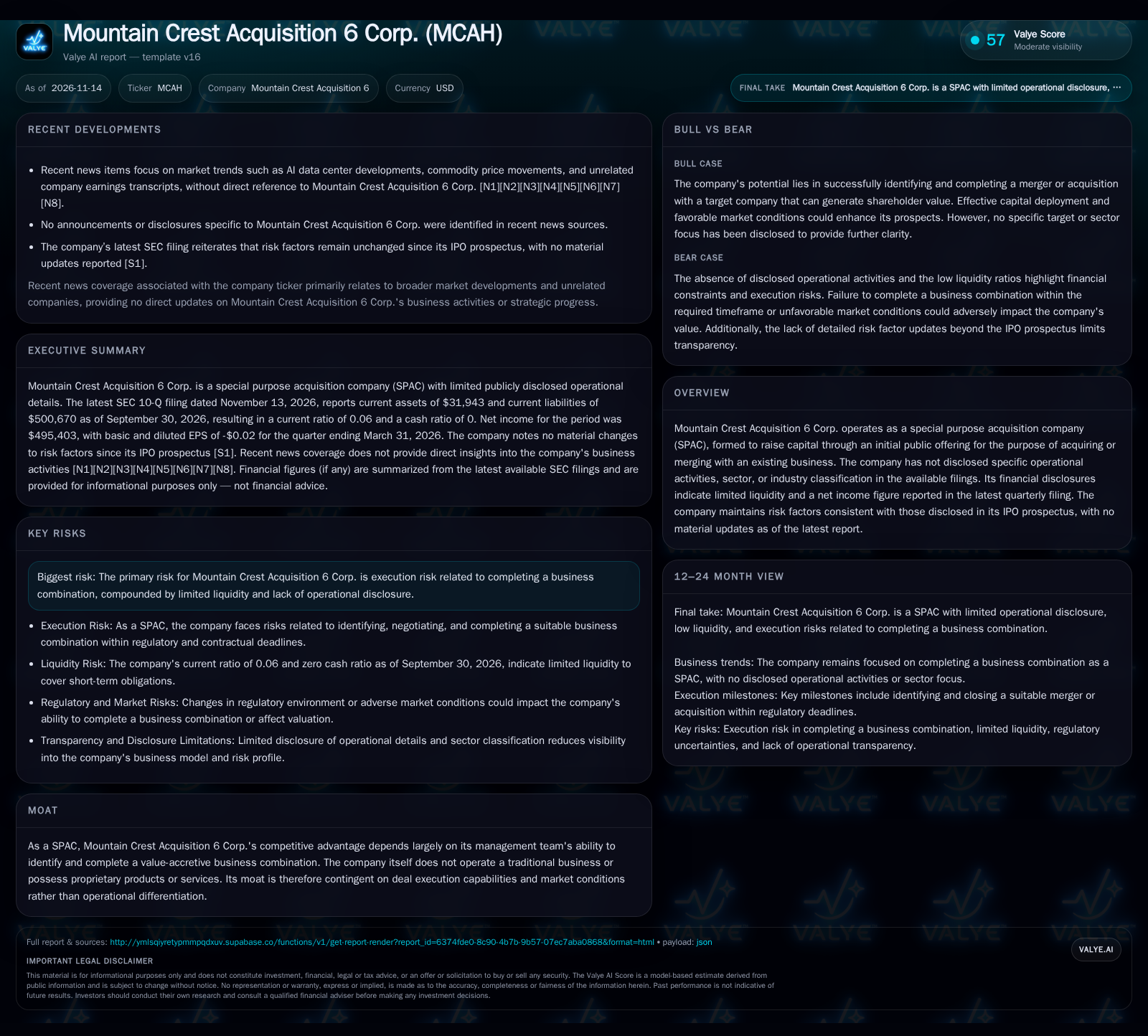
As of September 30, 2026, Mountain Crest Acquisition 6 Corp. reported current assets of $31,943 against current liabilities of $500,670, resulting in a current ratio of 0.06 and a cash ratio of 0. These metrics indicate that the company has almost no liquid resources available to meet near-term obligations outside its segregated trust account [S1]. Net income for the quarter was $495,403, but this figure is entirely attributable to interest income from funds held in trust, not from any operating business [S1]. Critically, no business combination target has been identified or announced, and the company explicitly states it has not initiated substantive discussions with any potential target as of the latest filing [S1]. These facts place the company squarely in the SPAC search phase, with heightened execution risk due to the ticking regulatory clock and lack of operational progress.
The absence of a merger target at this stage compels scrutiny of the SPAC’s operational runway beyond headline liquidity figures. While the trust account safeguards investor capital earmarked for the business combination, it typically remains restricted from use until a definitive agreement is reached or liquidation occurs. Consequently, the company’s ability to fund ongoing administrative, legal, and regulatory expenses depends heavily on sponsor support or alternative financing mechanisms. This dynamic introduces a layered risk profile where liquidity constraints outside the trust can accelerate the urgency of deal-making or precipitate premature wind-down if external funding sources are unavailable or insufficient.
SPAC Economics: Trust Interest Versus Operating Cash Flow
Mountain Crest Acquisition 6 Corp. currently generates non-operating income in the form of interest on funds held in its trust account, not from any commercial activity [S1]. This is typical for a SPAC in its pre-deal phase, where the primary source of reported profitability is the yield on cash and marketable securities held in trust. The company's cash outside the trust is minimal, and its current liabilities far exceed available liquid resources, suggesting it relies on the deferred use of trust funds and sponsor support to meet ongoing expenses until a business combination is completed. If a merger is consummated, the economics would pivot sharply: the surviving entity’s business model, sector, and capital structure would determine future revenue, margin, and cash flow dynamics. Until then, fixed costs for public company compliance and deal pursuit are likely to outpace available resources, creating a negative operating leverage scenario if the timeline extends or a deal is not secured.
The reliance on trust interest income underscores the inherent temporal mismatch in the SPAC’s financial model. Interest yields on trust assets are generally modest and insufficient to cover fixed costs associated with maintaining a public listing, including compliance, reporting, and investor relations. This structural feature creates a negative operating leverage environment during the search phase, where incremental expenses erode net assets absent revenue-generating operations. Moreover, the economics post-merger hinge critically on the acquired company’s capital intensity, profitability profile, and growth trajectory, which will ultimately determine the sustainability of cash flows and the ability to service any new debt or equity raised as part of the transaction.
SPAC Market Saturation and the Challenge of Differentiation
Mountain Crest Acquisition 6 operates in a crowded SPAC landscape, where hundreds of blank check companies compete for a limited pool of attractive merger targets. With no disclosed sector focus, proprietary sourcing channel, or sponsor differentiation, the company’s ability to secure a compelling deal may be hindered by both competition from other SPACs and direct acquirers, as well as increasing skepticism among private companies regarding the SPAC route. Counterforces include target companies’ preference for traditional IPOs or strategic alternatives, regulatory scrutiny, and the risk of unfavorable deal terms as sponsor incentives become misaligned with public shareholders. Without a unique sourcing advantage or sector specialization, the company’s competitive position is undifferentiated, and its ultimate value creation will depend on deal execution skill and market timing.
A High-Quality Merger Target Could Transform the Equity Story
The most favorable outcome for Mountain Crest Acquisition 6 would be the identification and successful merger with a private company possessing strong growth prospects, sound financials, and public-market appeal. This could unlock value for shareholders through post-merger appreciation, enhanced liquidity, and access to capital markets for the target. Confirmation of this scenario would require a definitive merger agreement announcement, positive market reaction to the deal terms, and evidence that redemptions are manageable—indicating investor support. Early signals might include disclosures of target sector focus, initiation of due diligence, or sponsor commentary on deal pipeline quality. Falsification would occur if the company fails to announce meaningful deal progress well before the typical SPAC deadline, or if a proposed combination is met with overwhelming shareholder redemptions and skepticism.
Protracted Search Phase and Mounting Deadline Pressure
The most plausible scenario, absent new disclosures, is that Mountain Crest Acquisition 6 continues to search for a business combination target under increasing time and liquidity pressure. The company is likely to incur ongoing administrative and regulatory costs without corresponding operating income, relying on minimal non-trust cash and sponsor advances to cover expenses. If a deal is eventually identified, it may be under suboptimal terms due to the compressed timeline and competitive environment. Confirmation of this scenario would include further filings that reiterate a lack of deal progress, additional sponsor loans, or extensions of the SPAC timeline. Falsification would require either a credible merger announcement or evidence of early liquidation.
Failure to Secure a Merger and the Risk of Forced Liquidation
If Mountain Crest Acquisition 6 is unable to identify and close a business combination within the regulatory timeframe, the company would be forced to liquidate, returning trust assets to public shareholders minus allowable expenses. In this scenario, sponsor capital and any non-redeemable securities would likely be wiped out, and public shareholders would receive their pro rata share of the trust, potentially reduced by redemption-related and winding-up costs. Confirmation would come from explicit filings announcing liquidation, missed regulatory deadlines, or an inability to raise additional working capital. Falsification would require a timely, credible deal announcement and evidence of manageable redemptions.
Signals That Would Test the SPAC’s Execution Thesis
Announcement of a definitive agreement with a merger target, including sector and financial details.
Disclosures of sponsor loans, capital infusions, or amendments to the trust structure (if disclosed) that extend runway or signal additional support.
Filing of proxy materials or investor presentations outlining the merits and risks of a proposed business combination.
Redemption rates in connection with any announced deal—high redemptions would challenge deal viability and post-merger capitalization.
Extensions of the SPAC deadline or requests for shareholder approval to amend the timeline.
Any regulatory or legal developments that affect the SPAC’s ability to complete a merger.
Updates to risk-factor disclosures that reflect new operational, financial, or market realities.
Disclaimer: This is research-only, informational analysis and not investment advice. It may include AI-generated interpretation and general industry context. Always verify important details using primary sources.

Comments