
UY Scuti Acquisition Corp.: The SPAC Clock Ticks as Isdera Merger Deadline Approaches
UY Scuti Acquisition Corp. faces a binary inflection: the pending merger with Chinese automotive designer Isdera Group must close by year-end 2026 or the SPAC will be forced to liquidate.
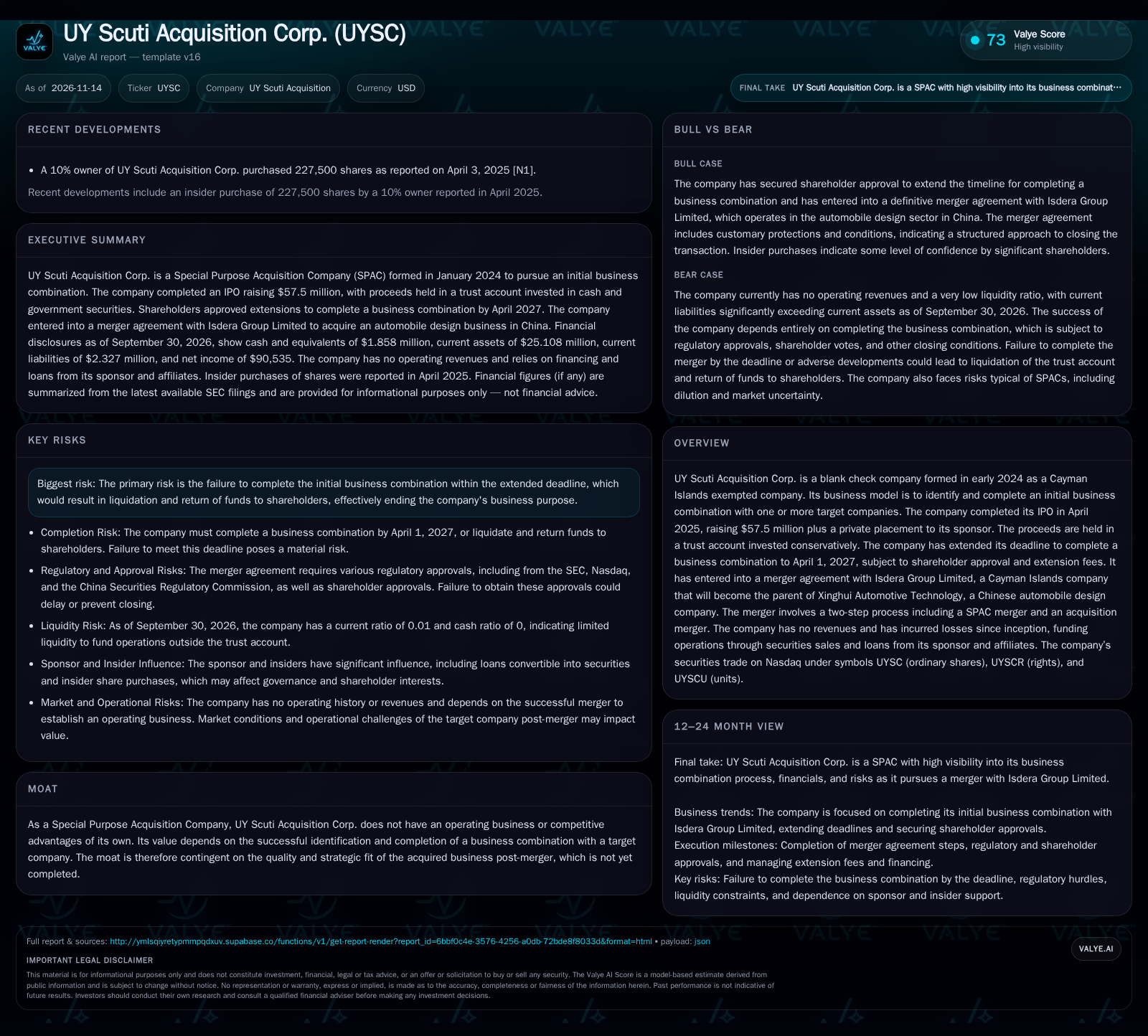
UY Scuti Acquisition Corp. is a blank-check SPAC that must complete its acquisition of Isdera Group, a Chinese automobile design firm, by December 31, 2026, or face liquidation. The company's trust account has been reduced to $34.4 million after substantial shareholder redemptions, and operating liquidity is minimal. The success of the merger depends on regulatory and shareholder approvals, with sponsor loans and insider purchases providing limited support. The binary outcome—closing the deal or returning funds to shareholders—makes execution and external approvals the decisive factors in the coming months. [S2] [N1]
UY Scuti Acquisition Corp. embodies the make-or-break tension of late-stage SPACs: with no operating business, depleted cash, and a looming hard deadline, its future rests entirely on the successful closing of its merger with Isdera Group, a Chinese automotive design company. After substantial redemptions and limited working capital, the company's trust account stands at $34.4 million. The merger, which must close by December 31, 2026, faces the familiar gauntlet of regulatory, shareholder, and execution risks. The next months will determine whether UY Scuti transitions from a financial shell to an operating company—or winds down and returns capital to remaining investors. [S2] [N1]
Merger Deadline, Redemptions, and the SPAC’s Binary Outcome
UY Scuti Acquisition Corp.'s existence is now defined by its pending merger with Isdera Group Limited, a Chinese automobile design firm. The company must close this transaction by December 31, 2026, or liquidate and return the remaining trust funds to shareholders. This binary outcome is sharpened by recent material developments: as of September 30, 2026, UY Scuti held just $1.858 million in cash and equivalents, with current assets of $25.108 million and current liabilities of $2.327 million—yielding a current ratio of 0.01 and a cash ratio of 0. Meanwhile, 2,437,288 shares were redeemed for $25.3 million, reducing the trust account to $34.4 million. The company has not generated operating revenues and all activity relates to the business combination process. Sponsor loans, convertible into equity at $10 per unit, and insider purchases—most notably a 10% owner acquiring 227,500 shares—provide limited financial support, but do not change the fundamental reliance on closing the Isdera deal. [S2] [N1]
How the SPAC Structure Shapes Value Creation and Dilution
As a SPAC, UY Scuti’s economics are binary: value is created only if a business combination is completed and the new entity can generate sustainable cash flows. Until then, the structure is almost entirely financial engineering. The IPO and private placement raised $57.5 million, most of which was placed in a trust account invested in low-risk securities. Shareholder redemptions prior to the merger have reduced the available cash for the transaction and post-merger operations.
The operating expenses and extension fees are covered by sponsor loans and promissory notes, which are convertible into equity if the merger closes. This setup means sponsor and insider interests are partially aligned with public shareholders, but can also introduce dilution—especially if additional loans are converted post-merger. The trust account provides redemption value for shareholders who do not wish to participate in the merger, effectively capping downside but also limiting capital available to the combined entity. If the merger closes, future value depends entirely on Isdera Group’s operating performance, cost structure, and ability to scale within the Chinese automotive design market. If the merger fails, liquidation will see remaining trust funds returned to shareholders, with little left for anyone else.
Strategic Implications of Acquiring a Chinese Automotive Designer
The proposed acquisition of Isdera Group, which specializes in automobile design in China, positions UY Scuti to enter a highly competitive and rapidly evolving sector. Chinese automotive markets are characterized by intense competition from both established OEMs and a fast-growing cohort of electric vehicle and smart mobility startups. For a post-merger entity, success may hinge on Isdera’s ability to differentiate through design innovation, partnerships with manufacturers, or intellectual property.
However, as a newly listed operating company, the combined entity would face immediate scrutiny over its ability to deliver growth, secure customers, and manage regulatory complexity—especially as cross-border transactions in the Chinese automotive sector can be sensitive to political and trade environments. UY Scuti’s sponsor and insider structure could provide some stability, but does not confer a lasting competitive advantage unless Isdera itself brings proprietary technology, customer relationships, or a compelling brand.
A Timely Close Unlocks Growth and Strategic Optionality
In the favorable scenario, UY Scuti secures all regulatory and shareholder approvals and closes the Isdera merger by the December 31, 2026 deadline. The combined entity then deploys the remaining $34.4 million trust proceeds to fund Isdera’s growth initiatives in the Chinese automotive design market. If Isdera’s technology and design capabilities attract OEM partnerships or licensing deals, the company could scale rapidly, leveraging capital markets access for further expansion.
Confirmation of this scenario would require clear evidence of regulatory approvals (SEC, Nasdaq, CSRC), positive shareholder votes, and a definitive closing announcement. Post-close, early commercial wins—such as new design contracts, customer announcements, or strategic partnerships—would further validate the upside thesis. The scenario could be falsified by delays in regulatory review, negative shareholder sentiment, or failure to close by year-end.
Most Plausible Outcome: Execution Strain and a Race Against Time
The most likely outcome is a tense, down-to-the-wire process in which UY Scuti spends the remainder of 2026 seeking regulatory clearance and finalizing shareholder approvals for the Isdera deal. Ongoing operating expenses and extension fees are funded by sponsor loans, increasing the potential for post-merger dilution. The available capital for the combined entity is materially reduced by prior redemptions, constraining growth and post-close flexibility.
Evidence supporting this scenario would include incremental regulatory progress, additional extension fee payments, and ongoing sponsor support. Falsification would come from unexpected regulatory rejection, loss of sponsor backing, or a material adverse event at Isdera that derails the transaction.
Deal Failure Triggers Liquidation and Capital Return
If the merger with Isdera cannot be completed—due to regulatory denial, adverse shareholder votes, or inability to meet closing conditions by December 31, 2026—UY Scuti will be forced to liquidate. In this scenario, remaining trust account funds are returned to the non-redeemed shareholders, and the company ceases to exist as an operating entity.
Confirmation would come from a public announcement of deal termination, regulatory rejection, or missed deadlines. The downside is capped for public shareholders by the trust account, but sponsors and insiders would lose their investments and any potential upside from converted loans or equity.
Milestones That Will Determine UY Scuti’s Fate in the Months Ahead
Regulatory approval progress from the SEC, Nasdaq, and China Securities Regulatory Commission—any delays or denials would directly threaten deal closure.
Shareholder vote outcomes and the volume of further redemptions, if disclosed, as high redemptions could further erode post-merger capital.
Updates on extension fee payments, sponsor loans, and whether additional financing is required to maintain operations before closing.
Public confirmation of the Isdera merger’s closing or any announced amendments to terms, timelines, or deal structure.
Any adverse developments or disclosures from Isdera Group that could affect its business prospects or regulatory standing.
Post-close commercial milestones, such as new design contracts or customer partnerships, would help test the thesis if the merger closes.
Changes in insider ownership or sponsor support, if disclosed, as a sign of confidence or concern regarding deal completion.
Disclaimer: This is research-only, informational analysis and not investment advice. It may include AI-generated interpretation and general industry context. Always verify important details using primary sources.

Comments