
Microbot Medical: Early Commercialization and Growth Prospects in Robotic Endovascular Surgery
Microbot Medical’s transition from R&D to commercial-stage operations hinges on the successful adoption and scaling of its LIBERTY® robotic system. Despite reported liquidity position, persistent losses and slow initial revenue signal the steep climb ahead as the company tries to establish clinical acceptance, reimbursement, and operational scale in a competitive medtech landscape.
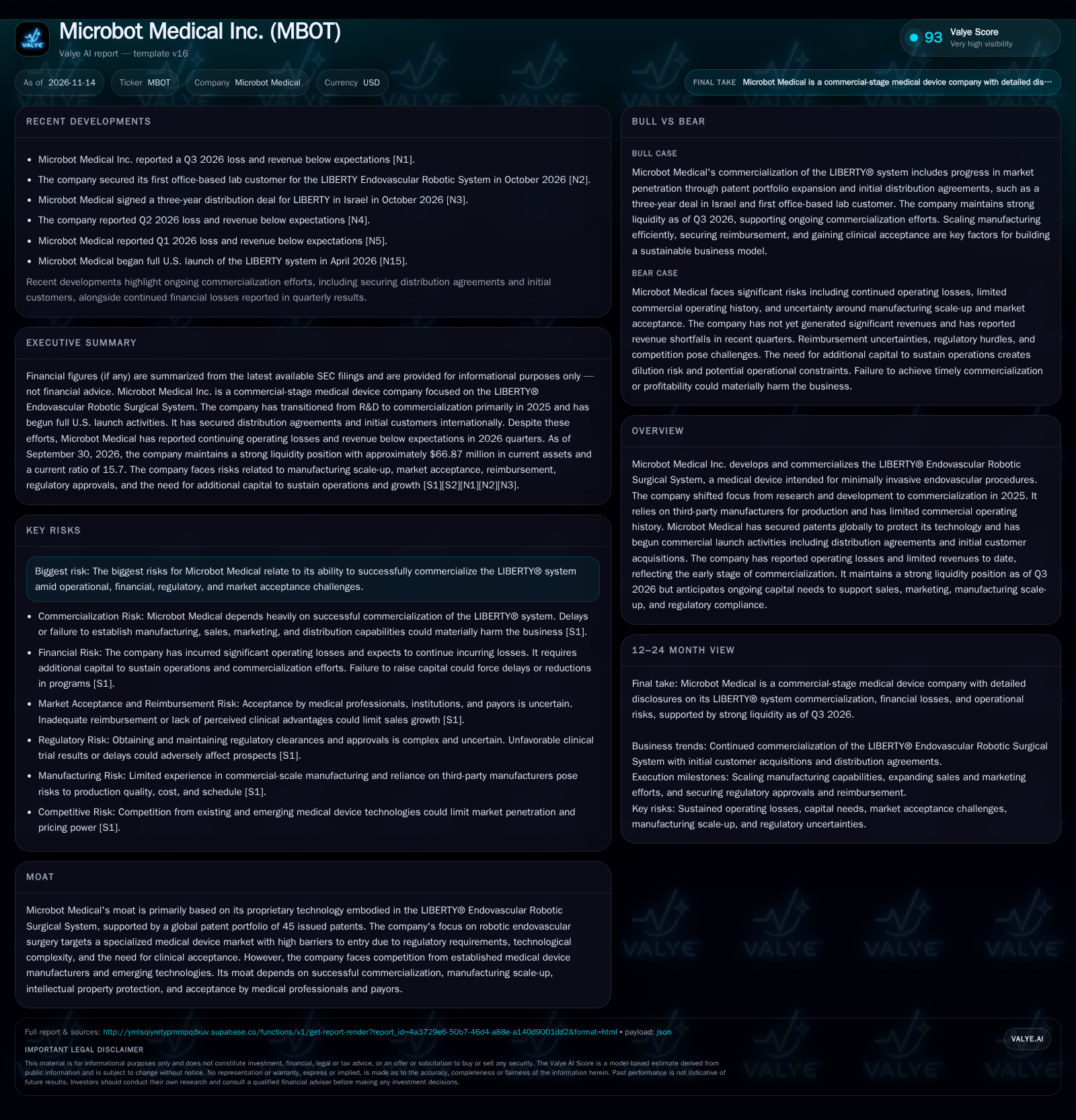
Microbot Medical has launched full U.S. commercialization of its LIBERTY® Endovascular Robotic Surgical System, but early revenues remain well below expectations and the company continues to post significant operating losses. With a robust current asset position, Microbot must now demonstrate market demand, secure reimbursement, and manage manufacturing scale-up—all while competing against established device makers and emerging technologies. The company’s future will be defined by its ability to convert clinical interest into repeatable commercial traction and to manage capital needs amid ongoing losses. [S2] [N1] [N2] [N3]
Microbot Medical’s bet on robotic endovascular surgery is entering its most critical phase. With the LIBERTY® system now commercially available in the U.S. and select international markets, the company faces the classic medtech inflection point: can it transform early clinical interest and distribution partnerships into sustainable commercial momentum before capital needs force strategic shifts? Despite reported liquidity position and initial customer wins, ongoing losses and revenue shortfalls highlight the formidable hurdles of reimbursement, manufacturing scale, and market adoption that often define the fate of first-mover medical device innovators.
LIBERTY® Launch, Initial Revenue Challenges, and Capital Overview
Microbot Medical has fully launched its LIBERTY® Endovascular Robotic Surgical System in the U.S. as of April 2026 and secured its first office-based lab customer, marking an initial step into commercial markets. Internationally, the company signed a three-year distribution agreement in Israel, providing a potential channel for non-U.S. revenue growth. However, financial results for Q1, Q2, and Q3 2026 all showed operating losses and revenue below expectations, signaling a slower-than-hoped commercial ramp. The company reported cash and liquidity metrics for the period; these figures do not by themselves establish operating runway, investment capacity, financial flexibility, or financing capacity. The central tension is whether this liquidity will be sufficient to bridge to meaningful, recurring revenue before further capital raises are needed. [S2] [N1] [N2] [N3]
Evaluating Revenue Opportunities and Cost Dynamics in Scaling Surgical Robotics
Microbot’s business model is built around the commercialization of a single complex product: the LIBERTY® robotic surgical system. In the medtech sector, initial sales cycles for capital equipment are typically long, with adoption hinging on clinical validation, regulatory clearance, and reimbursement. Revenues may consist of up-front system sales, recurring disposables, service contracts, and potential software upgrades. The company’s reliance on third-party manufacturers introduces variable costs and may limit gross margin expansion until sufficient volume is reached. Fixed costs include R&D, regulatory, and public company expenses, which are substantial given the need to support ongoing product development and sales infrastructure.
Operating leverage could be significant if LIBERTY® gains traction: incremental system sales and recurring disposables can drive margins higher as installed base grows. However, the company continues to incur significant losses, indicating that current sales volumes are insufficient to absorb fixed costs. The need for ongoing investment in sales, marketing, and regulatory compliance further delays the path to break-even. Given the capital intensity and the slow initial revenue ramp, Microbot may face dilution risk if additional funding is required before revenues inflect upward. [S1] [S2]
Competitive Landscape: Incumbents, Innovation, and Clinical Adoption Battles
Microbot operates in a highly competitive landscape, with established medtech giants and innovative startups all vying for share in the robotic and minimally invasive surgical space. Barriers to entry are high due to regulatory scrutiny, the need for clinical validation, and complex hospital procurement processes. Incumbents benefit from installed bases, bundled product portfolios, and established relationships with key opinion leaders and hospital systems.
For Microbot, the ability to demonstrate clear clinical advantages—such as reduced procedure time, improved patient outcomes, or enhanced workflow efficiency—will be critical for adoption. Reimbursement uncertainty remains a major hurdle; if payors are reluctant to cover procedures performed with LIBERTY®, hospitals may hesitate to invest. Additionally, rapid technological evolution in robotics and image-guided surgery means that Microbot must not only prove value today but also maintain an innovation cadence to avoid obsolescence. The company’s moat will depend on intellectual property protection, manufacturing reliability, and the ability to secure positive clinical and economic data supporting the LIBERTY® system. [S1]
Clinical Validation as a Catalyst for Commercial Expansion
In a favorable scenario, Microbot leverages strong early liquidity and initial customer wins to build a reference customer base for LIBERTY®, generating positive clinical data and testimonials. This evidence persuades additional office-based labs and hospital systems to adopt the platform, especially if early adopters report improved outcomes or operational efficiency. Reimbursement pathways clarify, either through new procedure codes or successful payor negotiations, reducing friction for procurement.
Manufacturing scale-up proceeds smoothly, enabling Microbot to fulfill demand without quality or cost overruns. Recurring revenue from disposables and service contracts begins to offset fixed costs, and operating leverage emerges as the installed base grows. Evidence confirming this scenario would include a sequential increase in system placements, growing disposable and service revenue, published clinical studies demonstrating efficacy, and a visible expansion in distribution partnerships. A material reduction in quarterly losses or a move toward cash flow neutrality would further validate the upside case.
Projected Adoption Trajectory and Financial Implications
The most plausible trajectory is a gradual commercial ramp, with sporadic system placements and modest growth in disposable revenue. Clinical interest may build, but widespread adoption remains slow due to conservative hospital procurement, lingering reimbursement ambiguity, and the inertia of established clinical workflows. Manufacturing scale-up encounters typical teething issues, leading to variable gross margins and potential supply constraints.
Operating losses persist as fixed costs remain high relative to revenue, and the company continues to draw down its liquidity buffer. Additional capital may be needed within 18-24 months unless revenue growth accelerates or costs are aggressively curtailed. Evidence for this scenario would be continued quarterly losses with only incremental revenue growth, slow but steady customer additions, and periodic fundraising activity. Confirmation of modest clinical adoption (e.g., a handful of new reference sites per year) and updates on reimbursement progress would further support the base case.
Risks of Limited Market Penetration and Financial Strain
In the downside scenario, LIBERTY® fails to gain meaningful traction in the market. Hospitals and labs remain hesitant due to insufficient clinical evidence, lack of reimbursement clarity, or superior alternatives from established vendors. Manufacturing scale-up may be hampered by quality issues or cost overruns, further eroding gross margins and customer confidence.
Persistently weak revenue and high fixed costs accelerate cash burn, forcing Microbot to seek additional capital on unfavorable terms, leading to significant dilution or operational retrenchment. If the company is unable to demonstrate commercial viability, options may narrow to strategic partnerships, asset sales, or even wind-down. Evidence confirming this scenario would include flat or declining system placements, little or no growth in recurring revenue, negative clinical or regulatory developments, and distressed capital raises.
Key Developments Influencing Microbot Medical’s Trajectory
Quarterly system placements and new customer acquisitions—especially in the U.S. and core international markets—would provide a direct measure of commercial traction.
Growth in recurring revenue streams from disposables and service contracts, if disclosed, would indicate progress toward a sustainable business model.
Updates on reimbursement status, such as new billing codes, payor agreements, or successful claims, would help gauge the addressable market and adoption pace.
Gross margin trends as manufacturing scale increases—improving margins would suggest successful cost management and operational execution.
Publication of peer-reviewed clinical studies or real-world evidence supporting LIBERTY®’s clinical and economic value would be a key catalyst for broader adoption.
Announcements regarding new distribution agreements or expansions into additional geographies would signal market expansion capability.
Disclosure of capital raises, burn rate trends, or explicit runway guidance would clarify the company’s ability to sustain operations without excessive dilution.
Evidence of competitive responses—such as new product launches or pricing moves from incumbents—would contextualize Microbot’s market positioning and potential pressures.
Disclaimer: This is research-only, informational analysis and not investment advice. It may include AI-generated interpretation and general industry context. Always verify important details using primary sources.

Comments