
JATT III Acquisition Corp: The SPAC Clock Starts—Liquidity, Uncertainty, and the Search for a Deal
With $69 million raised and a 24-month window to secure a business combination, JATT III Acquisition Corp faces the classic SPAC challenge: turn potential financial flexibility into a compelling acquisition before time and investor patience run out.
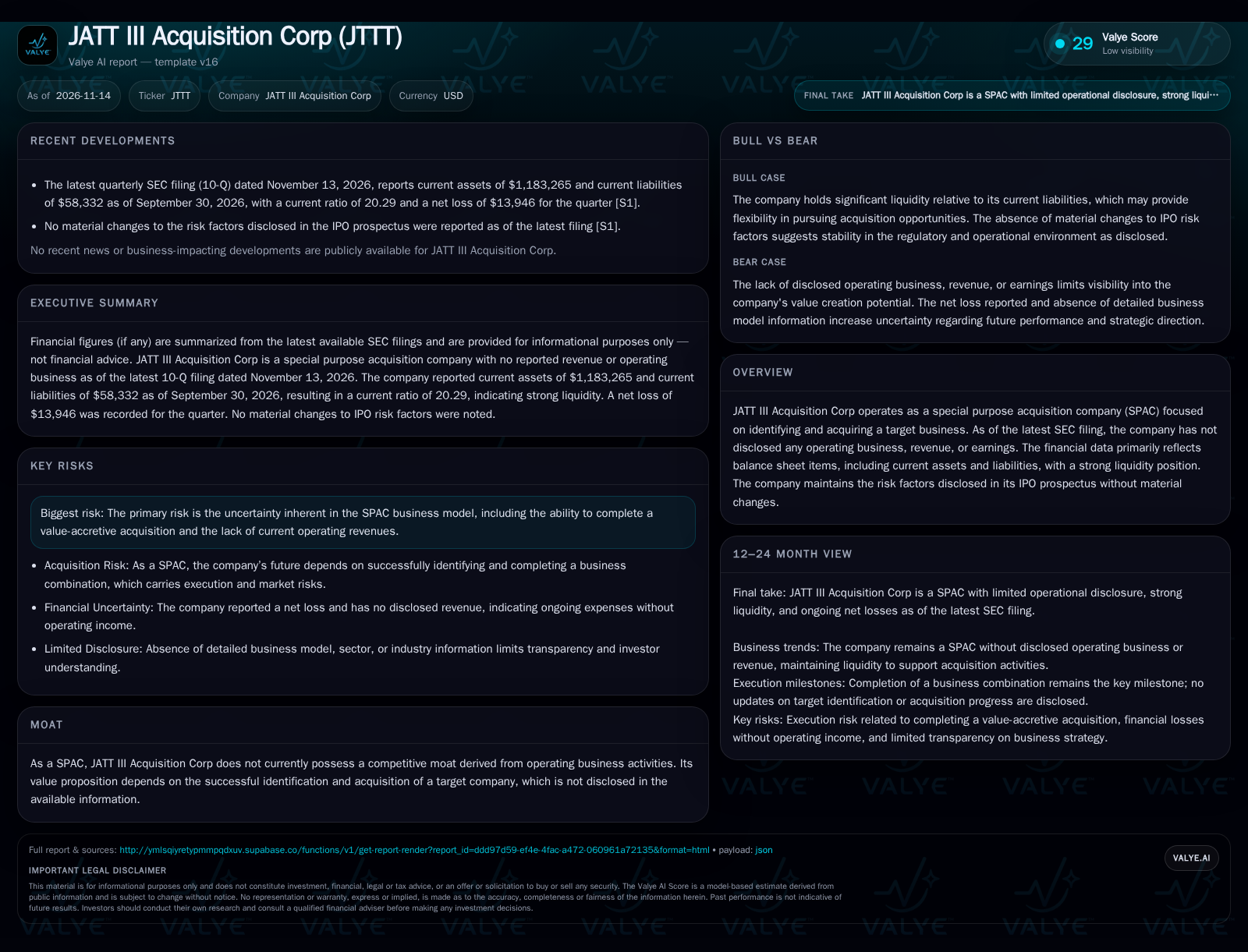
JATT III Acquisition Corp is a newly public SPAC with $69 million in IPO proceeds, a reported current ratio, and no operating business or revenue as of September 30, 2026. Its sole mission is to identify and close a business combination within 24 months. The absence of a disclosed target or sector focus highlights execution risk and the binary nature of value creation for shareholders in the coming year.[S1]
JATT III Acquisition Corp enters the crowded SPAC arena with $69 million in trust and a two-year window to find a merger target, but, as of its first post-IPO quarter, offers no clues as to sector focus or acquisition strategy. Investors face a familiar high-stakes, high-uncertainty dynamic: the company’s value will ultimately hinge on whether management can source and execute a business combination that creates lasting shareholder value—or return capital if not. This setup makes transparency, sponsor alignment, and execution skill paramount as the clock ticks.
IPO Proceeds and the 24-Month Countdown: Where JATT III Stands Now
JATT III Acquisition Corp completed its initial public offering on August 27, 2026, issuing 6.9 million shares at $10.00 each for gross proceeds of $69 million. An additional $2.34 million was raised through a private placement with the sponsor. As of September 30, 2026, the company reported current assets of $1,183,265 and current liabilities of $58,332, yielding a current ratio of 20.29. The company posted a net loss of $13,946 for the quarter, driven by formation, administrative, and compliance costs, partially offset by interest income from trust investments. Crucially, JATT III has not disclosed any operating business, revenue, target sector, or ongoing acquisition negotiations. Under its charter, the SPAC has 24 months from IPO closing to consummate a business combination, after which it must return funds to shareholders if no deal is completed.[S1]
How Value Might Be Created or Lost: Economics of the SPAC Model
JATT III’s economic engine is dormant until a business combination is executed. The company’s current financials reflect only the costs of maintaining a public shell—legal, audit, regulatory, and sponsor expenses—offset by interest earned on trust account investments. The primary economic lever is the identification and acquisition of a private operating business using IPO proceeds and possible share issuance or debt. If a suitable target is acquired, value creation will depend on the acquired entity’s growth, profitability, and public-market appeal.
SPACs typically face several economic pressures: (1) time-limited deal windows, (2) ongoing fixed costs unrelated to operating revenue, (3) dilution from sponsor shares and warrants, and (4) the risk of significant redemptions by public shareholders if a deal is perceived as unattractive. The trust proceeds are generally restricted for use in the eventual business combination or returned pro-rata to shareholders if no deal is completed. Until then, the company’s capital needs are modest and predictable, but post-merger, capital requirements will depend entirely on the target’s business model, funding needs, and growth plans.
SPACs in a Crowded Market: Sourcing Targets and Standing Out
JATT III operates in a highly competitive SPAC landscape, where hundreds of blank-check companies vie for a shrinking pool of high-quality private acquisition targets. The absence of a disclosed sector focus or sponsor track record in the current filings means investors cannot assess any sourcing advantage or differentiation. SPACs compete not only with each other but also with private equity, venture capital, and direct listings—each offering different exit terms and incentives for target companies.
A SPAC’s competitive position is typically shaped by its sponsor’s industry expertise, network, and reputation for value creation. Without a stated focus or disclosed sponsor strategy, JATT III’s ability to attract compelling targets may be limited to generic financial resources and standard deal terms. The risk is heightened as the SPAC market matures and targets become more selective, often seeking partners with operational value-add or sector insight.
Catalyst Pathway: What Success Would Look Like for JATT III
The most favorable scenario for JATT III shareholders is the identification and successful acquisition of a high-growth, profitable private company with a clear path to public-market value creation. This could occur if the sponsor team leverages undisclosed industry relationships, identifies a disruptive or underappreciated target, and negotiates favorable deal terms that minimize dilution while maximizing post-merger performance.
Confirmation of this scenario would come from a public announcement of a definitive merger agreement with a target in an attractive sector, accompanied by a compelling investor presentation detailing growth prospects, management quality, and financial projections. Early signals might include leaks about sector focus, sponsor background, or target shortlists. Falsification would be indicated by prolonged silence, vague updates, or the announcement of a deal in a saturated or declining sector with little growth or value-creation potential.
Most Likely Trajectory: A Standard SPAC Search with Heightened Execution Risk
Absent any disclosed target or sector, the most plausible course is that JATT III follows a typical SPAC lifecycle: it incurs ongoing administrative costs while searching for a viable acquisition, with public updates limited to regulatory disclosures. The sponsor team may initiate discussions with multiple potential targets, but the competitive environment and time pressure could force a compromise on deal quality or terms as the 24-month deadline approaches.
Confirmation of this scenario would include incremental disclosures of letters of intent, sector preferences, or preliminary negotiations, likely surfacing in SEC filings or press releases in the coming quarters. Falsification would be a rapid identification of a high-quality target or, conversely, early signals of inability to source a credible deal (such as management turnover or sponsor withdrawal).
What Could Go Wrong: Deal Failure, Redemption Waves, or Sponsor Misalignment
The adverse scenario for JATT III is failure to identify or close a business combination within the 24-month window, leading to the liquidation of the trust and return of funds to shareholders—typically with no upside for public investors and potential losses on time and opportunity cost. Alternative downside risks include the announcement of a subpar deal (e.g., with a distressed or low-growth business), triggering high redemption rates and dilution, or management missteps that erode trust and negotiating leverage.
Evidence for this scenario would include persistent lack of progress updates, delays in filing, sponsor resignations, or the disclosure of a weak or controversial target. Mass shareholder redemptions or a failed merger vote would also confirm the downside trajectory.
Signals That Will Define JATT III’s Next Act
Disclosure of any letter of intent, sector focus, or preliminary acquisition negotiations—these are the earliest indicators of strategy and execution.
Sponsor background and alignment, if disclosed—details on sponsor experience, incentives, and industry network would clarify sourcing advantages.
Updates on trust account balance and any material changes in current assets or liabilities, which could signal unexpected expenses or shifts in financial runway.
SEC filings or press releases announcing a definitive merger agreement or target shortlist, providing clarity on deal quality.
Redemption rates and shareholder sentiment around any proposed transaction, as high redemption could significantly affect post-merger capital structure.
Sponsor or management turnover, which may indicate internal disagreements or execution risk.
Timing of business combination announcements relative to the 24-month deadline—late-stage deals may carry heightened risk of rushed or lower-quality transactions.
If disclosed, details on the structure of any proposed transaction, including dilution, earn-outs, or sponsor concessions, would help assess alignment and value creation.
Disclaimer: This is research-only, informational analysis and not investment advice. It may include AI-generated interpretation and general industry context. Always verify important details using primary sources.

Comments