
Central Plains Bancshares: Regional Banking Scale, Loan Mix Dynamics, and the Strategic Stakes of Capital Return
A look at how Central Plains Bancshares leverages a diversified loan portfolio and disciplined underwriting in a concentrated Nebraska market, as it navigates local economic dependencies, intensifying competition, and the implications of a new share repurchase program.
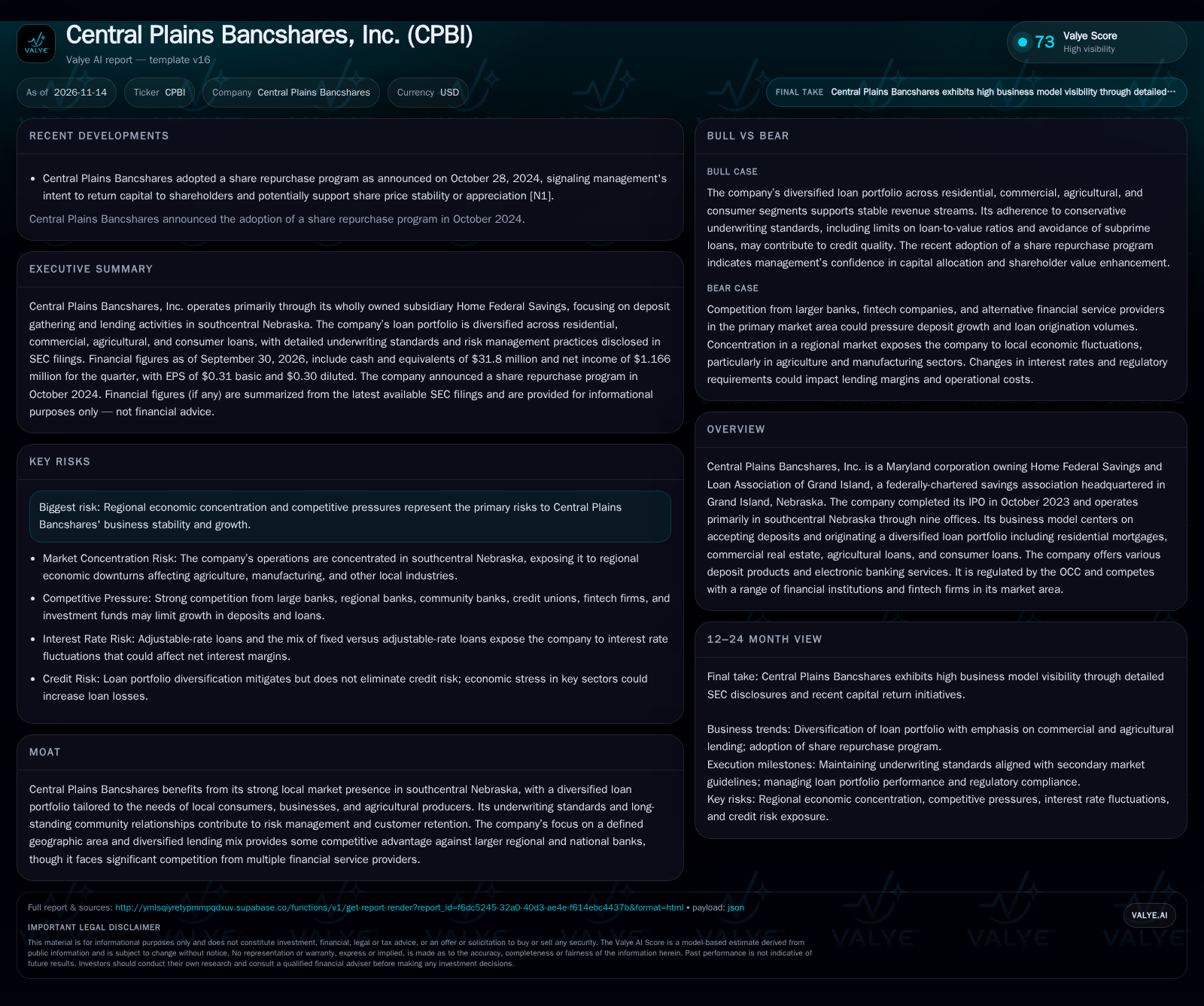
Central Plains Bancshares operates as a Nebraska-focused community bank, with $558.6 million in assets and a loan book diversified across residential, commercial, agricultural, and consumer segments as of March 2026. The loan portfolio’s risk profile is shaped by conservative underwriting, but interest rate volatility and local sector exposure are persistent watchpoints. [S2] [N1]
Central Plains Bancshares, Inc. stands as a prototypical regional banking story: a recently public Nebraska-based holding company with a diversified loan portfolio, deep roots in local communities, and a business model built on gathering deposits and lending into residential, commercial, and agricultural markets. Its scale—$558.6 million in assets—affords some operating leverage, but not immunity from the risks of economic concentration and intensifying competition. The recent move to implement a share repurchase program marks an inflection point for capital deployment and shareholder signaling, yet the core questions remain: Can Central Plains maintain credit quality and growth as local economies shift, and how exposed is its earnings power to the evolving landscape of financial intermediation?
Recent Capital Actions and the Shape of the Balance Sheet
Central Plains Bancshares completed its IPO in October 2023, raising $41.3 million to support balance sheet growth and capital adequacy. As of March 31, 2026, the company reported $558.6 million in consolidated assets, $460.4 million in deposits, and $89.0 million in stockholders' equity. The loan portfolio totaled $448.4 million, spanning residential real estate, commercial real estate, agricultural, and consumer loans. Cash and equivalents were $31.8 million as of September 30, 2026. Quarterly net income reached $1.166 million, translating to basic EPS of $0.31. The board authorized a share repurchase program in October 2024, indicating a willingness to return excess capital to shareholders. These facts frame a bank with a stable funding base, measurable profitability, and a newly flexible approach to capital management. [S2] [N1]
How Loan Mix, Deposit Costs, and Capital Allocation Drive Returns
Central Plains’ core economics revolve around the classic spread business: gathering local deposits at competitive rates and lending primarily into residential mortgages, commercial real estate, agricultural, and consumer segments. The portfolio’s composition—36% residential, 29% commercial real estate, and 12% agricultural—offers some diversification, but the yield and risk characteristics of each segment differ. Residential mortgages, often underwritten to Freddie Mac standards and with conservative loan-to-value ratios, typically provide lower yields but more predictable cash flows. Commercial and agricultural loans generally carry higher yields and risk, requiring diligent underwriting and ongoing monitoring.
Deposit funding is predominantly local, with rates and growth shaped by competition from banks, credit unions, and online alternatives. Rising interest rates can pressure net interest margins if asset yields lag deposit cost increases. Operating leverage is present but limited by the company's scale: expense ratios may benefit from asset growth, but technology and compliance costs are relatively fixed. The share repurchase program, if executed meaningfully, could enhance per-share metrics but may also signal limited organic growth opportunities or a desire to optimize capital ratios rather than pursue outsized expansion.
Capital needs are ongoing, especially if the bank seeks to grow the loan book faster than deposit growth or to absorb potential credit losses. Regulatory capital requirements and OCC oversight set hard boundaries on leverage and risk appetite. The company’s avoidance of subprime and negative amortization loans lowers tail risk but can constrain yield in risk-on environments.
Local Roots, Diverse Loan Book—and the Many Faces of Competition
Central Plains competes on several fronts: community relationships and local knowledge, product breadth, and the ability to underwrite diverse loan types. Its primary market—six Nebraska counties—creates a defensible niche, especially where large national banks may lack local presence or appetite for smaller-scale lending. However, this regional focus is a double-edged sword: the bank is exposed to the economic fortunes of local agriculture, manufacturing, and real estate.
Competitive threats are multifaceted. Traditional banks and credit unions often compete aggressively on rates and service, while fintech entrants and mortgage banking firms can erode margins or siphon off certain customer cohorts with digital convenience. Investment funds and non-bank lenders increasingly target commercial and agricultural credits, compressing spreads. The lack of subprime product offerings helps maintain credit quality but may limit responsiveness to certain borrower segments.
Switching frictions in banking are moderate: long-standing relationships, bundled products, and the hassle of moving accounts provide some stickiness, but rate or service differentials can drive attrition, particularly among commercial and agricultural clients. Digital banking expectations are rising, requiring ongoing investment in technology to remain competitive.
Unlocking Value Through Prudent Growth and Disciplined Capital Deployment
The most favorable scenario for Central Plains involves several reinforcing mechanisms. First, continued disciplined underwriting and portfolio diversification could keep credit costs low even if the regional economy faces turbulence. Second, a stable or expanding local economy—particularly in agriculture and real estate—would support demand for loans and deposits, enabling modest growth in both volumes and spreads.
The share repurchase program, if deployed at attractive valuations and without compromising regulatory capital, could boost per-share earnings and signal management’s alignment with shareholder interests. Success would be confirmed by a combination of rising EPS, stable or improving net interest margin, low non-performing asset ratios, and evidence of deposit growth outpacing regional peers. Conversely, any spike in credit losses, margin compression, or regulatory pushback on capital actions would quickly falsify the thesis.
Regional Breadth Offsets Volatility, but Growth Remains Moderate
The most plausible trajectory is one of measured balance sheet expansion, with earnings power anchored in the existing loan mix and deposit base. Modest growth in local residential and commercial lending could offset occasional weakness in agricultural or consumer segments. Net interest margins may remain under pressure if deposit competition intensifies or if interest rates move against the bank’s asset-liability structure.
Credit quality is likely to remain sound if underwriting standards are maintained and regional economic shocks are avoided. The share repurchase program may be executed opportunistically, supporting EPS but not transforming the growth outlook. Confirmation would come from steady loan growth, flat or slightly rising efficiency ratios, and stable asset quality metrics. Falsification would be signaled by persistent loan growth shortfalls, deteriorating credit, or margin erosion outpacing peers.
Economic Concentration and Credit Cycle Turns Could Erode Stability
The primary risk vector is a downturn in the regional economy—especially in agriculture or manufacturing—that drives up delinquencies and loan losses. Because Central Plains is concentrated in a defined geographic footprint, local shocks are not easily diversified away. A spike in non-performing assets could force higher provisioning, compressing earnings and potentially constraining capital return actions.
Intensifying competition could accelerate deposit outflows or force higher rates, squeezing net interest margins. Regulatory changes, technology gaps, or operational missteps could further erode competitive position. Downside confirmation would include rising non-performing loans, declining deposit balances, negative operating leverage, or regulatory intervention that constrains lending or capital return.
Benchmarks for Testing the Regional Banking Thesis at Central Plains
Quarterly trends in net interest margin, relative to peer community banks and adjusted for any rate environment shifts, would help validate the bank’s pricing power and liability management.
Loan growth by category—especially commercial real estate and agriculture—would clarify whether the bank is gaining share or losing ground to competitors; a useful metric would be loan origination volumes if disclosed.
Non-performing asset and charge-off ratios, reported quarterly, are essential for monitoring credit quality and early stress signals.
Deposit growth and mix (core vs. time deposits) would test the strength of customer relationships and competitive retention.
Execution of the share repurchase program, including number of shares repurchased and average price paid, would indicate management’s capital allocation discipline and market confidence.
Expense ratios and technology spending levels, if disclosed, would reveal the bank’s ability to manage costs and invest in digital infrastructure.
Any material regulatory developments or changes in OCC oversight and capital requirements could alter the risk/reward calculus.
Disclaimer: This is research-only, informational analysis and not investment advice. It may include AI-generated interpretation and general industry context. Always verify important details using primary sources.

Comments