
FDCTECH, INC.: Building an Integrated Fintech Platform Across Borders—Promise, Pressures, and the Path to Scale
FDCTECH, INC. is pursuing a global, multi-segment fintech strategy with proprietary trading technology, regulated brokerage operations, and early-stage payment services.
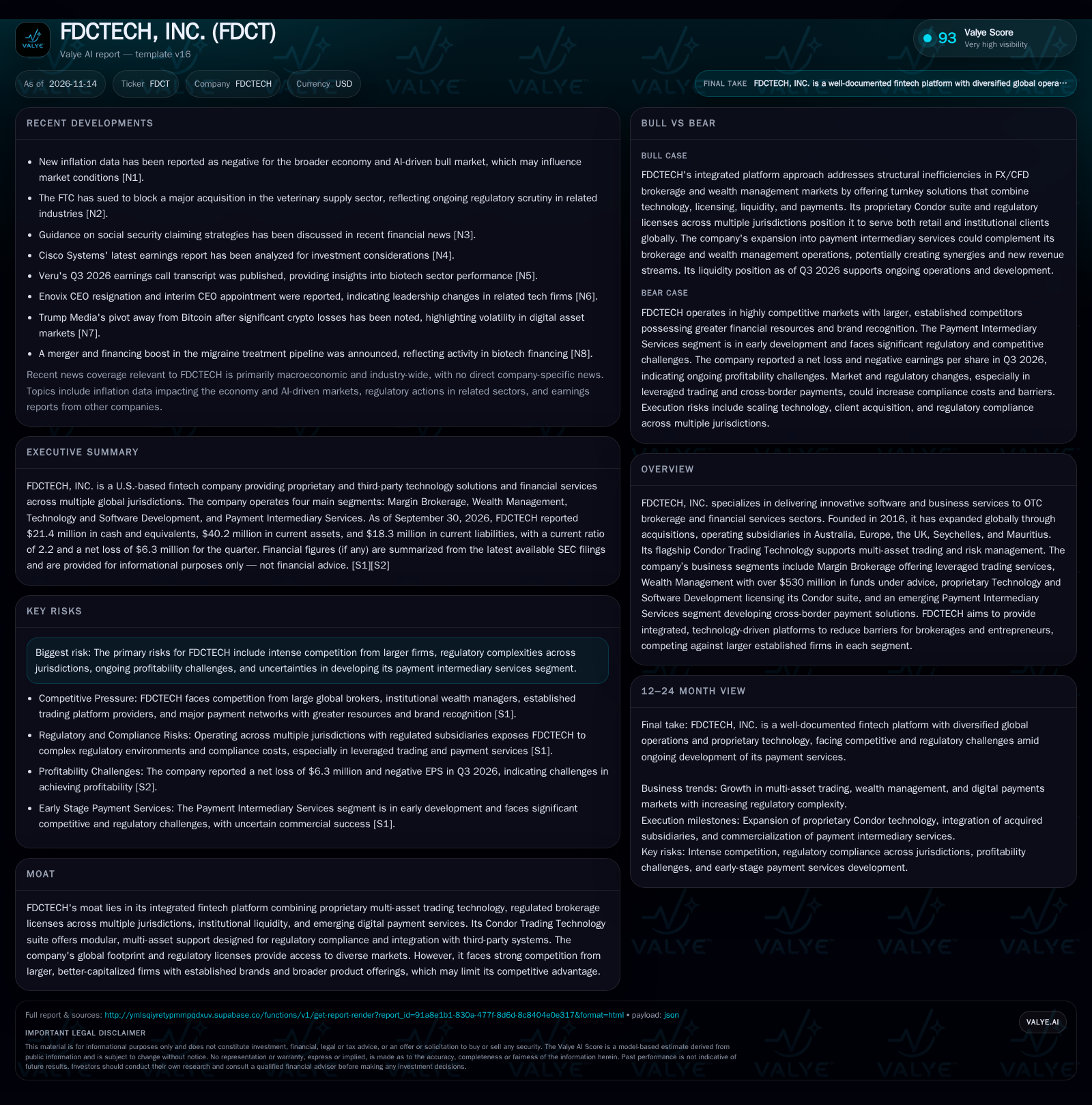
FDCTECH, INC. specializes in fintech solutions for OTC brokerage and financial services, operating globally with regulated subsidiaries and a proprietary trading technology suite. As of Q3 2026, it reported $21.4 million in cash and a net loss of $6.3 million, reflecting both resource availability and ongoing profitability challenges. Its integrated platform approach could unlock synergies across brokerage, wealth management, and emerging payment services, but scaling these segments amid strong competition and regulatory complexity is an unresolved test.[S1] [S2]
FDCTECH, INC. is attempting to carve out a position as an integrated fintech provider, combining technology, regulated brokerage, wealth management, and nascent payment services across several jurisdictions. Its approach—centered on the proprietary Condor Trading Technology suite and a network of licensed subsidiaries—aims to lower barriers for brokerages and entrepreneurs. However, the company’s Q3 2026 net loss and the early-stage status of its payment segment underscore the difficulty of scaling a multi-segment model in the face of entrenched competitors and regulatory demands. The next phase will test whether FDCTECH can translate its asset base and platform ambitions into sustainable profitability and defensible market share.[S1] [S2]
Recent Financials and Strategic Footprint: Where FDCTECH Stands Now
The company reported a current ratio of 2.2 for the period. [S2] The company posted a net loss of $6.3 million for the quarter, with basic and diluted EPS of -$0.06, highlighting continued challenges in achieving profitability.[S2]
The business operates through several regulated and unregulated subsidiaries across Australia, Malta, the UK, Cyprus, Seychelles, and Mauritius, supporting its multi-segment approach: Margin Brokerage, Wealth Management (over $530 million in funds under advice as of December 2024), Technology and Software Development (Condor Trading suite), and Payment Intermediary Services (regulated in Mauritius, early-stage).[S1] This structure provides geographical and regulatory diversification but also multiplies compliance and execution risks.
How FDCTECH’s Multi-Segment Model Could Drive Revenue and Margin Expansion
FDCTECH’s economics hinge on the interplay between transactional, fee-based, and technology-licensing revenues. In Margin Brokerage, revenue is typically derived from spreads, commissions, and financing charges on leveraged trading in FX, CFDs, equities, commodities, and digital assets. These businesses can be volume-driven, with high operational leverage but also significant regulatory and market risk. The wealth management segment, with over $530 million under advice, likely generates recurring management fees, which can provide more stable income and cross-selling opportunities if clients adopt other FDCTECH services.[S1]
The Technology and Software Development segment could offer scalable, higher-margin revenue streams if the Condor Trading suite is successfully licensed to third-party brokers or institutions. However, the report does not specify the proportion of internal versus external technology revenue, nor the contract terms or renewal rates, making it difficult to assess the magnitude of this potential operating leverage.
The Payment Intermediary Services segment, still in early development, targets merchant acquiring and cross-border payments—markets with high volume potential but also fierce price competition and pressure on take rates. If FDCTECH can establish proprietary rails or unique integrations between its brokerage, wealth, and payments platforms, it may be able to increase retention and extract greater wallet share from clients. However, capital requirements for regulatory compliance, technology upgrades, and customer acquisition are likely to remain significant, especially as the company attempts to scale across jurisdictions.
FDCTECH’s Competitive Landscape: Advantages, Threats, and Substitution Risks
FDCTECH faces entrenched competition in every segment—from global retail brokers and institutional wealth managers to established trading platform providers and major payment networks.[S1] Its proprietary Condor Trading Technology suite and regulatory licenses may provide some differentiation, especially for smaller brokerages seeking turnkey solutions, but these advantages are counterbalanced by the resource advantages and brand recognition of larger incumbents.
In brokerage and wealth management, switching costs for clients can be moderate, driven more by regulatory onboarding and platform familiarity than by deep product lock-in. Technology licensing could confer stickiness if integrations are complex and compliance-driven, but pricing power is limited in a landscape where open-source and white-label solutions proliferate.
The Payment Intermediary Services segment is particularly vulnerable to substitution by global payment networks and fintechs with greater scale, established merchant relationships, and broader regulatory coverage. Unless FDCTECH can demonstrate unique value through integrated workflows, lower onboarding friction, or cost advantages, it may struggle to build sustainable share in this area.
Unlocking Platform Synergies: What a Successful Integration Could Deliver
The most favorable scenario for FDCTECH involves successful commercialization of its integrated platform—leveraging the Condor Trading suite, regulated brokerage licenses, and payment rails to attract new brokerages, retain existing clients, and cross-sell wealth management and payment services. If the company can demonstrate that its bundled offering reduces cost and complexity for clients, it could accelerate adoption, increase share of wallet, and drive operating leverage through higher platform utilization.
Evidence that would confirm this scenario includes: rapid growth in third-party licensing of Condor technology, increased funds under advice in wealth management, and material transaction volumes in payment intermediary services (if disclosed). Additional signs would be reduced client churn, higher gross margins from software and payments, and successful expansion into new regulatory jurisdictions without significant compliance setbacks.
This scenario would likely require continued investment, but if operating losses narrow as revenue scales, it would suggest the business model is beginning to realize its intended synergies.
Incremental Progress Amid Persistent Headwinds: The Most Likely Course
Absent a major breakthrough in payment services or technology licensing, the most plausible outcome is moderate growth in brokerage and wealth management, with the payment segment remaining a longer-term project. FDCTECH may continue to leverage its global licenses and technology to attract niche brokerages and wealth clients, but competitive pricing, client acquisition costs, and regulatory compliance will constrain margin expansion.
Confirmation would come from stable or modestly increasing revenue, a gradual reduction in net loss (if disclosed), and continued but measured investment in technology and regulatory expansion.
Falsification would be signaled by a sharp reversal in brokerage or wealth management revenues, regulatory actions affecting key subsidiaries, or rapid cash burn without corresponding revenue growth.
Execution Risks and Market Realities: How the Model Could Falter
The adverse scenario for FDCTECH involves intensifying competition, regulatory setbacks, or failure to achieve commercial traction in its new payment services. If larger incumbents accelerate technology innovation or price aggressively, FDCTECH’s value proposition for brokerages and wealth clients could erode, leading to client attrition and pricing pressure across segments.
In payments, slow merchant onboarding, inability to differentiate from established networks, or regulatory delays in additional jurisdictions could prevent the segment from scaling. Mounting compliance costs and continued operating losses could force the company to curtail investment, divest segments, or seek dilutive financing.
Evidence for this scenario would include declining funds under advice, negative revenue momentum in brokerage or technology segments, increased legal or compliance expenses, or a deteriorating cash position without offsetting strategic progress.
Testing FDCTECH’s Platform Ambition: What Will Reveal Real Progress or Setbacks?
Sustained growth (or contraction) in funds under advice in the wealth management segment would help gauge traction and cross-selling effectiveness—especially if disclosed at regular intervals.
The number and scale of third-party licensing agreements for the Condor Trading suite, if disclosed, would indicate the commercial appeal and scalability of FDCTECH’s technology platform.
Material transaction volume and revenue contribution from the Payment Intermediary Services segment (if disclosed) would be critical to assessing whether this early-stage bet is gaining traction.
Client acquisition and retention rates for Margin Brokerage and Wealth Management—if available—would provide insight into competitive positioning and stickiness.
Gross margin trends by segment, particularly for software and payments, would reveal whether the business is achieving the intended operating leverage.
Regulatory developments affecting licensing status or compliance costs in major jurisdictions could materially impact the company’s ability to operate and grow.
Cash burn rate and changes in operating loss, especially in relation to new investments or segment expansion, would help test the sustainability of the current strategy.
New partnerships, integrations, or cross-segment initiatives that demonstrate actual platform synergies would be a concrete sign that FDCTECH’s integrated model is more than the sum of its parts.
Disclaimer: This is research-only, informational analysis and not investment advice. It may include AI-generated interpretation and general industry context. Always verify important details using primary sources.

Comments