
Berto Acquisition Corp.: SPAC Incentives, Liquidity Strain, and the High-Stakes Search for a Target
Berto Acquisition Corp.
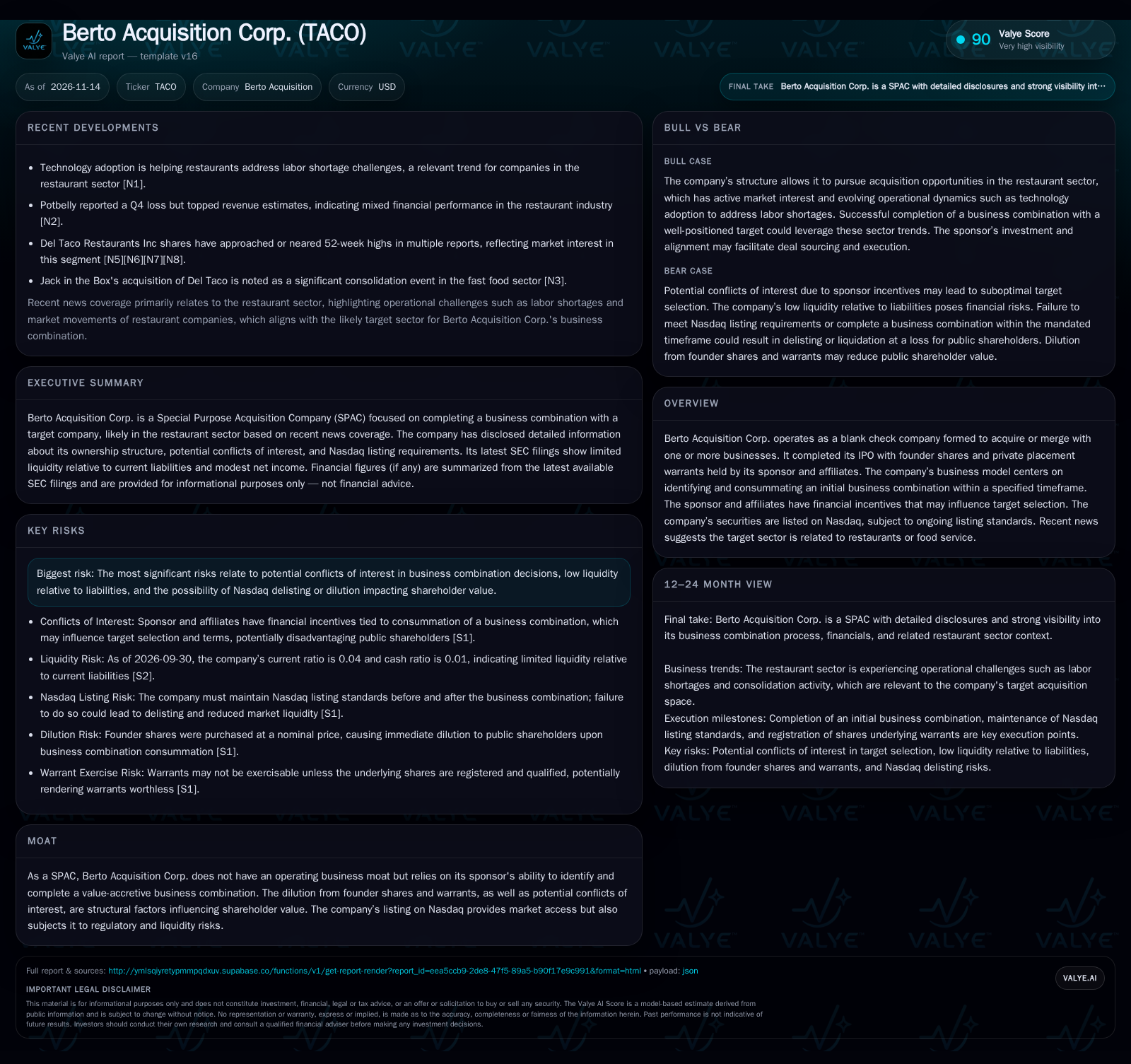
Berto Acquisition Corp. is a SPAC with substantial current liabilities, low liquidity, and sponsor-driven incentives that may influence target selection. The company must maintain Nasdaq listing standards and navigate dilution risk from founder shares and warrants. Its ability to secure an attractive merger, while managing conflicts and financial constraints, will determine shareholder value as the SPAC clock ticks down.
With a trust account that once held over $300 million but now faces a stark imbalance between assets and liabilities, the company’s next moves—both strategic and financial—are critical. Sponsor incentives, Nasdaq listing pressures, and the looming threat of dilution will shape not only the structure of any future deal, but also the ultimate value delivered to shareholders.
Acute Liquidity Imbalance and Sponsor-Driven Incentives Define the Present
Berto Acquisition Corp., as of September 30, 2026, holds $48.7 million in cash and equivalents, set against $148.0 million in current assets and a daunting $3.85 billion in current liabilities. The company reported cash and liquidity metrics for the period; these figures do not by themselves establish operating runway, investment capacity, financial flexibility, or financing capacity. [S2] The company reported net income of $1.33 million for the period, but these earnings are likely non-operational in nature, given the SPAC’s mandate and lack of ongoing business activity [S2].
Founder shares, purchased at a nominal price, and private placement warrants were issued to the sponsor and affiliates, setting up structural dilution for public shareholders upon consummation of a merger [S1]. The sponsor and its affiliates are financially incentivized to close a deal, regardless of the quality of the target, introducing potential conflicts of interest [S1].
Maintaining Nasdaq listing is essential for liquidity and credibility, but the company must meet ongoing requirements—failure to do so could lead to delisting and a collapse in market access [S1].
How SPAC Economics Shape Shareholder Outcomes
The SPAC model is fundamentally a race against time and dilution: public funds are raised and placed in trust, with the sponsor holding founder shares and warrants that become valuable only upon successful deal completion. The economics for public shareholders are shaped by the eventual merger’s terms, the valuation of the target, and the extent of dilution from sponsor and affiliate instruments.
Revenue generation for Berto Acquisition Corp. prior to a business combination comes almost exclusively from interest income on trust assets, not from operating activity [S2]. After a merger, the combined entity’s business model will determine long-term economics, but until then, the primary financial levers are interest income, expense management, and the negotiation of deal terms.
Operating leverage pre-merger is minimal—costs are largely fixed (legal, listing, search, and administrative). However, capital needs are acute: the company’s current liabilities vastly exceed liquid assets, likely reflecting deferred underwriting fees and possible redemptions. Unless a deal is consummated that both preserves cash and attracts new capital, public shareholders face the risk of significant value erosion through dilution or liquidation at a discount.
The exercise of warrants by public and sponsor holders introduces further dilution unless the post-merger entity can deliver sufficient value to offset this effect. If a business combination is not completed, warrants could expire worthless, and shareholders may receive less than trust value after expenses.
SPACs, Target Competition, and the Dynamics of Deal Sourcing
Berto Acquisition Corp. operates in a highly competitive SPAC environment, where hundreds of similar vehicles vie for a shrinking pool of attractive targets. The sponsor’s network and deal-making experience may offer an edge in sourcing proprietary opportunities, especially if the rumored focus on restaurants or food service aligns with recent market trends [N5] [N6] [N7] [N8]. However, competition from private equity, strategic buyers, and other SPACs drives up valuations and can force compromises on deal quality or structure.
Sponsor incentives—such as the potential to convert founder shares into outsized equity stakes post-merger—can create a misalignment with public shareholders, especially if the priority shifts from deal quality to simply closing any transaction. The risk is that Berto selects a suboptimal target to avoid SPAC liquidation and preserve sponsor economics.
Counterforces include Nasdaq’s regulatory oversight, which may act as a partial brake on poor-quality deals, and the redemption rights held by public shareholders. If redemptions are high, the post-merger entity may face cash shortfalls, further threatening its competitive positioning and long-term viability.
Relevant competitor categories include other SPACs targeting the same sector, traditional private equity, and corporate acquirers. The company’s ability to differentiate its value proposition to targets—through speed, certainty of closing, or sponsor expertise—may determine its success in a crowded market.
A High-Quality Target and Low Redemptions Could Unlock Shareholder Value
The best-case scenario for Berto Acquisition Corp. is the identification and successful merger with a high-growth, well-managed company—ideally in a sector with strong public market appetite, such as technology-enabled food service. If the sponsor leverages its network to secure an exclusive deal at a favorable valuation, and the target’s fundamentals excite public shareholders, redemptions could remain low, preserving cash in trust and minimizing dilution.
Confirmation of this scenario would come from the announcement of a respected, scalable target with robust historical and projected financials, a clear rationale for going public via SPAC, and a merger structure that limits dilution (e.g., through PIPE financing or sponsor concessions). A post-announcement rally in the share price, strong PIPE participation, and limited redemption activity would further validate the upside case.
Falsification would occur if the announced target is viewed as low-quality, if redemptions are high—draining cash from the deal—or if PIPE financing fails to materialize, forcing the sponsor to renegotiate or abandon the transaction.
Most Likely: Deal Pressure Drives a Compromise Target with Mixed Shareholder Outcomes
Given the acute liquidity pressures and sponsor incentives, the most plausible outcome is that Berto Acquisition Corp. pursues a deal with a mid-tier target—possibly in the restaurant or food service sector, as suggested by recent news flow—at a valuation that reflects current SPAC market realities rather than true public market demand. The sponsor’s need to consummate a transaction to realize its economics may outweigh the pursuit of only top-tier targets.
In this scenario, redemptions are likely moderate to high, reducing the cash available to the post-merger entity and increasing reliance on PIPE or alternative financing. Dilution from founder shares and warrants will be significant, and the merged company may struggle initially to gain investor confidence, leading to share price volatility.
Evidence confirming this outcome would include a target announcement met with tepid market reaction, high redemption rates, and a merger structure that leans heavily on sponsor concessions or incremental financing. Falsification would require either a runaway positive market response (suggesting the target exceeded expectations) or a failed merger vote, forcing the SPAC into liquidation.
Failure to Secure a Merger Could Trigger Liquidation and Value Erosion
The adverse scenario for Berto Acquisition Corp. is the inability to identify or close a merger within the SPAC’s mandated timeframe. In this event, the company would be forced to liquidate, returning trust account proceeds to public shareholders after deducting expenses and deferred underwriting fees. Given the current liability imbalance, shareholders may receive less than the initial trust value.
This outcome could be triggered by a combination of high redemption rates, regulatory challenges (such as loss of Nasdaq listing), or failure to secure a willing and suitable target. Sponsor incentives may delay but not ultimately prevent liquidation, especially if the economics of a subpar deal are unsustainable.
Confirmation would come from repeated deal delays, withdrawal of announced targets, or public filings indicating the trust account is being unwound. Falsification would require the announcement and successful closing of a deal with sufficient post-merger liquidity and market support.
Milestones and Data Points That Will Define Berto Acquisition’s Ultimate Outcome
Announcement of a definitive merger agreement, including the identity and sector of the target business.
Size and terms of any PIPE financing or additional capital commitments accompanying the merger, if disclosed.
Redemption rate of public shares at the time of the merger vote—high redemption rates would signal weak shareholder support and cash constraints.
Changes in Nasdaq listing status or the emergence of warning notices from the exchange.
Sponsor concessions such as founder share forfeitures, warrant amendments, or backstopping arrangements to limit dilution, if any are disclosed.
Post-announcement share price performance relative to trust value, as a proxy for market confidence in the deal.
Disclosure of final merger structure, including dilution mechanics and post-merger capital structure.
Disclaimer: This is research-only, informational analysis and not investment advice. It may include AI-generated interpretation and general industry context. Always verify important details using primary sources.

Comments