
StableX Technologies: Transitioning to MicroLED Optical Interconnects in AI Data Centers
StableX Technologies, Inc. is wagering its future on MicroLED-based optical interconnects for next-generation AI data center infrastructure. The company’s exclusive partnership with Kopin Corporation provides access to advanced MicroLED technology, but the absence of a prototype, lack of revenue, and heavy capital needs highlight the precariousness of its early-stage bet. The core question is whether StableX can translate technical ambition into a defensible commercial position before larger semiconductor incumbents or alternative technologies close the window of opportunity.
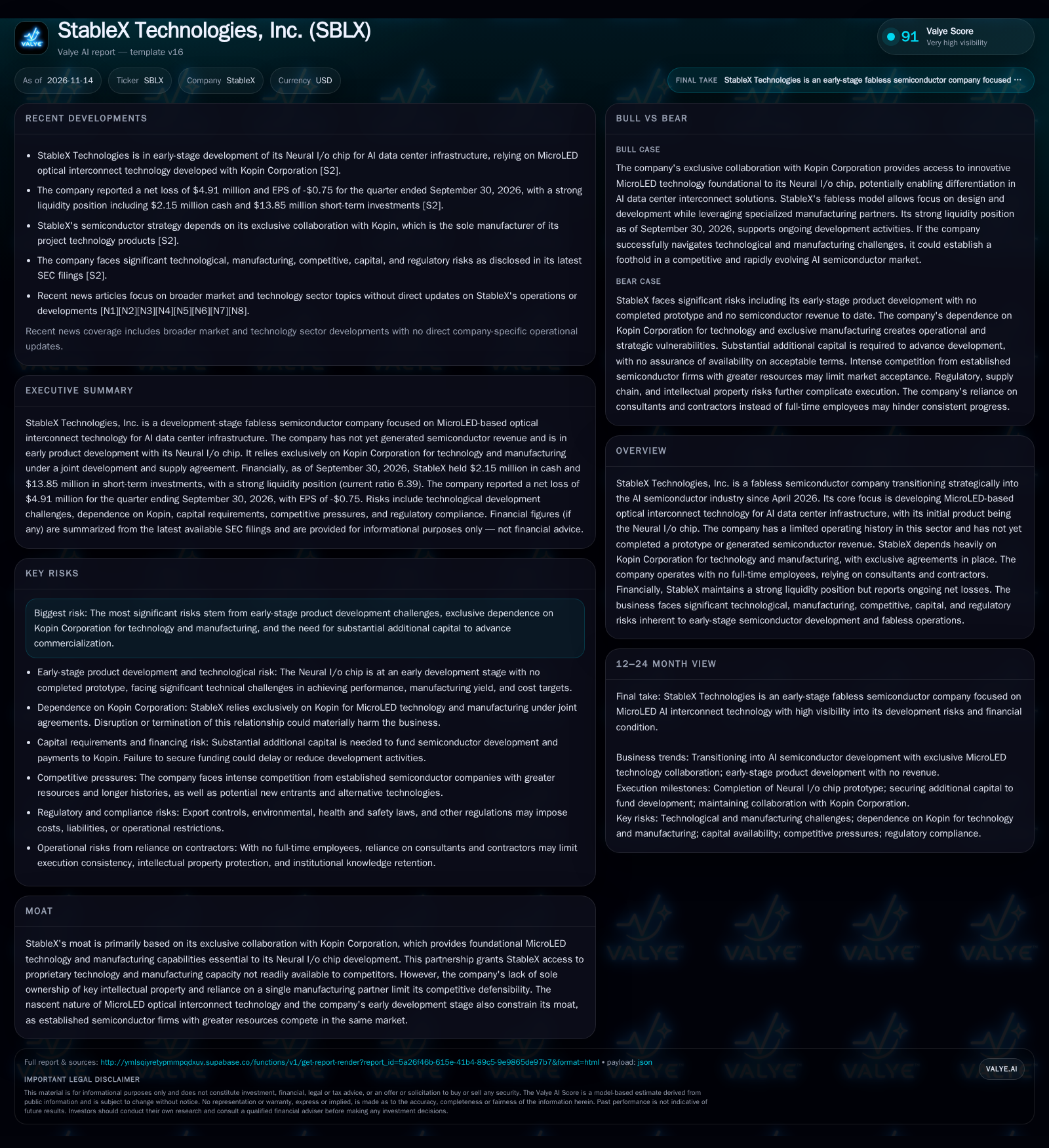
StableX is an early-stage fabless semiconductor company developing MicroLED optical interconnects for AI data centers, leveraging an exclusive technology and manufacturing relationship with Kopin Corporation. As of September 2026, it has no completed prototype, no semiconductor revenue, and relies on consultants rather than full-time staff. Its prospects hinge on moving from technical promise to prototype and funding while managing competitive and operational risks. [S2]
StableX Technologies, Inc. represents a classic high-risk, high-reward bet in the semiconductor sector: a fabless startup with a bold vision to reshape AI data center infrastructure using MicroLED-based optical interconnects. The company’s exclusive partnership with Kopin Corporation grants it access to proprietary technology that, if successfully commercialized, could offer performance and power advantages over incumbent optical and copper interconnect solutions. Yet StableX remains pre-revenue, with no completed prototype, a small and largely externalized workforce, and looming capital requirements. The next 18–24 months will be crucial as the company attempts to move from technical ambition to tangible milestones in an industry defined by rapid innovation—and brutal competition.
StableX’s Progress, Partner Reliance, and Financial Health Shape Immediate Prospects
The most material facts shaping StableX’s current position are its early-stage status, the absence of a completed prototype for its Neural I/o chip, and a total lack of semiconductor revenue as of November 2026. The company's exclusive agreements with Kopin Corporation make Kopin the sole technology and manufacturing partner, concentrating both opportunity and risk in a single external relationship. Financially, StableX reported a net loss of $4.91 million in the September 2026 quarter and held $2.15 million in cash and $13.85 million in short-term investments, but faces substantial future development payments to Kopin—up to $40 million depending on milestones. The company operates with no full-time employees, relying entirely on consultants and contractors, which may limit execution continuity and organizational learning. These factors collectively highlight a business at a critical inflection point, with execution, capital, and partnership risks likely to determine whether it can progress beyond the development stage. [S2]
Monetization Potential and Economic Challenges of MicroLED Optical Interconnects for StableX
StableX’s business model is inherently high-fixed-cost and high-risk: as a fabless semiconductor company, it outsources manufacturing while focusing on chip design and IP development. The economics of the proposed Neural I/o chip depend on achieving technical breakthroughs in bandwidth, latency, and power efficiency that would allow MicroLED-based optical interconnects to outperform traditional copper and fiber solutions in AI data center environments. If these advantages can be realized and validated through prototype demonstration, StableX could pursue a business model based on direct sales to data center OEMs, licensing, or joint ventures. However, the lack of revenue to date and the need for $15–$40 million in future development payments to Kopin mean StableX will require significant additional capital before reaching even an initial commercial launch.
Gross margins for fabless chip companies can be attractive if volumes and yields are high, but StableX’s exclusive supply arrangement with Kopin may constrain its ability to negotiate pricing, control costs, or diversify supply. The fixed costs of R&D, IP protection, and partnership obligations will likely dominate the P&L until meaningful volumes are achieved. Variable costs will be driven by Kopin’s manufacturing yields, input pricing, and any royalty or milestone payments embedded in the agreements. Operating leverage could be substantial if the technology gains traction, but the capital intensity and long development cycles of semiconductor hardware mean that negative cash flow is likely to persist for several quarters or years. Dividend and anti-dilution terms on Series K Preferred Stock add further complexity to the company’s future capital structure and potential dilution for common shareholders. [S2]
Assessing StableX’s Position Against Established and Emerging Optical Interconnect Competitors
StableX’s competitive position hinges on two main factors: the technical differentiation of its MicroLED-based interconnects and its exclusive partnership with Kopin. The potential advantages of MicroLEDs—such as higher bandwidth density, lower power consumption, and improved thermal performance—could be compelling for AI data center operators seeking to overcome the scaling limitations of copper or conventional optical links. However, the company is up against entrenched semiconductor giants with deep R&D budgets, established customer relationships, and proven supply chains.
New entrants and alternative interconnect technologies (such as silicon photonics, co-packaged optics, and advanced copper solutions) pose additional threats, as do the evolving requirements of hyperscale data center operators. StableX’s reliance on Kopin both for technology and manufacturing is a potential double-edged sword: while it provides access to proprietary IP, it also creates a single point of failure and limits the company’s ability to pivot in response to market or supply chain shifts. Without sole ownership of the foundational IP, StableX may struggle to build a lasting moat if MicroLED interconnects become widely adopted. The lack of full-time technical staff also limits the company’s ability to respond rapidly to competitive or technological shifts. [S2]
Prototype Advances and Funding Increases Could Propel StableX Toward Market Entry
In a favorable scenario, StableX successfully completes a working prototype of its Neural I/o chip that demonstrates clear performance and cost advantages over incumbent interconnect solutions. This would validate the technical promise of MicroLED optical interconnects in high-density AI data center environments and could trigger strategic interest from data center OEMs, cloud providers, or semiconductor ecosystem partners. A working prototype would also serve as a catalyst for raising additional capital—either through equity issuance, strategic partnerships, or non-dilutive funding—enabling StableX to fund the required milestone payments to Kopin and accelerate toward initial commercial production.
Confirming evidence would include public demonstration of a prototype meeting key performance specifications, announcements of pilot projects or design wins with major data center operators, and the closing of a sizeable funding round sufficient to cover near-term development obligations. Falsification would be signaled by missed development milestones, inability to raise needed capital, or prototype performance that fails to match or exceed competing solutions. [S2]
Delays in Commercialization and Capital Requirements Mark the Next Year or Two
The most plausible middle path is one in which StableX continues to advance Neural I/o chip development through iterative prototyping and lab validation, but faces delays in achieving target performance, manufacturability, or cost metrics. Capital constraints may force the company to stage development more slowly, seek additional bridge financing, or renegotiate terms with Kopin. The absence of full-time employees and reliance on consultants could slow technology transfer and institutional learning, further extending development timelines.
Evidence confirming this scenario would include incremental technical updates (rather than a full prototype launch), continued operating losses, and ongoing or delayed capital raises. Falsification would occur if StableX either accelerates to a successful prototype and funding round (moving toward the upside) or encounters a critical technical or financing failure (pushing into the downside). [S2]
Inability to Produce a Prototype or Raise Capital May Lead to Restructuring or New Strategies
In a negative scenario, StableX is unable to overcome technical hurdles or meet the performance/cost targets required to make MicroLED interconnects commercially viable. The inability to deliver a working prototype within a reasonable timeframe diminishes credibility with both strategic partners and investors. If additional capital cannot be secured—whether due to missed milestones, market skepticism, or dilution concerns tied to Series K Preferred Stock—StableX may be forced to halt development, restructure, or pursue a sale of assets or IP. Dependence on Kopin heightens exposure to supply chain disruptions, potential contract disputes, or strategic misalignment.
Evidence supporting this scenario would include repeated delays or negative technical updates, public disclosure of capital shortfalls or going-concern warnings, and the absence of commercial or partnership announcements. Falsification would require clear progress on technical or funding fronts that extend the company’s runway and improve visibility into commercialization. [S2]
Key Milestones Defining StableX’s MicroLED AI Interconnect Venture Outcomes
Completion and public demonstration of a Neural I/o chip prototype meeting target performance specifications would be a decisive milestone.
Announcement of pilot projects, design wins, or commercial partnerships with data center OEMs or hyperscale operators would help test market acceptance.
Disclosure of additional capital raises or non-dilutive funding sufficient to cover near-term development obligations to Kopin would indicate financial viability.
Any renegotiation or amendment of the exclusive development and supply agreements with Kopin—especially terms affecting pricing, IP ownership, or manufacturing flexibility—could materially alter the company’s risk profile.
Updates on the hiring of full-time technical or business development staff would help assess StableX’s ability to build organizational capacity and protect IP.
Evidence of improved manufacturing yields, cost reductions, or supply chain resilience—if disclosed—would be important for assessing scalability.
Material changes in the competitive landscape, such as new product launches or partnerships by incumbent semiconductor firms targeting AI data center interconnects, would inform the threat environment.
Disclosures related to Series K Preferred Stock dividend payments, conversion events, or anti-dilution triggers would clarify capital structure and dilution risks.
Disclaimer: This is research-only, informational analysis and not investment advice. It may include AI-generated interpretation and general industry context. Always verify important details using primary sources.

Comments