
TurnOnGreen’s Custom Power and EV Charging Ambitions: Technical Differentiation Meets Financial Strain
TurnOnGreen, Inc. is expanding its presence in the EV charging and custom power solutions markets, reporting contract wins and improved gross margins.
TurnOnGreen is building a diversified portfolio in EV charging infrastructure and custom power products, targeting high-specification sectors such as defense and e-mobility. While recent contract wins and margin improvements suggest operational progress, the company’s ability to convert its backlog into sustained revenue is threatened by recurring losses, negative working capital, and reliance on external financing.
TurnOnGreen, Inc. sits at the intersection of custom power electronics and the fast-growing EV charging infrastructure market, leveraging proprietary design capabilities to serve demanding sectors including e-Mobility and defense. Recent financials highlight a company with technical traction—evidenced by improved gross margins and a growing contract backlog—but also acute financial vulnerability. With only $65,000 in cash and negative working capital as of September 2026, TurnOnGreen’s survival depends on its ability to rapidly convert contracts into cash flow while securing ongoing external financing. The company’s future hinges on whether its engineering strengths and new wins can translate into sustainable scale before liquidity pressures force retrenchment or restructuring.
Contract Momentum and Margin Gains Collide with Severe Liquidity Strain
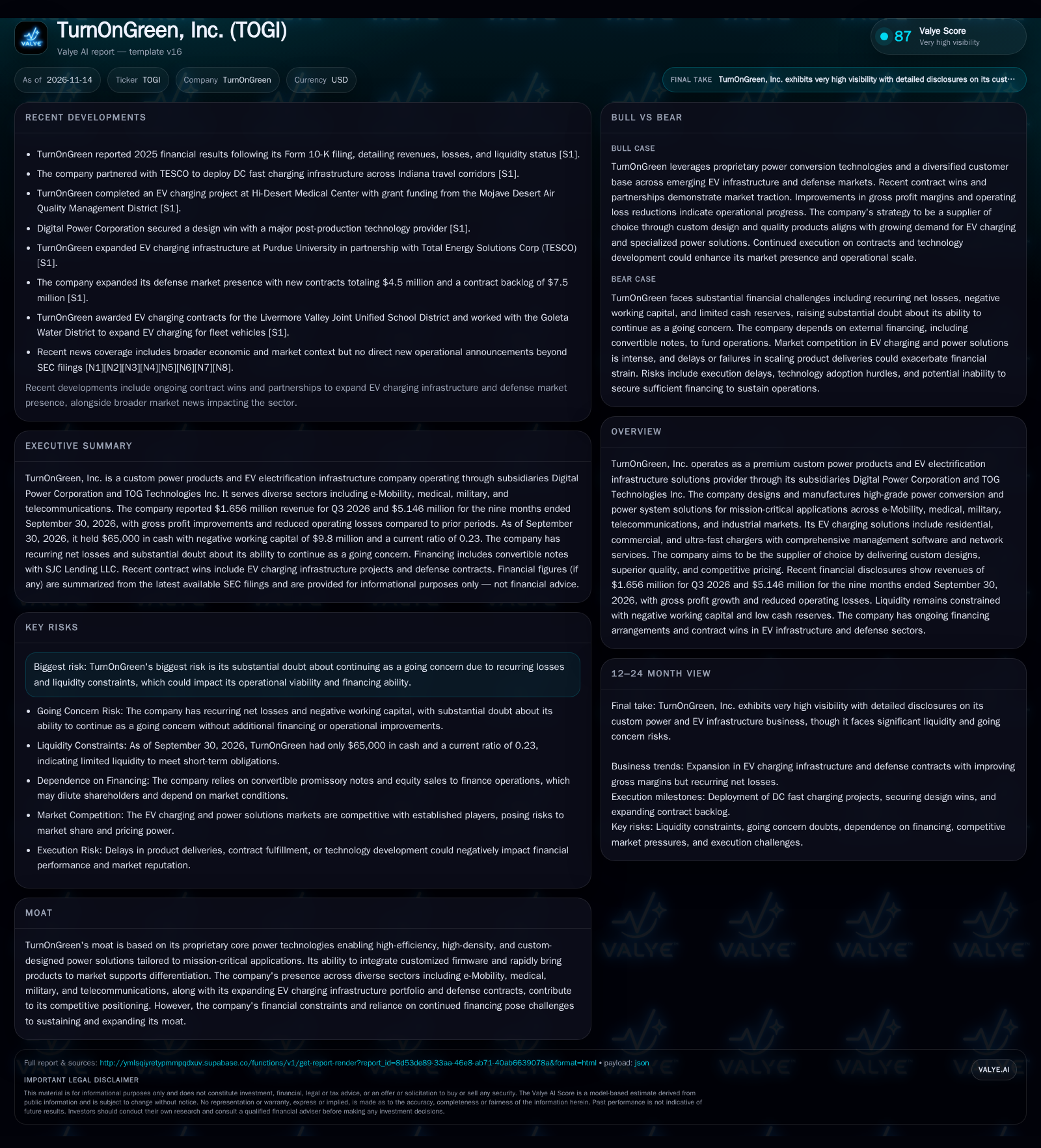
TurnOnGreen reported $1.656 million in revenue and $837,000 in gross profit for Q3 2026, with operating losses narrowing compared to the prior year. The company’s gross profit improvements are attributed to a sales mix shift toward higher-margin products and reduced inventory write-offs [S2]. Importantly, TurnOnGreen’s contract backlog has expanded, with new EV charging projects (including with TESCO and Purdue University) and multi-million-dollar defense market wins pushing backlog to $7.5 million [S2]. However, these operational advances are overshadowed by acute liquidity constraints: as of September 30, 2026, the company held just $65,000 in cash, with a current ratio of 0.23 and negative working capital of $9.8 million [S2]. The company’s recurring net losses and explicit going concern risk signal that execution on its backlog and continued access to external funding are existential priorities.
How TurnOnGreen’s Dual-Segment Model Could Create (or Destroy) Value
TurnOnGreen operates at the intersection of two capital-intensive, technically demanding verticals: custom power conversion (via Digital Power Corporation) and EV charging infrastructure (via TOG Technologies Inc.). The economics of custom power solutions typically favor high-mix, low-volume production with premium pricing justified by mission-critical reliability, especially in defense, medical, and industrial markets. This segment can deliver attractive gross margins if product complexity and customer requirements support a moat around design and integration expertise. However, the need for continual engineering investment and highly customized solutions can limit scalability and produce lumpy revenue streams.
The EV charging segment addresses a much larger, rapidly growing market but is characterized by intense competition, falling hardware ASPs, and a race to secure installation sites and network effects. Here, value is often created through bundled hardware, software, and recurring management services, but achieving scale requires significant upfront capital for R&D, inventory, and working capital. TurnOnGreen’s rising gross margins suggest some success in targeting higher-value contracts, but persistent operating losses and negative working capital highlight the company’s inability—so far—to reach break-even scale. The company’s reliance on convertible debt (12% interest, convertible at $0.035/share) further erodes long-term value for equity holders if operational cash flow does not materialize rapidly [S2].
Technical Differentiation and Sector Breadth: Can Niche Strengths Overcome Scale Disadvantages?
TurnOnGreen’s competitive positioning is anchored in proprietary power electronics, including high-density, low-leakage, and firmware-customized solutions for demanding applications. In the custom power market, this technical edge enables the company to compete for specialized, high-margin contracts in defense and medical sectors where reliability and tailored performance are at a premium. The company’s ability to integrate quickly and deliver mission-critical products is a potential moat against generic competitors.
In EV charging, TurnOnGreen faces a fragmented landscape populated by both large diversified players and focused challengers. The company’s approach—pairing hardware with management software and targeting institutional customers such as universities, municipalities, and fleet operators—may allow it to carve out defensible niches. However, these markets are marked by intense price competition, rapid technological change (including vehicle-to-grid integration and ultra-fast charging), and shifting regulatory requirements. The question is whether TurnOnGreen’s engineering strengths and sector breadth can offset its capital disadvantages and allow it to compete against better-funded rivals, especially in national infrastructure rollouts.
From Backlog to Cash Flow: What a Winning Execution Arc Could Look Like
The favorable scenario for TurnOnGreen is an operational flywheel: contract backlog in both EV charging and defense is converted into timely product deliveries, driving revenue acceleration and incremental gross profit. As higher-margin projects are fulfilled, operating leverage improves and the company approaches cash flow break-even, reducing reliance on dilutive external financing. Continued design wins with blue-chip or institutional customers (e.g., additional university or municipal projects) would provide validation and open doors to further contracts. If the company can leverage its technical differentiation to win repeat business and expand its contract base faster than its cash burn, it could build a platform for sustained growth.
Evidence confirming this scenario would include: sequential revenue acceleration, positive operating cash flow, backlog conversion rates exceeding expectations, new multi-year contracts with major customers, and a measurable reduction in net losses or reliance on external debt. Evidence falsifying it would be continued delays in contract execution, customer churn, or persistent operating losses despite backlog growth.
Liquidity Constraints Force Tactical Execution and Incremental Progress
The most plausible near-term trajectory for TurnOnGreen is one of incremental operational progress constrained by capital scarcity. The company may succeed in delivering on a portion of its existing backlog, generating modest revenue growth and further gross margin improvements. However, the acute working capital deficit and reported cash balance mean that project execution will be gated by the timing and availability of external financing—especially convertible debt or equity infusions.
In this scenario, TurnOnGreen’s technical strengths enable it to win and execute some contracts, but the lack of financial slack prevents aggressive scaling, limits inventory and R&D investment, and leaves the company vulnerable to execution delays or customer payment slippage. Confirmation would come from steady but unspectacular revenue growth, ongoing (but narrowing) net losses, and periodic financing events to bridge working capital gaps. Falsification would be a major contract win translating into a step-change in quarterly revenue or, conversely, a liquidity event triggering restructuring or asset sales.
When Liquidity Runs Out: How Execution Risk and Financing Gaps Could Trigger Restructuring
If TurnOnGreen is unable to secure sufficient external financing or accelerate contract-to-cash conversion, the company’s acute working capital deficit and minimal cash reserves could force drastic action. In this downside scenario, delays in customer payments, supply chain disruptions, or contract execution hiccups exacerbate cash burn, leading to missed payroll, vendor defaults, or covenant breaches on existing debt. The company could be forced to halt operations, enter restructuring negotiations, or pursue asset sales at distressed valuations.
Evidence supporting this scenario would be missed SEC filing deadlines, default notices, layoffs, or public statements about seeking strategic alternatives. Confirmation would also come from a spike in short-term debt, a sharp drop in backlog conversion, or loss of key customers due to execution failures. Falsification would be rapid, outsized contract wins translating into immediate cash infusions or a major equity/debt raise on non-dilutive terms.
Milestones to Clarify TurnOnGreen’s Path from Technical Progress to Sustainable Scale
Sequential quarterly revenue growth relative to backlog size—particularly whether new contract wins translate into recognized revenue and cash receipts.
Gross margin trends by segment, especially evidence that higher-margin custom power or defense contracts are driving overall profitability improvements.
Disclosure of operating cash flow and working capital movements—positive cash flow from operations would be a critical inflection point.
Updates on financing activities, including terms and amounts of new debt or equity raises, and the degree of shareholder dilution or restrictive covenants, if disclosed.
Backlog conversion rates and customer concentration—high rates and diversified customer base would suggest improving execution and reduced revenue risk.
Any signals of customer churn, contract delays, or project cancellations, which would undermine the thesis of operational momentum.
Material developments in regulatory or market conditions affecting EV infrastructure funding or defense procurement processes that could impact contract flow.
Disclaimer: This is research-only, informational analysis and not investment advice. It may include AI-generated interpretation and general industry context. Always verify important details using primary sources.

Comments