
Silo Pharma: Psychedelic IP, Regulatory Hurdles, and an Unconventional Diversification Play
Silo Pharma advances a dual strategy: developing patented psychedelic therapies for PTSD and fibromyalgia while diversifying into AI agent technology. With reported liquidity position, a recent capital raise, and a maturing IP portfolio, the company faces both high regulatory barriers and uncertain commercialization pathways in an emerging, volatile sector.
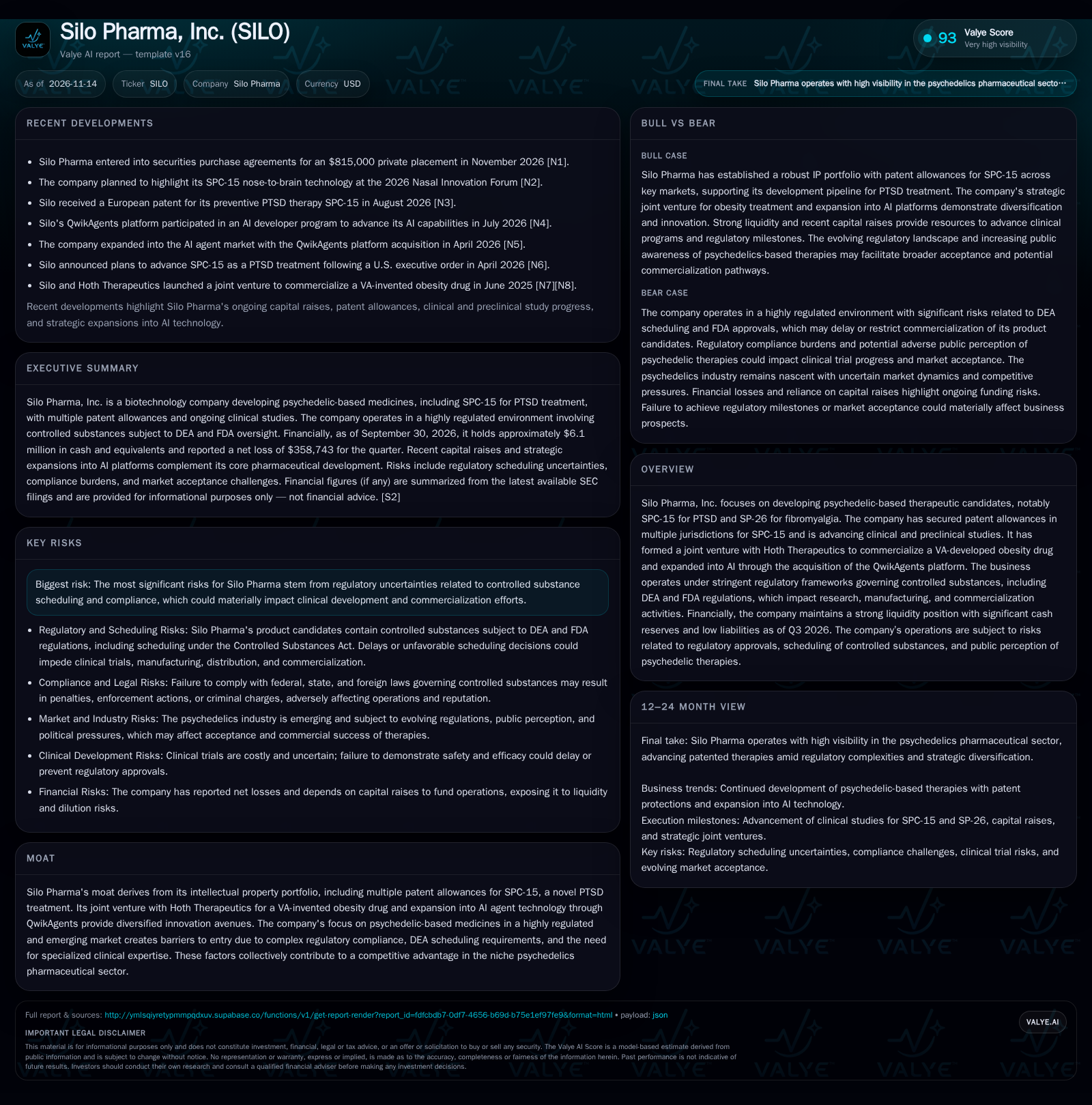
Silo Pharma is progressing with SPC-15 (for PTSD) and SP-26 (for fibromyalgia), both leveraging novel delivery mechanisms and protected by multiple patents. The company maintains strong cash reserves, recently raised new capital, and has expanded into AI technology. However, it operates in a highly regulated, nascent psychedelics market where clinical, legal, and acceptance hurdles could delay or derail commercial success. Diversification into AI provides optionality but may dilute focus.
Silo Pharma sits at the intersection of two high-risk, high-innovation frontiers: psychedelic-based therapeutics and artificial intelligence. Its lead candidate, SPC-15, targets PTSD with a patented intranasal delivery system and has achieved multi-region patent allowances, while a ketamine implant (SP-26) for fibromyalgia expands the pipeline. With robust cash reserves, a fresh capital injection, and a joint venture in obesity therapeutics, Silo is well-resourced for near-term R&D. However, the path to revenue is obstructed by regulatory complexity, uncertain market acceptance, and the challenge of simultaneously building credibility in both biotech and AI. The company's ability to convert IP assets and pipeline progress into commercial value remains unproven, and its diversification strategy will be tested as competitive and regulatory pressures mount.
Patent Progress, Financial Cushion, and New Capital Define Silo’s 2026 Position
Silo Pharma’s most material current facts are: (1) SPC-15, its lead PTSD therapy, now holds patent allowances in the US, Europe, and Canada, and is advancing toward an IND submission, following positive preclinical and regulatory interactions in 2024 and 2025 [N3] [N7] [N8] [S2]. (2) As of September 30, 2026, Silo reported $6.1 million in cash and equivalents, $1.96 million in short-term investments, and a low liability base, resulting in a current ratio of 24.43 and cash ratio of 22.91 [S2]. (3) The company completed an $815,000 private placement in November 2026, bolstering liquidity for ongoing R&D and operational needs [N1]. (4) Silo also expanded into AI with the QwikAgents acquisition and maintains a joint venture with Hoth Therapeutics to commercialize a VA-invented obesity drug [N4] [N5] [N7] [N8]. These developments collectively position Silo for continued pipeline investment and diversification, but commercialization and revenue generation remain distant and highly contingent on successful clinical, regulatory, and partnership milestones.
Pipeline-Driven Value Creation: High Fixed Costs, Deferred Revenue, and Capital Intensity
Silo Pharma’s business model is characteristic of early-stage biotech: value is primarily created by advancing drug candidates through preclinical and clinical milestones, supported by a robust IP portfolio. The company’s economics are dominated by R&D spending—expenses related to in-licensed technology, CRO contracts, regulatory filings, and preclinical/clinical manufacturing—rather than by recurring revenue streams [S2]. Revenue for the three months ended September 30, 2026, was only $18,026, against a net loss of $358,743, reflecting minimal commercial inflows and ongoing operating deficits [S2].
The fixed cost base is substantial, driven by research, regulatory, and administrative functions. Variable costs are relatively limited at this stage, as there is no large-scale manufacturing or salesforce. The business is capital-intensive, requiring frequent capital raises to fund multi-year clinical programs and to maintain optionality for future in-licensing or acquisitions. Operating leverage will only materialize if and when candidates reach late-stage trials or approval and commercial launch.
The QwikAgents AI platform introduces a potentially different economic model—software development can scale with lower marginal cost if the platform achieves traction. However, there is no evidence yet that this business contributes meaningful revenue or margin, and it may require further investment before its economics become favorable.
IP Portfolio and Regulatory Complexity Shape Silo’s Moat—But Also Its Vulnerabilities
Silo Pharma’s main competitive advantages stem from its intellectual property—multi-jurisdictional patents for SPC-15 and a provisional patent for SP-26—plus first-mover positioning in a nascent psychedelics pharmaceutical market. These patents may provide a time-limited moat if the company can demonstrate clinical efficacy and secure regulatory approval before competitors. The intranasal delivery route for SPC-15 and the controlled-release implant for SP-26 are intended to differentiate Silo’s offerings from traditional oral or parenteral formulations.
However, the competitive field is intensifying. Numerous biotech firms—ranging from established neuropsychiatric drug developers to new entrants focused on psychedelics—are pursuing similar indications (PTSD, fibromyalgia, chronic pain, and obesity) with overlapping mechanisms or alternative compounds. Silo’s regulatory environment is especially challenging: the need for DEA and FDA approvals, compliance with the Controlled Substances Act, and public/political scrutiny over psychedelics create high barriers but also slow the pace of progress [S1].
AI agent technology is an unconventional diversification. While it could someday provide data-driven insights for clinical development or new business lines, Silo faces a steep learning curve and entrenched competitors in the AI space. The question is whether this move enhances the core business or merely dilutes focus and resources.
Breakthrough Regulatory Wins and Early Partnerships Unlock Commercialization Pathways
If Silo secures rapid regulatory progress on SPC-15—such as a successful IND submission, fast-track designation, and positive early-stage clinical data—the company could attract licensing partners or acquirers seeking exposure to the emerging psychedelic therapeutics market. The intranasal delivery system, if proven superior in efficacy or safety, could further differentiate SPC-15, supporting premium pricing or exclusive collaborations with healthcare systems.
SP-26’s ketamine implant, if it shows robust efficacy and safety in preclinical and early clinical trials, could address an unmet need in chronic pain management and position Silo as a leader in non-opioid pain therapies.
The QwikAgents AI platform could generate incremental revenue if it achieves product-market fit or is integrated into digital health or clinical trial optimization solutions, creating a new, less capital-intensive revenue stream.
Evidence confirming this scenario would include: regulatory designations that expedite approval (e.g., Breakthrough Therapy), licensing deals with upfront payments, strong safety/efficacy data from early human trials, and visible commercial traction or partnerships for the AI platform.
Pipeline Advances, Regulatory Delays, and Ongoing Capital Needs Define the Likely Trajectory
The most plausible scenario is that Silo continues to advance SPC-15 and SP-26 through preclinical and early clinical development, incurring rising R&D and administrative costs with limited or no commercial revenue through at least the next 12-24 months. Regulatory progress is likely to be incremental, with potential for delays due to scheduling, DEA/FDA requirements, or protocol changes. The obesity drug JV and AI initiatives may yield optionality but are unlikely to contribute significant revenue in the near term.
Silo will probably rely on periodic capital raises to fund operations, as evidenced by the recent private placement [N1]. The company’s reported liquidity position could provide a buffer for the next several quarters, but continued net losses and cash burn will require careful management.
Evidence supporting this outcome would include steady but slow clinical and regulatory updates, continued net operating losses, and additional capital markets activity. Signs that would falsify this scenario include either a major regulatory/clinical setback or an unexpected commercial partnership/licensing deal.
Regulatory Setbacks and Funding Gaps Threaten Pipeline Continuity
In an adverse scenario, Silo could face regulatory setbacks—such as delays or rejections from the DEA or FDA, negative preclinical/clinical data, or unfavorable scheduling decisions for its lead compounds. Such events could halt or slow pipeline progress, erode investor confidence, and make future capital raises more dilutive or unavailable.
If clinical results for SPC-15 or SP-26 are inconclusive or negative, or if the regulatory environment becomes less favorable due to shifting political winds or public backlash against psychedelics, Silo could be forced to suspend development or seek strategic alternatives under distressed conditions. The AI agent platform may not gain traction or could become a cash drain if it fails to deliver near-term results.
Evidence confirming this scenario would include: clinical hold letters, regulatory denials, missed IND or trial milestones, sharp increases in cash burn, inability to raise new capital, or management pivoting to asset sales or restructuring.
Milestones That Will Shape Silo Pharma’s Ability to Deliver on Its Dual-Track Strategy
Progress on SPC-15 IND submission and acceptance by the FDA, including any expedited regulatory designations or fast-track status.
Initial safety and efficacy data from SPC-15 clinical studies—positive signals would de-risk the pipeline, while negative results would undermine the core thesis.
Preclinical and clinical updates for SP-26, particularly animal model results and movement toward human trials.
Details and progress from the Hoth Therapeutics joint venture, including preclinical outcomes and regulatory interactions for the obesity drug candidate.
Financial runway and cash burn rates—tracking how long current liquidity will last given R&D and SG&A spending trends (a useful metric would be quarterly cash flow if disclosed).
Commercial or partnership activity for the QwikAgents AI platform, including any customer wins, licensing, or integration into healthcare workflows.
Changes in the regulatory environment for psychedelic therapies, such as DEA/FDA guidance updates, state-level legal shifts, or major policy announcements that could impact development timelines or market access.
Public and investor sentiment regarding psychedelic medicine adoption, which may affect capital access and market acceptance.
Disclaimer: This is research-only, informational analysis and not investment advice. It may include AI-generated interpretation and general industry context. Always verify important details using primary sources.

Comments